
Faced with rising cancellations and slipping loyalty, the airline needed answers fast. Enola cut through the data chaos, delivering clear insights in record time, averting analysis paralysis, and pointing the way to targeted actions that could save their most valuable members.
Challenge
An international airline’s loyalty program was losing momentum. Across its three loyalty tiers, Star, Nova, and Aurora, active members declined from 2017 to 2018. At the same time, cancellations were rising, directly eroding membership value.
Key concerns included:
- Active loyalty members are falling year-over-year across all tiers.
- Cancellations are increasing, suggesting customer disengagement.
The airline’s leadership wanted answers to two urgent questions:
- Why are cancellations increasing?
- Which actions can reduce them, especially for high-value members?
Enola’s Approach
Enola used a two-stage workflow: a rapid exploratory sweep to generate candidate explanations, followed by a targeted deep analysis to validate drivers and quantify impact.
1. Enola began by scanning key metrics:
- Active members by the three tiers (2017 vs. 2018)
- Cancellation counts per tier
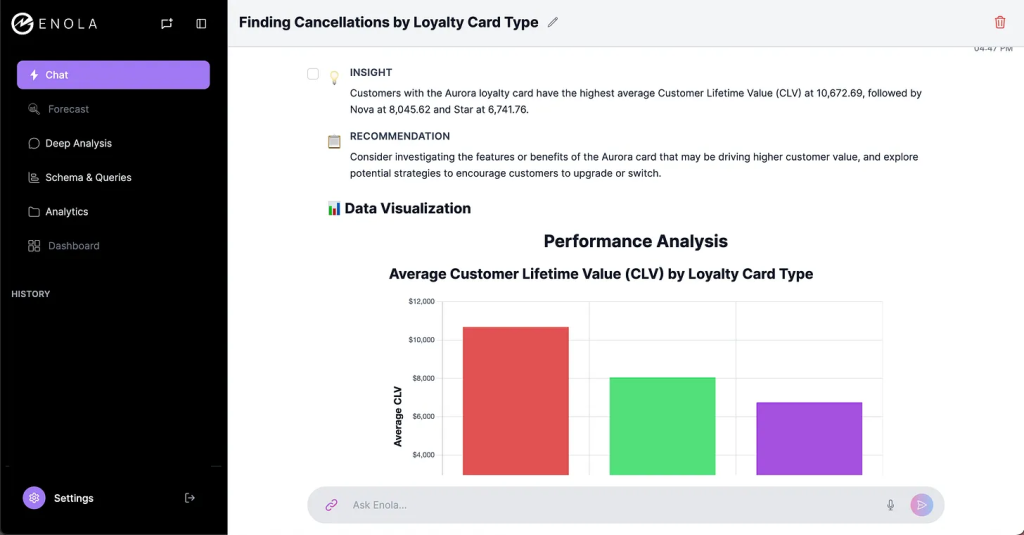
- Customer lifetime value (CLV) for the three tiers
With this quick analysis, Enola was able to tell us that:
- Membership dropped across all tiers.
- Cancellations rose significantly.
- Aurora had fewer members, but the highest CLV, making it the priority for intervention.
This shifted business priorities. Rather than evenly spreading effort across all tiers, it now made sense to focus analytical and marketing resources on Aurora.
2. Enola then created a structured hypothesis table,
It asked the data: What could be driving cancellations?
The hypotheses included:
- Limited points redemption leading to dissatisfaction.
- Companion travel patterns influencing cancellation likelihood.
- Lower flight activity is correlating with cancellations.
- Salary band affecting cancellation behavior.
- Flight frequency and rank as risk factors.
Enola asked us clarifying questions (time frame, segment focus, stakeholders) to sharpen the analysis, then automatically built an analysis plan linking each hypothesis to the correct datasets, tables, and metrics.
This plan described which tables and columns would be used, the statistical tests and segmentations to run, and the acceptance criteria for confirming or rejecting each hypothesis. Ensuring the correct column mappings is important in this domain.
To ensure the analysis was accurate and trustworthy, Enola used it’s automatically created Data Catalog as a single source of truth for all metric definitions and data joins. To resolve any ambiguity from having multiple source columns, we clearly documented which column was chosen and the reason for the choice.
3. With the plan in place, Enola validated each hypothesis using advanced statistical driver analysis:
- Salary band
- Companion vs. solo travel
- Flight activity and redemption history
The system produced segment-level visualizations and a hypothesis validation table (confirmed, rejected, inconclusive). Importantly, Enola flagged inconclusive results rather than forcing an answer, ensuring credibility.

Result
The deep dive produced actionable insights:
Key Findings
- Cancellations increased most sharply among mid-salary Aurora members traveling without companions.
- Points redemption and flight activity were not significant drivers.
- Aurora’s high CLV made this segment the most critical to retain.
The analysis produced clear, business-actionable conclusions. The most robust finding was that cancellations among Aurora members increased materially between 2017 and 2018 and that the strongest predictive driver was salary band combined with companion behavior. Specifically, mid-salary Aurora members who traveled with fewer companions had the highest increase in cancellations. Contrary to some initial assumptions, points redemption activity and low overall flight counts were not significant predictors of cancellations in this cohort.

Because Aurora had the highest CLV, the airline’s product and marketing teams gained a prioritized path to value. The analysis recommended three tactical moves:
- Launch a targeted retention campaign for mid-salary Aurora holders who typically travel without companions. Messaging and offers should be tailored to reduce friction that leads to cancellations for this specific cohort.
- Reallocate some retention budget away from broad points-redemption incentives and toward targeted outreach and interventions for the identified risk segments. The data showed diminishing returns from point-focused spend for this problem.
- Study high-CLV, low-cancellation Aurora members to extract behavioral and offer-design signals that can be replicated for at-risk groups.
A quantitative goal of a 5% reduction in cancellations was retained as a planning target, but the immediate recommendation was to run a focused pilot on the identified segment and measure lift.
Related Blog: