Most organizations have more data than they know what to do with. Yet decision-makers still feel stuck — waiting days for analysis, receiving dashboards that raise more questions than they answer, or drowning in spreadsheets with no clear path to action. The gap isn’t data. It’s methodology. That’s exactly what the BADIR™ framework was designed to close.
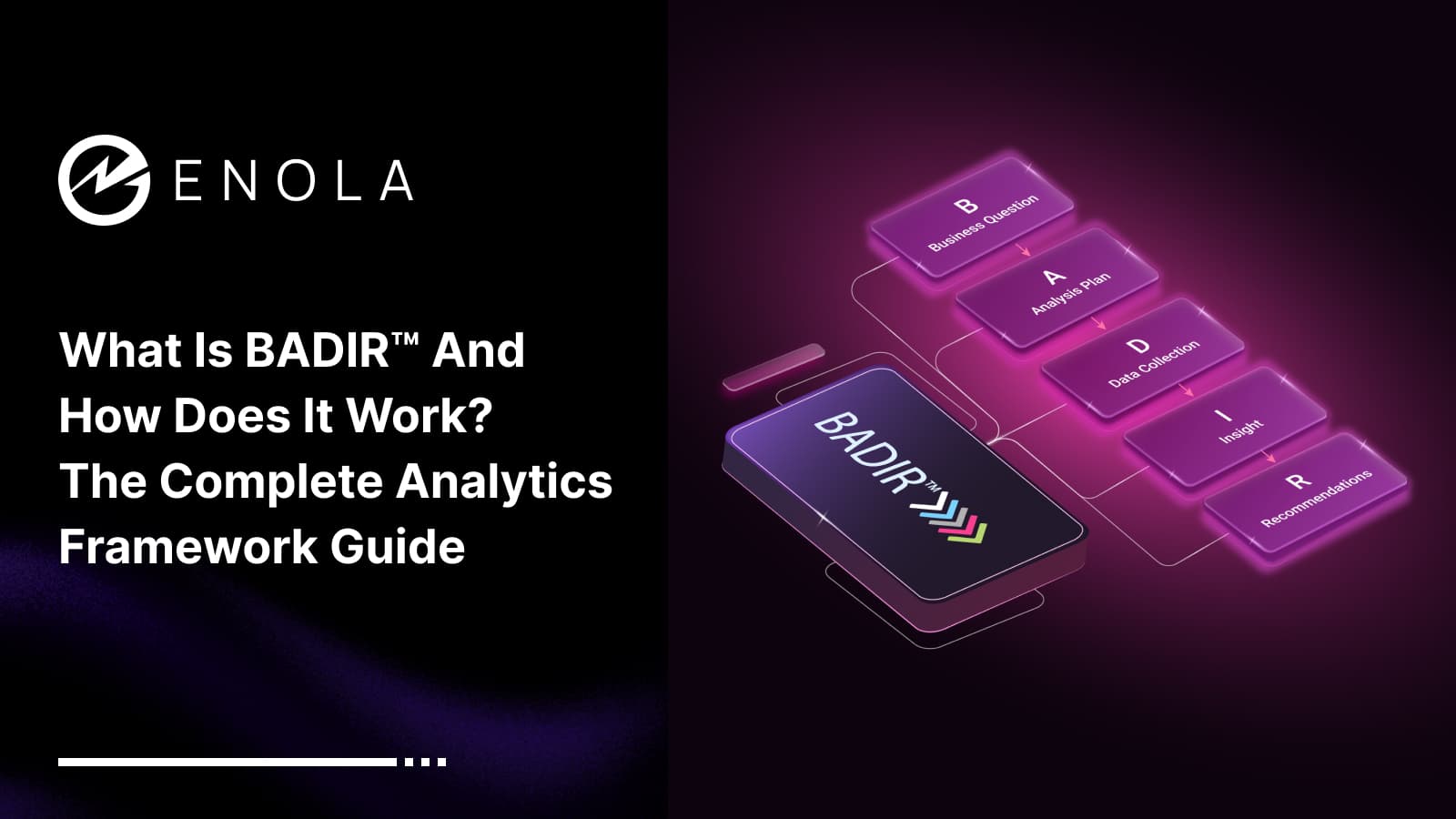
BADIR™ Framework: A 5-step proprietary analytics methodology — Business question, Analyze, Data, Insights, Recommendations — developed by Piyanka Jain and Aryng to transform raw data into structured, decision-ready outputs.
What Is the BADIR™ Framework?
BADIR™ is a structured approach to analytics created by Piyanka Jain, CEO of Aryng and author of Behind Every Good Decision. The framework provides a repeatable, five-step process that guides analysts — and now AI systems — from a raw business question all the way to an actionable recommendation.
Unlike ad hoc analysis, which often starts with data and hopes to find an answer, BADIR™ starts with the business question and works backward to identify exactly what data and analysis are needed. This shift in direction — from data-first to question-first — is what makes the framework so powerful for business users.
AskEnola is built entirely on the BADIR™ framework, automating all five steps so any business user can get structured, decision-ready answers without writing a single line of SQL.
The 5 Steps of BADIR™ Explained
Step 1 — Business Question (B)
Every analysis starts with a clearly defined business question. Not “show me sales data,” but “Why did our conversion rate drop 12% in Q3, and which channels are responsible?” A well-framed business question has a clear scope, a decision attached to it, and a measurable outcome. Without this step, any analysis risks answering the wrong question entirely.
Step 2 — Analyze (A)
Before touching any data, the analyst (or AI) maps out the analytical approach. This means identifying which variables to examine, what relationships to test, and what hypotheses to evaluate. Think of this as drawing the roadmap before starting the drive. Many teams skip this step and go straight to pulling data — which is how analysis ends up unfocused and inconclusive.
Step 3 — Data (D)
With the analytical plan in hand, Step 3 focuses on sourcing the right data. This includes identifying data sources, checking for completeness and quality, and pulling only what’s needed for the hypothesis at hand. BADIR™ is deliberate here: you gather data to test specific hypotheses, not to explore everything and see what sticks.
Step 4 — Insights (I)
Insights are where raw findings become meaningful. This isn’t a list of observations — it’s the “so what?” layer. An insight answers why something is happening, not just what happened. For example, “Revenue dropped because mobile checkout abandonment increased 34% after the October app update, concentrated in the 25–34 age segment” is an insight. “Revenue dropped 10%” is a finding.
Step 5 — Recommendations (R)
The final step translates insights into a clear, prioritized recommendation tied directly to the original business question. Good BADIR™ recommendations are specific, actionable, and include an expected impact. They should make the decision-maker’s next step obvious — not leave them asking, “Okay, but what do I do with this?”
Why BADIR™ Beats Traditional Analytics Approaches
Traditional analytics workflows are often fragmented. A business leader submits a data request, a data analyst interprets that request (sometimes differently than intended), pulls data, builds a report, and returns it days later. The leader reviews the report, has follow-up questions, and the cycle repeats. Many teams report this cycle taking anywhere from three days to two weeks for a single analytical question.
BADIR™ eliminates this fragmentation by creating a shared language between business stakeholders and analysts. When everyone works within the same five-step structure, questions are framed more precisely, analyses are more targeted, and outputs are directly tied to decisions.
BADIR™ vs Ad Hoc Analysis
| Dimension | Ad Hoc Analysis | BADIR™ Framework |
|---|---|---|
| Starting point | Available data | Business question |
| Direction | Data → Insight (maybe) | Question → Analysis → Data → Insight → Recommendation |
| Output | Report, chart, table | Structured recommendation |
| Repeatability | Low — depends on analyst | High — structured process |
| Decision-readiness | Often requires interpretation | Built into the output |
How AskEnola Automates the BADIR™ Framework
Running BADIR™ manually still requires a trained analyst and takes time. AskEnola was built to automate the entire framework — so business users can type a question in plain English and receive a structured BADIR™ output in minutes.
Here’s how AskEnola maps to each step:
- B — Business Question: The user types a natural language question. AskEnola’s AI parses the intent and frames it as a precise analytical question.
- A — Analyze: AskEnola determines what analytical approach is appropriate — trend analysis, segmentation, cohort comparison, attribution, and so on.
- D — Data: AskEnola connects directly to your data warehouse (Snowflake, BigQuery, Redshift, and others) and pulls the relevant data without requiring SQL.
- I — Insights: The AI surfaces the most meaningful patterns, anomalies, and causal relationships — not just raw statistics.
- R — Recommendations: AskEnola delivers a clear, structured recommendation that a decision-maker can act on immediately.
The result: the analytical rigor of a trained data team, delivered in minutes to anyone in the organization.
FAQ: BADIR™ Framework
What does BADIR stand for?
BADIR stands for Business question, Analyze, Data, Insights, and Recommendations. It’s a five-step analytics methodology designed to move from a business question to a decision-ready recommendation in a structured, repeatable way.
Who created the BADIR™ framework?
BADIR™ was created by Piyanka Jain, CEO of Aryng and author of Behind Every Good Decision. Aryng has trained thousands of analysts and business leaders worldwide on the framework.
How is BADIR™ different from CRISP-DM?
CRISP-DM is a data science process model designed for machine learning and predictive modeling projects. BADIR™ is designed for business analytics — answering specific business questions quickly. BADIR™ is more accessible to non-data-scientists and optimized for decision speed, while CRISP-DM is better suited for long-running data science initiatives. Learn more about BADIR™.
Can non-analysts use BADIR™?
Yes. BADIR™ was explicitly designed to be used by business people, not just analysts. Its structured language — especially the emphasis on framing the business question first — helps non-technical users think through problems analytically. AskEnola takes this further by automating the technical steps entirely.
Does AskEnola use BADIR™?
Yes. AskEnola is built on the BADIR™ framework end-to-end. Every answer AskEnola delivers follows the five-step structure, ensuring outputs are structured, decision-ready, and directly tied to the original business question.
Ready to Turn Data into Decisions?
See how AskEnola automates the BADIR™ framework — no SQL, no dashboards, no waiting.