Business intelligence is evolving at lightning speed. Data that once informed strategic efforts is now being transformed into predictive insights through business analytics and AI. A time-consuming, laborious process of waiting for reports and studying spreadsheets that had existed before is now a highly automated, intelligent system that is capable of learning, predicting, and taking action.
With 2025 nearing its end, businesses no longer debate whether or not they should use AI for analytics but how heavily they can integrate it into their organizations. According to Gartner, over 75% of enterprises will operationalize AI-driven business analytics by 2026, making predictive intelligence a key competitive differentiator. The future of innovation is predictive intelligence, the ability to look forward and predict trends, assess risk, and make forward-looking decisions that propel competitive advantage.
Here, we are going to look at how AI business analytics is transforming decision-making in the digital age, transforming raw data into predictive capability, and ushering in the AI super analyst for business, a savvy assistant that analyzes, interprets, and recommends insights in real time.
The Shift from Reactive to Predictive Intelligence
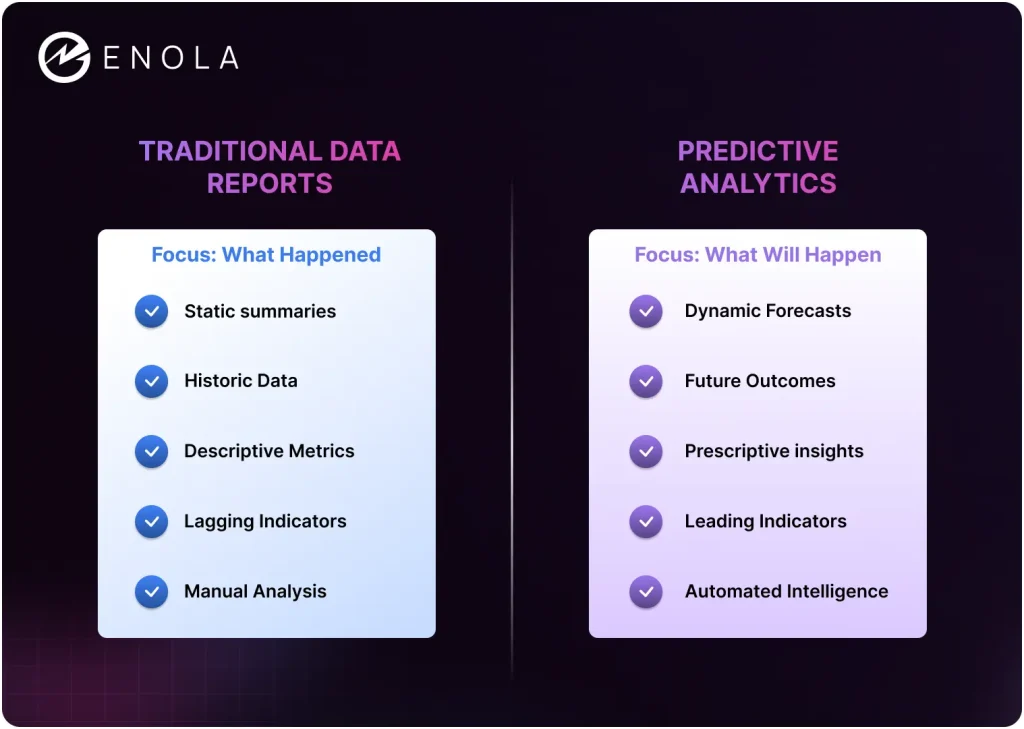
The traditional approach of business intelligence was to focus on the past. Analysts examined previous data to get the right causes and effects. Despite the good insights gained, it still hampered the organization’s flexibility and sometimes even prolonged response times.
Now that we have AI in business analytics, this reactive model has transformed into a proactive one. Predictive analytics, in the form of predictive forecasting, gets the machine learning algorithm to spot the patterns hidden in the large datasets of organizations for forecasting purposes, instead of just reacting to the present.
For Instance, when the AI-based BI tool detects the dropping of customer engagement and thus prevents it from becoming churn, or it predicts that the supply chain will get bottlenecked before the disruption happens to the operations. The transition from hindsight to foresight gives the winners of the market a strategic advantage in decision-making.
How AI Transforms Business Analytics
AI business analytics uses complex algorithms and neural networks to process data more quickly and accurately than human teams. What is unique about AI is its ability to grasp context. It combines data points from sources to reveal trends that define strategy and performance.
The following is how AI changes business analytics:
- Data Automation: AI automates data gathering and cleansing, reducing manual labor.
- Anomaly Detection: It identifies anomalies that signify threats or opportunities.
- Predictive Modeling: Machine learning algorithms predict sales, demand, and behavior trends.
- Prescriptive Insights: AI not only predicts what will happen but suggests what should happen next.
Together, these capabilities deliver continuous learning, generating smarter insights with each new update of data.
The Role of Predictive Analytics in Decision-Making
One of the most significant benefits of predictive analytics is the transition from reactive to proactive management. It provides organizations with the ability to not only anticipate results but also devise plans and reduce risks, all before the unfavorable event takes place. Rather than being driven by quarterly data, the executives can take up their role in directing the subsequent quarter’s results with the upcoming decisions.
For instance, in the case of retail, predictive models will help to determine the demand for each season. In the finance sector, they prophesy the slightest change in the market or even the most significant risks related to investments. In hospitals, they are predicting the number of patients and thus organizing the accommodation for them efficiently. With AI working for analytics, enterprises are not merely monitoring the situation but are also one step ahead, treating data as a dynamic, evolving system.
The Rise of the AI Super Analyst
The next step in AI business analytics will bring us the dawn of the AI super analyst that will be exclusively for the business sector. The blending of data science depth along with human expert intuition is what defines this intelligent system.
Now, instead of waiting for static reports, users can just ask, “What was the reason behind last quarter’s revenue drop?” and get instant, visual, and contextual answers. The AI super analyst takes in enormous data sets, pinpoints the reasons, and delivers the insights in a user-friendly way.
Market analysts are provided with this tool that takes the technical factor out of the data and builds up the strategic insight. It is a thing of power for the professionals who can go ahead and make educated decisions without necessarily having to possess advanced coding or analytical skills.
AI and Predictive Analytics: The Human Connection
AI has made it so that human talent is not just a thing of the past; rather, it has been a plus for AI. The input of the algorithms guarantees computation, reliability, and vastness, while the input of people is made up of the attributes of judgment, imagination, and morality. This has built a technology-empowered decision-making model grounded in human judgment and AI balance.
The whole idea of technological-human collaboration is what’s behind the data approach at AskEnola. The conversational interface of the platform and the AI for analytics capabilities allow professionals to have the data conversation in a way they are already used to and get insights faster. It is the point where human inquisitiveness meets machine intelligence, leading to better business outcomes.
Building a Predictive Culture with AI
Applying artificial intelligence and business analytics is not an easy task, nor is it simply a matter of switching to new tools. There is a need for a complete change in thinking that will allow us to see the future through predictive lenses. Organizations that cultivate the use of AI in analytics and are successful in doing so will prompt the level of curiosity, understanding of data, and automation throughout the entire enterprise.
To build a predictive culture:
- Do not limit your data-related curiosity to the analytics department only.
- Prepare employees to be able to tell the story behind AI-generated insights.
- Include predictive models not only in analysis but also in planning.
- Keep on refining the baseline according to the real-life results.
This philosophy guarantees that the insights can be transformed into strategies, which in turn empower organizations to interact with the problems before they rise to the level of crisis. Following structured frameworks like BADIR can further reinforce this culture by ensuring that every stage from defining business questions to delivering actionable recommendations is guided by data-backed reasoning and clarity of purpose.
The Future of AI in Business Intelligence
AI for business analytics is still on its way to becoming a real-time, adaptable, and explainable technology as we near 2026. The next-generation BI systems will not just predict the possible future but will also do so in simple terms.
The analytics tools will be smart enough to improve on their own, be trained by the users and provide the insights that are in line with the changing priorities of the company. The role of artificial intelligence in business analytics will be that of a trusted advisor, seamlessly adapting to the human workflow.
However, as AI systems gain autonomy in analytics, maintaining data transparency, ethical governance, and human oversight will remain crucial for building long-term trust
The companies that will grab this opportunity now will be the ones to enjoy the long-term benefits, quick reactions, accurate predictions, and a more intuitive grasp of their data.
AI business intelligence and predictive analytics are two things that have always been, and will continue to be interrelated. What once was a matter of static reporting has now become an ongoing learning process.
By bringing the three key elements together, i.e., data automation, advanced analytics, and human intuition, companies will always be able to rely on their data as foresight. The AI super analyst for business marks the beginning of an era where insights are available nearly in real-time, and decisions.
Related Blog: