There has been a tremendous shift in the field of business analytics. A function that was all about static dashboard reporting has now started shifting towards becoming an intelligent and intuitive domain that continuously learns from data. The increasing inclusion of artificial intelligence in business analytics has led organizations today from wondering whether AI has a role in business analytics or not to figuring out how it can be harnessed most effectively.
Naturally, the adoption of AI by analysts as well as end users is increasing. Analysts are expected to act at a rapid pace, provide better explanations for their results, and be able to forecast the outcomes instead of just reacting to them. End users, or business users, on the other end are expected to have a basic level of familiarity with analytics and be comfortable deriving insights on their own without shooting ad-hoc requests at the analytics team at every turn.
From Traditional Analytics to AI-Powered Intelligence
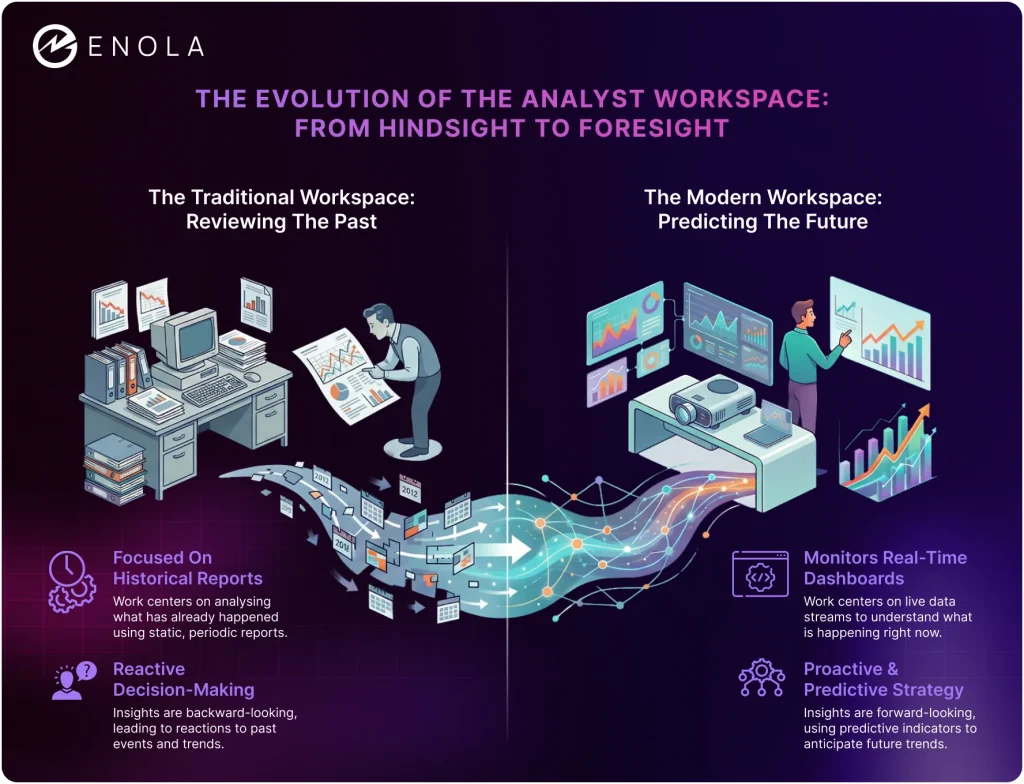
When it came to more traditional forms of business analytics, the aim was to understand “what has already happened.” Analysts examined existing data and explained the reasons behind the results after the fact. This provided value in terms of understanding, but not necessarily in terms of agility.
With AI integrated in analytics, there has been a paradigm shift in this model, too. AI-driven systems are now continuously analyzing data streams and producing early warnings based on these analyses. With this advancement, organizations are no longer relying on hindsight foresight but are instead progressing from hindsight foresight to foresight.
Effective implementation of AI requires an understanding of the fact that analytics is, in essence, the foundation upon which everything else rests. AI systems improve the process of analytics because they facilitate the speedy recognition of patterns, but they do not eliminate the process of analytical thinking.
Inception of Clear Analytical Intent into AI Adoption
One of the most common mistakes in AI adoption is beginning with the tools rather than the purpose. Successful implementation comes with clear and well-defined analytical objectives. Proven frameworks like BADIR™ can go a long way towards rooting the entire process in business goals. Which decisions would benefit best from additional insight: forecasting accuracy, organizational performance, customer behavior, or risk analytics?
Only when such requirements are clearly sorted out can AI be brought in. Therefore, through the IT design implementation process, data selection, model design, and outputs shall all be connected to these priorities. Clear intentions open ways to responsibly introduce AI to business in terms that facilitate a purposeful, well-organized, and uninterrupted path forward, away from avoiding fragmented experimentation and scattered deployment.
Supporting the AI analytics, the Data Readiness
The AI analytics era ultimately hinges on the quality of the data. Inconsistent, inaccurate, or data that are poorly governed data impede even the most advanced models. Data must be analyzed, standardized, and contextualized before the application of AI.
Analysts are instrumental in the transcription of data definition to the functional application that supports business decisions. Without a robust foundation in data, applying AI in business analytics results in deceitful insights that weaken trust. Data readiness fingers instantaneously the emergence of sustainable digital conversion with AI.
Embedding AI into Analytical Workflows
The use of AI analytics provides the highest benefit when included in workflows rather than as a separate layer. Analysts already utilize structured processes for data discovery, hypothesis testing, and report generation. By adding AI capabilities, these workflows can be augmented by having the machines automatically conduct repetitive tasks such as data processing, anomaly detection, and trend investigation.
This integration allows analysts to concentrate on comprehension and strategic judgment. In an environment where humans and AI can be freed up to complement one another with long-established analytical practices, they can obtain results more easily than when AI had to be forced into the picture.
The Role of Organization in Analytics Driven by AI
Speed alone does not ensure better decision-making. Structure becomes essential when insights are expedited. To direct the analytics team from articulation of the business problem to the generation of full-reach recommendations, an analytic framework like BADIR would constantly maintain the analytical rigor of their concepts.
This makes AI insights contextual, explainable, and aligned to the requirements of decision-making. AI enables the acceleration of discovery by certain elements, while structure guarantees clarity and consistency.
Expanding access but maintaining governance
AI Analytics enhances the availability of business intelligence using natural language interfaces and automatic summaries. Business professionals are able to analyze the business without requiring technical skills, hence improving business flexibility. This also raises the requirement for business governance.
While analysts’ responsibility for validation, interpretation, and consistency was not altered, a sound implementation plan of AI must therefore strike a balance between access and accountability.
AskEnola and Responsible AI Analytics Adoption
AskEnola aims to support the adoption of AI analytics through analyst-led insights. The platform places less emphasis on creating static dashboards and more on transforming data into clear, explainable insights. By structuring AI capability against analytical workflows and frameworks such as BADIR, AskEnola’s platform enables scalable business analytics with AI while preserving accuracy, transparency, and trust.
Building a Predictive Analytics Culture
Analytics adoption with AI is not a purely technical effort. Rather, it is a cultural shift based on curiosity, data literacy, and continuous learning. Successful organizations embed predictive thinking into planning, operations, and strategy.
Key practices of this include:
- Encouraging data-driven questioning across teams
- Training stakeholders to interpret AI-generated insights
- Integration of predictive outputs into planning cycles
- Continuously retraining the models with real-world outcomes
These practices ensure insights translate into action rather than remaining isolated observations.
The Future of AI Analytics in Business
As the field of AI analytics continues into 2026, there is an increased focus on adaptive, explainable, and human-centric artificial intelligence and analytics systems. The future era of analytics will interact with the human brain, serving as a “trust advisor,” learning constantly with feedback and data.
Organizations embracing AI analytics will realize increased speed in receiving responses, predictions, and insights into their data. The future for AI and business looks exciting, with continuous evolution and improvement expected, as long as transparency and analytics discipline are maintained.
Artificial intelligence and analytics can no longer be considered distinct fields. Coming together it symbolizes a transition from static reporting to the concept of continuous intelligence.
Related Blog: