Analytics has always played a central role in business decision-making. In essence, analytics is the structured process of examining data to understand performance, discern patterns, and guide action. As the volume of data grows and the pace of decision cycles accelerates, traditional approaches to analytics are not enough. This is when artificial intelligence begins to play a major role in data analytics.
Artificial intelligence strengthens analytics by improving speed, scale, and depth of insight without supplanting the analytical discipline. In such a situation, comprehending the benefits of AI in analytics is indispensable for analysts to deliver timely, correct, and effective insights in 2026 and beyond.
From Manual Analysis to Intelligent Automation
Traditional analytics tends to take a lot of manual effort. For any amount of useful analysis, data typically has to be collected, cleaned, validated, and structured. These steps are necessary but very time-consuming, therefore limiting the speed at which insights can be delivered.
AI reinforces this process by automating it. AI data analytics systems can automatically prepare the dataset, identify inconsistencies, and surface relevant variables. By freeing up time from routine tasks, AI allows the analysts to focus on interpretation, validation, and strategic reasoning. This shift turns analytics from a labor-intensive function into an intelligence-driven capability.
Faster and Accurate Time-to-Insight
Speed alone doesn’t create value if accuracy is compromised. Perhaps one of the most important benefits of AI in business analytics is the ability to deliver faster insights without sacrificing analytical rigor. Machine learning models, applied continuously to large datasets, identify trends and correlations that might be impossible to find with manual analysis.
AI also minimizes human errors related to calculations and pattern recognition. Artificial intelligence, when data foundations are reliable, enhances consistency and precision in data analytics, enabling analysts to deliver timely and valid insights.
Improved Predictive and Prescriptive Capabilities
Analytics traditionally have been focused on explaining past performance. AI extends that capability by enabling predictive and prescriptive analysis. Predictive models forecast outcomes such as demand, revenue, or customer behavior, while prescriptive models suggest possible next actions based on those forecasts.
This shift in AI-powered analytics helps businesses make better decisions by enabling them to anticipate outcomes rather than react after the fact. Analysts can test scenarios, evaluate risk, and recommend clear courses of action. The result is decision-making that is more confident, faster, and far more proactive.
Improved Pattern and Anomaly Detection
The modern organization generates enormous amounts of data related to operations, finance, marketing, and customer engagement. It is increasingly difficult to identify meaningful signals within the data.
AI provides an excellent mix of pattern recognition and anomaly detection. AI-powered data insights surface deviations, emerging trends, and unusual behavior in real time. Analysts will investigate these early warning signals to prevent minor issues from becoming significant ones and identify opportunities well ahead of their competition. This capability enhances both operational awareness and strategic planning.
Accessibility Enhanced Without Losing Control
AI analytics is changing the way users interact with data naturally by including natural interfaces and automated explanations for nonspecialist stakeholders who better understand and build on insights. This democratization of analytics will lead to greater organizational agility and alignment.
Yet, governance remains critical. Analysts retain responsibility for validating results, ensuring consistent definitions, and applying business context. When applied responsibly, AI in business analytics opens up access to insight while preserving analytical control and credibility.
Scalability Across Complex Business Environments
As organizations grow, so does the demand for analytics. It’s tough to scale manual approaches across multiple markets, products, or data sources. AI provides the scale needed at the enterprise level for analysis.
Because it constantly learns from new data, AI Data analytics automatically adapts to changing conditions with minimal manual intervention. Analysts will also be able to apply consistent logic across different data sets to ensure alignment in insights as the business evolves. This scalability is a key driver of long-term analytical maturity.
How AskEnola Supports AI-Driven Analytics
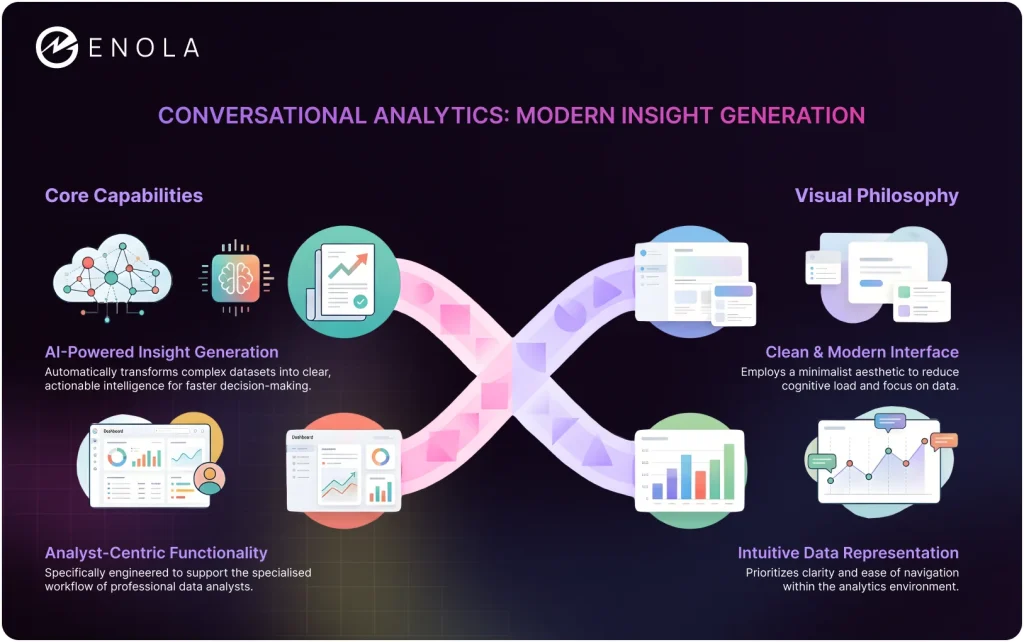
AskEnola is designed to give analysts faster, clearer, and more accurate insights. Instead of focusing on dashboards, the platform prioritises explainable, decision-ready outputs that can be acted on with confidence. By combining AI with structured analytical workflows, AskEnola supports the responsible use of AI while maintaining transparency and trust.
This ensures that AI strengthens analytical thinking rather than replacing it, helping teams make better decisions without losing control or clarity
Measuring Business Impact Beyond Adoption
The value of AI in analytics is not defined by adoption alone. True impact is measured through improved decision quality, faster response times, and more accurate forecasts. Organizations should track how AI-driven insights influence outcomes such as efficiency, revenue growth, and risk reduction.
Continuous evaluation ensures AI stays in step with analytical objectives. Regular reviews of models, assumptions, and data inputs maintain relevance and reliability. It enhances discipline and, thereby, the long-term effectiveness of using AI for business decision-making.
AI offers so much more than just automating analytics. AI in data analytics enables faster analysis, greater accuracy, and deeper insights without weakening analytical rigor. Predictive modeling, anomaly detection, scalability, and intelligence make AI in business analytics potent in driving better decision-making with confidence.
When done responsibly, AI data analytics becomes a strategic enabler that returns meaningful AI-powered data insights. AskEnola demonstrates how AI can strengthen analytics, enabling analysts to drive measurable business impact in 2026 and beyond.
Related Blog: