Data volumes are growing faster than most teams can manage. With more dashboards on the horizon than ever before, longer analyst queues, and decision-makers still waiting for answers to key business questions, AI-powered analytics has emerged as a solution for today’s business teams.
AI-powered analytics is AI-powered analytics refers to the use of artificial intelligence and machine learning to automatically analyze data, surface insights, and deliver recommendations — enabling business users to make faster, more accurate decisions without relying on analysts or complex BI tools.
In 2026, businesses are no longer wondering if they should be using AI systems; they are wondering how they can leverage AI to make decisions faster and better. Let us understand what AI-powered analytics really is, how it works, and why today’s businesses are moving from traditional reporting to intelligent and conversational decision-making systems.
What is AI-Powered Analytics?
AI-powered analytics refers to a category of tools that use artificial intelligence techniques such as machine learning and natural language processing, combined with sophisticated statistical models to automatically analyze business data and provide actionable insights.
Unlike traditional business intelligence tools, which involve manual querying and browsing through multiple dashboards, AI-powered analytics enables users to ask questions and get instant answers.
Thus, AI-powered analytics tools help to:
- Automate the data exploration process
- Identify patterns/anomalies
- Generate predictive insight
- Provide actionable recommendations
- Reduce reliance on technical teams.
How AI-Driven Data Analytics Works
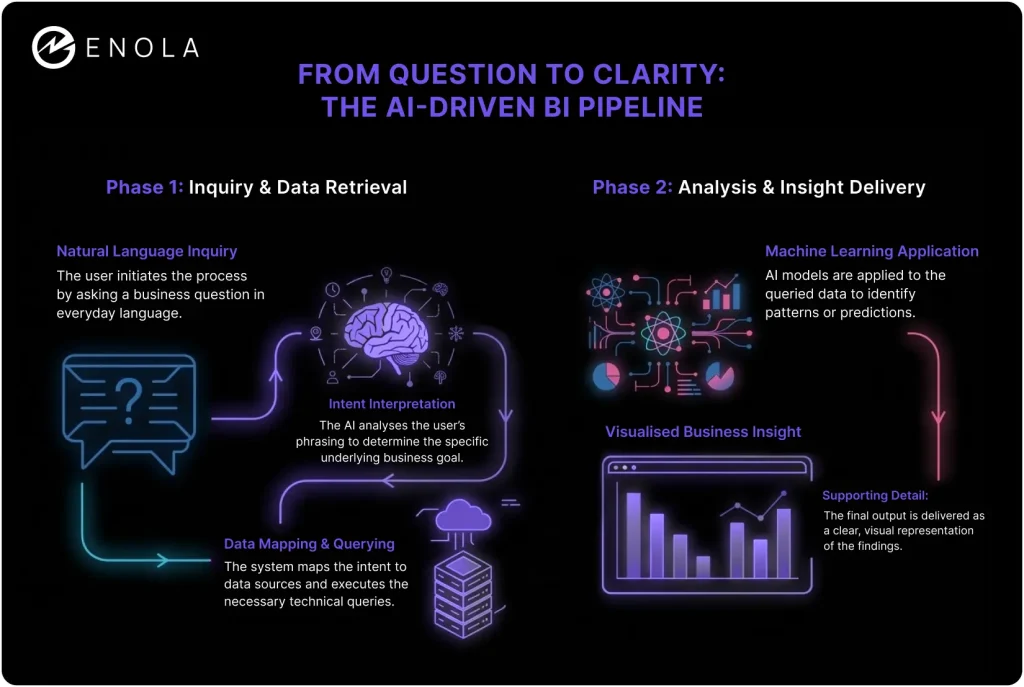
To better understand AI-driven data analytics, let’s examine the key components that power it.
An AI-powered analytics system:
- Interprets the user’s intent
- Identifies relevant data sets
- Analyzes results
Typically, AI analytics platforms are developed on the following pillars:
Natural Language Processing (NLP)
The user can ask business questions in English. The system can understand the context.
Intelligent Data Mapping
The system can automatically identify relevant tables, fields, and relationships in the data warehouse and map them to the business question.
Automated Query Generation
The system can automatically generate and execute optimized SQL queries without requiring the user to write SQL code.
Advanced Analytics and Machine Learning
Machine learning algorithms can automatically identify trends, correlations, outliers, and forecasts from historical data.
Insight Delivery
Insights are summarized, visualized, and explained in simple business terms.
Modern AI analytics platforms can automatically perform the entire process of insight generation, thereby accelerating decision-making.
AI Analytics vs Traditional BI
Traditional business intelligence solutions rely heavily on dashboards and static visualizations. While effective, they often require:
- Technical expertise
- Pre-built reports
- Manual slicing and filtering
- Static metrics
Whereas AI-powered analytics allows for dynamic, question-driven exploration. Rather than having to browse through dashboards to find answers, one can simply ask:
– Why did revenue decline in the last quarter?
– Which marketing channel has the highest lifetime value?
– What is driving churn in the enterprise business?
This marks a larger shift from simply providing access to data (traditional BI) to providing contextual insights that help in decision-making directly.
Enterprise AI-Powered Data Analytics Features
Like all AI technologies, enterprise-grade AI-powered data analytics platforms vary in capability and performance. However, leading solutions typically offer the following features:
Secure Warehouse Integrations with Minimal Data Replication
Direct integration with modern data warehouses such as Snowflake, BigQuery, Redshift, Azure Synapse, or Databricks, without requiring data duplication.
Automated Semantic Layer
Automatic scanning of metadata to generate standardized business definitions that ensure consistent reporting across teams.
Transparency of Insight
Clear, traceable logic behind every output, providing confidence and eliminating black-box decision-making.
Predictive and Prescriptive Intelligence
Moving beyond descriptive reporting to forecasting future trends and recommending next actions.
With such capabilities, enterprise-level AI-powered analytics platforms offer speed and trust.
Why Businesses Are Embracing AI-Powered Analytics in 2026
The need for AI-powered analytics is on the rise due to the following reasons:
Faster Decision-Making
The traditional process of analytics involves several steps, such as the user asking a question, the analyst writing queries, the generation of reports, the generation of revised reports, and the final generation of insights. This process may take days or even weeks.
AI-powered analytics cuts down this time from “days” to “seconds.”
Less Dependence on Analysts
AI-powered analytics helps executives, product leaders, and marketing teams to analyze data on their own, thus cutting down on the waiting time for analytical support.
Accuracy
Enterprise-level platforms execute queries directly within secure data warehouses, thus minimizing the chances of errors and the duplication of data.
This ensures that every answer supports strategic decision-making rather than isolated reporting.
Choosing AI-Powered Analytics Solutions
Before choosing any AI-powered analytics platform, business executives should assess:
- Does this product allow users to perform analysis directly against the data they are interested in?
- Is it able to remove the need for manual navigation of dashboards?
- Are the insights produced by this system tied to corporate key performance indicators?
- Is this software secure and compliant with applicable regulations?
- Is this system simple enough that an executive without a technical background can use it?
An ideal AI-powered analytics solution allows decision-makers to not only receive the answers they require but also ask better questions and take quick action on the results obtained.
How AskEnola Delivers Enterprise-Grade AI Powered Analytics
AskEnola is built for high-growth, data-intensive businesses that cannot afford to wait to make a decision. It provides enterprise-grade AI-powered analytics by empowering founders, CXOs, and function heads to get the right, contextually accurate answers to tough business questions in seconds in simple English without writing SQL, browsing dashboards, or involving analysts.
Using the BADIR™ framework, AskEnola structures every analysis by identifying a specific business question, using a hypothesis-driven approach, identifying appropriate warehouse data, connecting KPIs to metrics and insights, and providing actionable recommendations.
This structured approach ensures clarity, accuracy, and business relevance in every response.
The Future of AI Powered Analytics in 2026
In 2026, competitive advantage will be defined by clarity and speed. The purpose of AI-powered analytics is not only to answer questions but to enable better questions and faster decisions.
Organizations that adopt AI-powered analytics early will experience:
- Faster decision cycles
- Increased analytical accuracy
- Greater confidence in business strategy
- Improved alignment between data and execution
The future belongs to businesses that can directly connect data to action. AI-driven data analytics provides that connection with immediacy, reliability, and strategic clarity.
Related Blog:
Frequently Asked Questions
What is AI-powered analytics?
AI-powered analytics is the use of artificial intelligence — including machine learning, natural language processing, and predictive modeling — to automatically analyze business data, surface insights, and generate recommendations. Unlike traditional BI tools that require users to navigate dashboards or write queries, AI-powered analytics platforms allow business users to ask questions in plain language and receive structured, decision-ready answers from their live data.
How does AI analytics work?
AI analytics works by connecting to your data sources (warehouse, CRM, ERP, marketing platforms), processing natural language questions from users, automatically generating the appropriate database queries, analyzing the returned data using machine learning models, and synthesizing findings into a plain-language answer or recommendation. The entire pipeline — from question to insight — happens in seconds, with the AI handling the technical steps that would otherwise require a data analyst.
What is the difference between AI analytics and Business Intelligence?
Business Intelligence (BI) is primarily descriptive — it shows what happened through dashboards, reports, and visualizations of historical data. AI analytics is more dynamic — it explains why things happened, predicts what will happen next, and prescribes what to do about it. BI requires users to know which metrics to look at; AI analytics surfaces the relevant insights proactively. BI is static; AI analytics adapts to each question in real time.
How can I implement AI-powered analytics without a data team?
Modern AI-powered analytics platforms are designed specifically for organizations without large data teams. The key is choosing a platform that connects directly to your existing data warehouse or data sources with minimal configuration, and that allows business users to interact through natural language rather than technical interfaces. Platforms like AskEnola require no SQL expertise, no custom dashboards, and no ongoing analyst support — business users connect their data and start asking questions immediately. The setup time is typically measured in hours, not months.