In high-growth, data-rich organisations, the speed and quality of decisions determine success. But often teams are overwhelmed by all the raw available data, creating delays and ambiguity. The 4 different forms of analytics: descriptive, diagnostic, predictive, and prescriptive, simplify complexity and help leaders advance from understanding what has happened in the past to confidently shaping their future.
The use of AI in analytics makes insights available quickly, accessible, and aligns directly with the organisation’s overall goals. For those competing in a fast-paced market, being proficient in all of these types of analytics is critical if one wants to make better decisions, improve strategies, and to translate data into tangible outcomes.
Let’s look at each of the four types of analytics and the ways that they enhance the ability to make more intelligent decisions. Each stage builds on the previous one, creating a complete decision-making system.
1. Descriptive Analytics
Descriptive Analysis is the first step of analysis. It uses historical data to provide insight into previous events that occurred related to business activities.
Example: If a business reviews its sales on a month-by-month basis, it can get a better idea of sales trends. Descriptive Analysis is one of the more frequently used types of analytical data analysis used on a daily basis by businesses to gain useful historical insights.
It helps answer questions like:
– What were last quarter’s revenues?
– Which product had the most sales?
– How many new users signed up last week?
Descriptive Analysis does not provide predictive or prescriptive information about future actions, but it does provide foundational information for deeper analytical insights. Without this information, decision-making lacks direction.
2. Diagnostic Analytics
Once you understand what occurred, the next step is determining why. Diagnostic Analysis is used to assist in performing some follow-up analysis to identify the root causes to identify causes and patterns in past decisions.
For example, if sales have been declining for the past few years in a business, diagnostic analysis can reveal whether it was due to pricing, competition, or customer behavior changes. Among the different types of analytics, this stage is crucial as it identifies the outcome and then provides specific reasons and data to support the outcome.
It helps answer questions like:
– Why was customer churn highest this year?
– What factors contribute to reduced traffic?
– What were the contributing factors to revenue growth this year?
Using diagnostic analytics eliminates guesswork and promotes well-informed decision-making.
3. Predictive Analytics
Predictive analytics uses historical data along with statistical models and machine learning to determine future outcomes. This analytics is significantly important to business planning, especially for risk management purposes, because it helps companies to calculate expected demand, determine likely customer churn, and estimate future revenue trends before they occur.
Thus, predictive analytics is practical in nature and provides proactive rather than reactive (or preventive) insights. While the predictions produced by predictive analytics are largely statistically based (and therefore, subject to uncertainty), they provide an effective basis for proactive decision-making.
4. Prescriptive Analytics
Prescriptive analytics goes one step further than predictive analytics by not only identifying problems but also recommending actions for the problems identified by predictive analytics.
For example, if predictive analytics shows that there is a high likelihood of customer churn, prescriptive analytics might suggest performing targeted retention programmes or lowering the prices offered to retain customers.
This is where modern AI Analytics tools add significant value. They help decision-makers move quickly from insight to action without manual interpretation. Likewise, prescriptive analytics is particularly useful in fast-moving business environments where the time it takes to make a decision can impact revenue and grow significantly.
How do these Analytics Work Together?
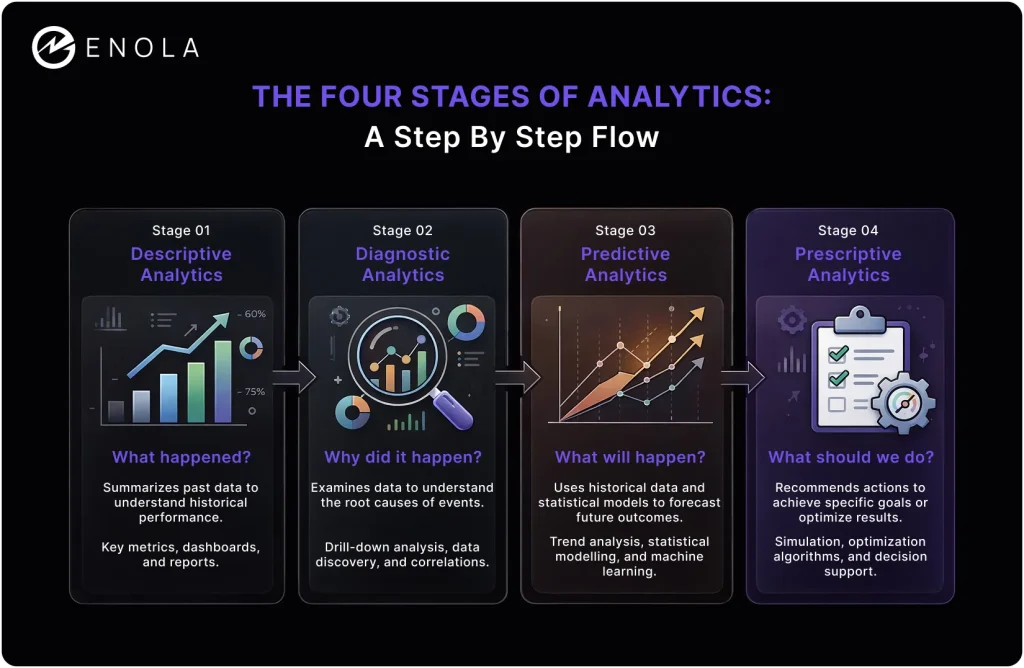
All these 4 types of analytics have their own purposes, but there is greater value when they are connected together in one workflow.
- Descriptive analytics provides historical data for analysis.
- Diagnostic analytics provide reasoning for the outcomes.
- Predictive analytics forecast future possibilities.
- Prescriptive analytics give decision makers a course of action.
Using an integrated approach also adds value in data analytics in real-time visibility, contextuality of the analytical results, and faster reporting. With an integrated reporting capability, businesses get one comprehensive view of their business operations instead of numerous sources of fragmented data.
Making Decisions with Data Analytics Through AskEnola
Most teams have no problem obtaining data, but rather connecting different types of analytics into one cohesive decision-making process. Through the application of its BADIR™ framework to every query, AskEnola eliminates those obstacles by automatically structuring each analysis from business question to recommendation.
AskEnola is able to run the query directly in your data warehouse like Amazon Redshift or Snowflake, build contextual information via The Data Layer, and present you with answers to the analytics question without the need for dashboards or SQL. AskEnola effectively compresses the entire analytics lifecycle into a single interaction, delivering insights tied to KPIs that are ready to act on within seconds.
Turning Analytics into Better Decisions
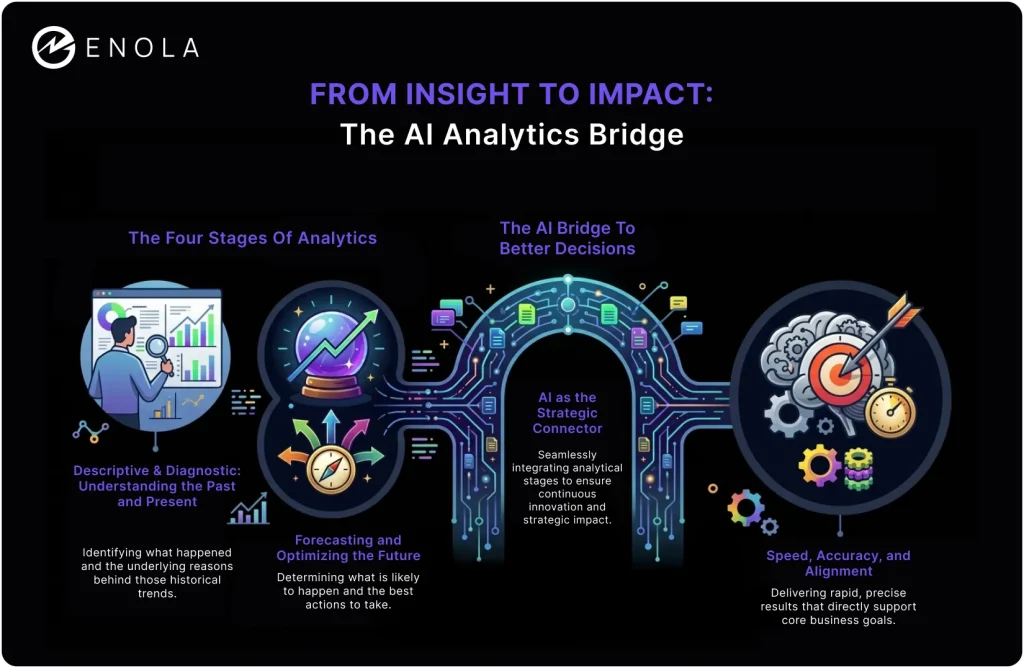
Each of these types of analytics, descriptive through to prescriptive, serves to connect insights with decisions, allowing leaders to foresee challenges, discover new opportunities, and take actions with clarity. AI-powered analytics provide these insights much quicker, more accurately and closely aligned with the overall company objectives than was ever possible before, while also reducing the amount of reliance placed on manual operations.
The ultimate value lies in creating a culture in which data drives a business’s strategy, positioning the organisation to move rapidly and continually innovate, achieving a sustainable competitive advantage in changing & evolving markets.
4 types of analytics with examples
The four types are descriptive (what happened), diagnostic (why it happened), predictive (what might happen), and prescriptive (what to do next). For example, a report showing last month’s sales is descriptive. On the other hand, forecasting future demand is predictive analytics.
How does AI improve decision-making in data analytics?
AI helps analyze massive data sets quickly and highlights patterns that can often go unnoticed. This helps teams across businesses to make faster decisions based on actual insights.
Which AI for decision-making?
Tools such as Power BI, Tableau, and Google Analytics are often used for data-driven decision-making. Platforms like AskEnola, along with these tools, help analyze data, generate insights, and support faster, more informed decisions.
What are 5 advantages of AI Analytics?
AI analytics provides faster insights, reduces human bias, improves accuracy, and uncovers patterns in large data sets. It also supports faster decisions, reduces manual work, and helps businesses respond quickly to market changes.
Related Blog: