
Sales conversations contain some of the most valuable business insights. Each sales call, demo, or meeting is an opportunity to understand consumer preferences, where sales are going wrong, and what resonates with customers. Unfortunately, most of these insights remain unnoticed in recordings, CRM entries, or scattered customer feedback.
This is where new sales strategies in the form of conversational intelligence are transforming the way sales teams work. By analyzing actual sales conversations, sales teams are now able to uncover patterns to improve messaging and sales performance.
With the help of modern conversational analytics tools like AskEnola, sales leaders are now able to unlock valuable insights from everyday customer conversations to drive better sales performance and revenue growth.
Why Sales Conversions Are Important for Revenue Insights
Sales teams interact with potential customers every day; however, very few of those interactions are analyzed in a methodical manner. Many crucial items may go unnoticed like buyer objections, interest in specific features, mention of competitors, and concern over price.
Using sales conversation intelligence, organizations can collect and analyze this information from hundreds or thousands of conversations. Rather than relying on anecdotal feedback from individual reps, leaders can understand the market easily.
- What objections are raised most frequently in late-stage deals
- What messages resonate most with high-value customers
- At what points in the conversation do prospects tend to drop off
- What behaviors differentiate top-performing sales reps
Through the application of conversation intelligence for sales teams, organizations can leverage everyday conversations to create a learning engine for revenue growth.
Turning Conversations into Data-Driven Sales Strategies
The success of sales is often affected by subtle factors within conversations. This could be the way the sales representative introduces value, handles objections, or even positions the price.
The use of conversational engagement analytics in sales allows for the identification of such patterns in the way the sales team engages with prospects.
For instance, teams can identify:
- Recognise the types of questions that top sales performers ask at the beginning of the discovery calls.
- Identify the types of messaging that are more effective in terms of demo engagement.
- Recognise the areas that are more prone to requests for follow-ups or clarifications.
- Recognise the areas where the discussion of price impacts the level of interest shown by the prospects.
These insights allow revenue leaders to improve the effectiveness of playbooks, the quality of the onboarding process, and the way the sales team is guided to more effective selling behaviors.
In the long run, the organisation develops a systematic understanding of the factors that drive the conversion in their specific market.
Improving Sales Coaching with Real Conversation Insights
Traditionally, sales coaching involves occasional call review or manager feedback. Although helpful, this approach is difficult to scale across growing teams.
With sales conversation intelligence, managers get access to insights from hundreds of conversations, not just a few. This enables them to identify strengths and weaknesses across the entire sales team.
This means managers can quickly get answers to questions such as:
- What sales reps are good at handling objections
- What stages of the sales process are being stalled in product-related conversations
- How top performers introduce pricing conversations
- What language can help in better customer engagement
This enables sales coaching to be far more effective.
With sales coaching frameworks and conversational engagement analytics, sales teams can motivate their sales team with actual data. The result is faster skill development and more consistent performance across the team.
Identifying What Actually Moves Deals Forward
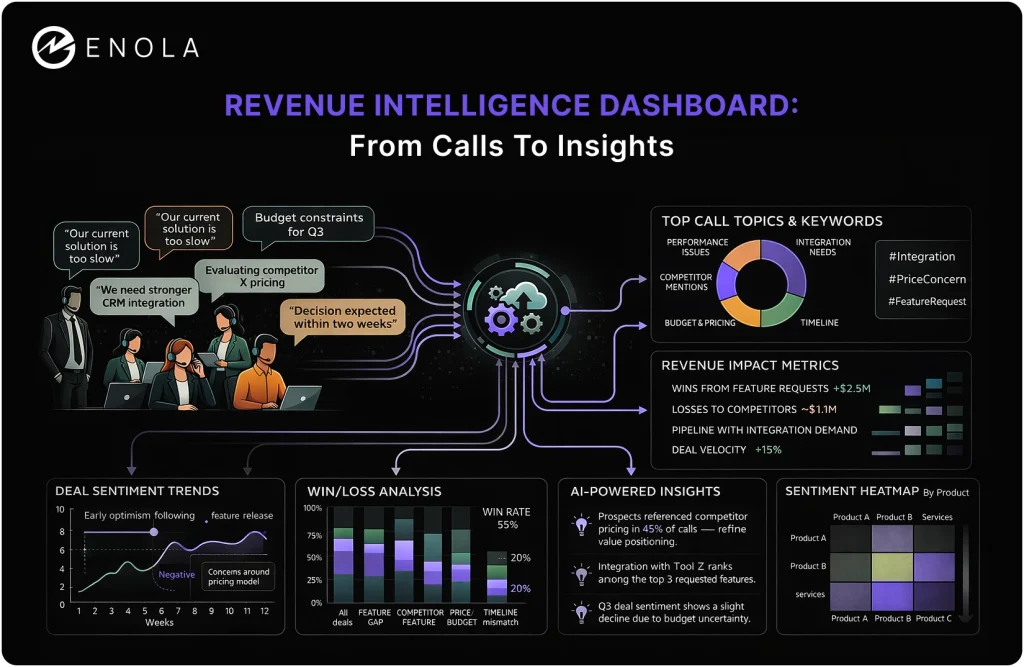
One of the major challenges for sales leaders is understanding what actually drives deal success. Using actual customer conversation data is the key to making informed decisions.
By using conversational intelligence sales, organizations can understand the impact of various messaging approaches on deal progression. They can also recognize patterns, such as competitor mentions, feature requests, or price discussions, which have an impact on deal success.
Advanced conversational analytics software allows revenue leaders to process conversational data and obtain definitive answers to questions such as:
-What are the value propositions that are most appealing to enterprise buyers?
-What are the most commonly encountered objections when a deal has been lost?
-What messaging has the greatest impact on converting demos to proposals?
These insights help revenue teams focus on strategies that consistently move deals forward.
AskEnola: Bringing Speed and Clarity to Conversational Analytics
In modern organizations, the ability to analyse conversations is only useful when the results come quickly and accurately. AskEnola helps revenue teams move from raw interaction data to decision-ready insights in seconds.
Each and every insight is based on its BADIR™ framework, ensuring the conversations analysed are relevant to the real business questions at hand, the relevant data is being utilised, and the results provide clear recommendations for the organisation. This means leaders don’t just see numbers and graphs; they know exactly what they mean and what to do about it. By directly querying the data warehouse, there is no need to move any data, ensuring the results provided are reliable and trustworthy for the sales and revenue leaders to make the most critical decisions with confidence.
Building a Smarter Revenue Engine with Conversation Data
Sales conversations take place every day, but many of which provide valuable intelligence that often remains hidden. The analysis of these sales conversations provides organizations with a clear understanding of customer expectations, objections, and how they make their final decision.
Modern sales conversation analytics tools allow revenue teams to analyse this intelligence and develop better messaging, coaching, and strategies for success.
When sales conversation intelligence is incorporated into your everyday decision-making process, sales leaders can stop guessing and build repeatable processes that allow their teams to close more sales and create long term revenue growth.
FAQs –
What are the benefits of conversational analytics?
Conversational analytics makes it easier to explore data using simple questions instead of complex tools. It helps different teams across organizations get quicker insights and make better decisions.
How does data analytics help sales?
Data analytics helps sales teams understand customer behavior, trends, and performance. This helps businesses identify opportunities easily and improve overall sales strategies.
How does conversational analytics help increase sales revenue?
Conversational analytics helps teams to quickly access insights that highlight customer needs and trends. This can support faster decisions to improve sales outcomes over time.
What are the key benefits of conversational analytics?
Some key benefits of conversational analytics include ease of use, faster access to insights, and better decision-making. It also reduces reliance on technical skills and makes data more accessible to multiple teams across the business.
Related Blog: