
Businesses today need to make faster, smarter, and data-driven decisions more than ever before. The truth, though, is that many businesses still rely on dashboards, analyst queues, and manually produced reports to answer simple but critical questions.
Conversational analytics is the ability to query and analyze business data using natural language questions, receiving structured, decision-ready insights instantly — without SQL, dashboards, or analyst involvement.
The gap between data availability and decision speed is exactly where conversational analytics steps in to change the game. It allows leaders to interact with data in plain, natural language and receive meaningful insights instantly, without any technical friction.
Understanding Conversational Analytics
Conversational analytics is the ability to analyse business data through natural language conversations. Rather than navigating charts or writing queries, users pose direct questions like “Why did revenue decline last quarter?” or “Which feature is driving customer retention?” to get structured, data-informed responses.
Contrary to basic reporting tools, conversational analytics not only fetches numbers but also identifies intent, uses logic for analysis, and provides results that meet actual business goals. An advanced conversation analytics software uses natural language processing (NLP), analytics engines, and direct data access techniques for accuracy and relevance.
The Limitations of Traditional Analytics Solutions
Traditional business intelligence products were designed a long time ago and are based on dashboards, predefined key metrics as well as analyst intervention. They give users visibility into how a business is operating, but usually lack clarity and precision. Consequently, leaders often need to take additional time to understand charts, challenge their own assumptions and wait for an analyst to provide follow-up analysis.
The problems this approach creates are several:
- Decision cycles slow down significantly
- Analysts become bottlenecks
- Businesses lose confidence in the data provided
- Insights seem disconnected from organisations’ objectives
Conversational analytics eliminates these issues by removing layers between the question and the answer.
How Conversational AI Analytics is Changing Decision-Making
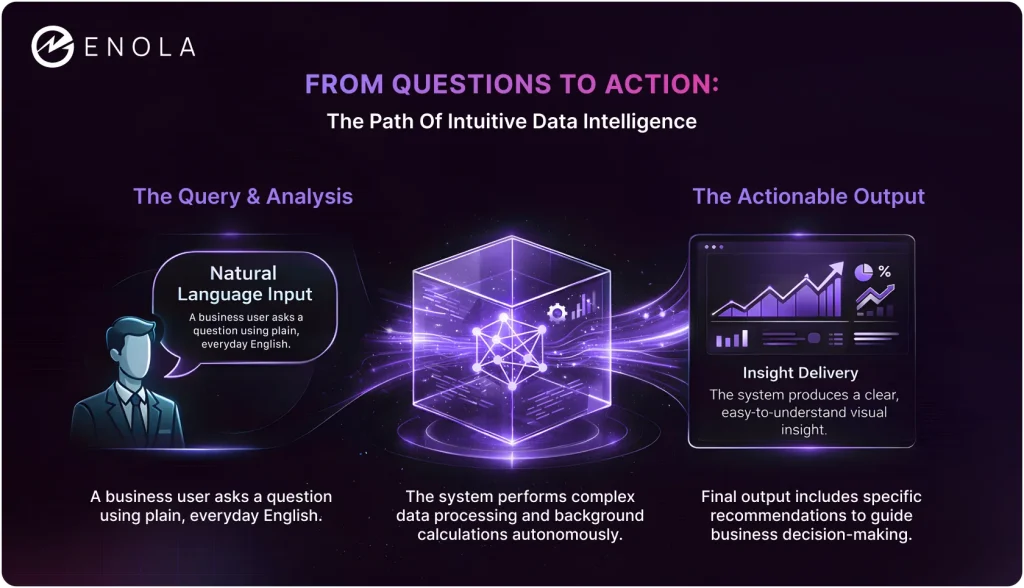
Conversational AI analytics leverages artificial intelligence to combine advanced analytical techniques and natural language interfaces to enable a more intuitive and simpler decision-making process. Rather than exploring large datasets manually, the user engages in an analytical conversation.
Well-designed conversational analytics platforms prompt the user with clarifying follow-ups, apply logical reasoning and ensure that insights are tied to measurable outcomes. By utilising conversational AI, teams can eliminate the chances of misinterpretation and focus on the essential priorities.
As conversational AI analytics develops, it will move from being a novelty item for businesses to being adopted for its consistency in providing reliable answers quickly and efficiently.
What makes Conversational Analytics Enterprise-Ready
All conversational interfaces are not created equal and are not ready to be used in enterprise environments. Most are based on external data uploads and/or surface-level models and analyses. Successful conversational analytics requires enterprise-grade safety, precision as well as governance.
Enterprise-grade conversational analytics software is integrated with data warehouses, where queries are executed directly and do not require the duplication or storage of sensitive data. It also applies consistent logic across teams, ensuring that finance, product, and revenue leaders operate from the same analytical foundation.
Equally important is the need for enterprise conversational analytics to limit the number of hallucinations. A business decision must be based on the right answer, not the most probable one. This is exactly where the role of structured frameworks becomes important.
From Questions to Outcomes, not Just Answers
The real value of conversational analytics lies in its ability to move beyond answers and toward outcomes. Knowing what happened is useful. Knowing why it happened and what to do next is transformative.
By structuring every interaction around business intent, analysis plans and actionable recommendations, conversational analytics helps organisations close the gap between insight and action. This is particularly powerful for high-growth companies where speed and alignment directly impact results.
When implemented correctly, conversational AI analytics becomes a strategic asset rather than a reporting tool.
Why Conversational Analytics Will Soon Be Required
With continued growth in the amount of available data and the increasing speed of change in market conditions, the business cost of delayed decisions will only compound.
Companies that rely on static dashboards and manual analyses are already discovering that they cannot compete effectively when it takes them too long to make informed decisions. As such, conversational analytics provides a scalable method for enabling widespread access to insights without compromising their integrity.
Conversational analytics allows founders as well as executives to get speedy answers without waiting; teams share a common base of information for better work alignment; organisations can leverage data as a competitive edge rather than treating it as an operational challenge.
The transition towards conversational analytics is therefore an essential development for businesses as they now operate.
How AskEnola Uses Conversational Analytics Practically
AskEnola turns conversational analytics into reality by combining natural language interaction with a robust analytical structure, resulting in an enterprise-grade conversational analytics platform. Using AskEnola, leaders can get answers to complex business questions within seconds, with actionable insights for decision-making.
At the core of AskEnola is the BADIR™ framework, which ensures every insight follows a disciplined path from business question to recommendation. By connecting directly to modern data warehouses and building an automatic semantic layer, AskEnola eliminates analyst dependency while maintaining trust, accuracy and security. This is conversational analytics designed for real-world decisions.
Making data work at the speed of business
Conversational analytics signifies a transformation in the way organisations engage with data. This is because removing technical impediments and integrating analytical rigour into how businesses tackle questions enables them to make quicker, more accurate decisions.
For companies seeking development and growth, it’s not only beneficial but essential to implement conversational AI analytics. Platforms like AskEnola demonstrate how conversational analytics software can progress beyond experimentation and develop into a core decision engine for an enterprise.
Book a demo or request a free trial today itself to discover the power of conversational analytics for decision-making in your business!
Related Blog:
Related Blog: