
In fast-moving organizations, decisions cannot wait for weekly reports or delayed dashboards. Decision-makers require answers to their questions when the opportunity or risk is still relevant. This is where conversational analytics comes into play. With conversational analytics, business users can engage with data in natural language.
This means that the latest conversational analytics software tools make real-time decision-making possible across functions without relying on analysts or technical teams.
With the increasing adoption of artificial intelligence in business decision-making, the role of conversational analytics is becoming more important than ever for organizations that believe in the power of speed, simplicity and accountability.
Why Real-Time Decision Making Is No Longer Optional
Markets are dynamic. Customer behavior changes from day to day. Revenue trend signals come and go in a matter of hours. Real-time decision-making enables teams to make decisions while the outcome can still be affected.
Conversational analytics solutions make this possible by constantly querying data sources in real-time, providing answers in an instant. Leaders can react to performance trends, campaign outcomes or operational issues without waiting for end-of-day reporting.
Real-time decision-making also helps minimize organizational friction. Decisions are made closer to the point of impact, enabling faster execution and less dependence on reactive processes.
The Role of Conversational Analytics in Modern Enterprises
Conversational analytics is a new way of analysing business data through natural language conversations rather than static reports. Business users can simply ask questions and the answers will appear in context, in real-time.
Unlike traditional reporting software, conversational analytics software uses intent and understands the context of business. This makes artificial intelligence in business decision-making more accessible to founders, CXOs and function leaders who want answers, not data.
As organizations begin to use AI powered business intelligence tools, conversational analytics becomes the interface between human thinking and complex data systems.
How Conversational Analytics Drives Business Decisions
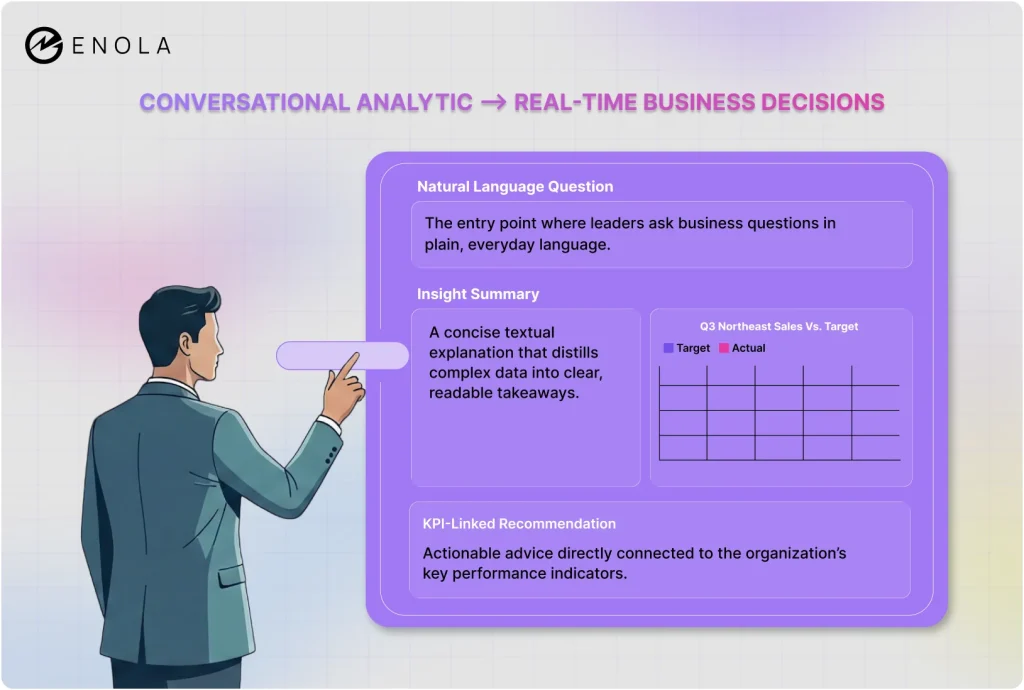
Conversational analytics solutions operate by translating business questions into structured paths of analysis. When a business leader asks a question, the system interprets the intent of the question, identifies the data, applies logic and provides answers in seconds.
Sophisticated conversational analytics software does more than match keywords. It recognizes metrics, time, comparisons along with trends. This is the heart of artificial intelligence in business decision making because it eliminates ambiguity and builds confidence in the results.
For leadership teams, this means less time in meetings arguing over numbers and more time that can be redirected towards taking action on a shared understanding of the data.
The Role of AI-Powered Business Intelligence Tools
AI-powered business intelligence tools are an extension of traditional business intelligence tools. They are more focused on outcomes than on reports. Instead of having to switch between different dashboards, users are provided with insights that are directly linked to business questions.
The best interface for such tools is conversational analytics. It makes it easier for users to understand the insights without having to put in much cognitive effort. AI-powered business intelligence tools also help to standardize interpretation by linking insights to logic.
If used properly, these tools help to achieve alignment faster and provide a better quality of strategic discussions.
From Insights to Action Without Delays
The biggest benefit of using conversation analytics services is the speed of action. The insights are not only descriptive but also decision-ready.
Since conversational analytics software provides context along with numbers, leaders are able to understand what happened, why it happened as well as what needs to be done next. This is very important for real-time decision-making in revenue, marketing, finance and operations.
Artificial intelligence in business decision-making becomes important only when the insights are actionable. Conversational analytics helps to ensure that the insights are provided in a manner that encourages immediate action.
Where Conversational Analytics Has the Greatest Impact
Conversational analytics software provides tangible benefits for a variety of functions. Revenue teams leverage it to monitor pipeline activity and conversion patterns. Marketing executives analyze campaign performance as it happens. Finance teams monitor cash flow, burn rate and forecast variance in real-time.
Because conversational analytics services are available via natural language, results are no longer the sole domain of technical professionals. This democratization of results is what sets AI-driven business intelligence software apart.
Trust, Reliability and Enterprise Readiness
If conversational analytics is to have any impact on decision-making, then trust is a non-negotiable factor. Enterprise-ready conversational analytics services must be able to provide accuracy, explainability as well as security.
This is achieved by the latest platforms that query data directly from the warehouses without any duplication of data. This helps to increase confidence in artificial intelligence in business decision-making.
How AskEnola Facilitates Faster, More Trustworthy Decisions
AskEnola is built for organizations that need speed without sacrificing trust. As an enterprise-grade conversational analytics platform, it enables leaders to ask complex questions in plain English and receive accurate, contextual insights in seconds. Powered by the BADIR™ framework, AskEnola ensures every output is structured, explainable and tied to business goals, making real time decision making practical and dependable.
From Data Access to Decision Velocity
Conversational analytics software is more than a new way to interact with data. It also marks a paradigm shift in how organizations think, decide and behave. By integrating conversational analytics software with AI-driven business intelligence software, organizations can eliminate bottlenecks, reduce reliance and enhance decision quality.
As the use of artificial intelligence in business decision-making becomes the norm, successful organizations will be those that emphasize clarity, trust and speed. This is where conversational analytics come into play, enabling organizations to transform everyday questions into instant, actionable decisions.
For teams ready to accelerate outcomes, the next step is simple. Book a Demo with AskEnola and experience how faster decisions change business momentum.
Related Blog: