Business analytics is changing fast. What used to be a function built around historical reports is now becoming a real-time decision engine. Organisations are no longer satisfied with understanding what happened in the past. They expect analytics to show what is likely to happen next, and what they should do about it.
AI analytics is now central to both planning and daily operations. At a practical level, analytics has always been about studying data to understand performance and support decisions. What AI brings is scale, speed, and the ability to detect patterns that are impossible to spot manually. Instead of simply explaining outcomes, analytics can now anticipate scenarios and recommend actions, turning insight into direct business impact.
The Evolution of Analytics: From Description to Decision-Intelligence
Traditional BI focused on descriptive analytics. Professionals used data visualizations to present historical data and results to make informed decisions. Although this solution provided insight regarding historical activities, it slowed reaction times.
Predictive analytics brought in the next level of maturity. With the application of statistical models and machine learning methods, it became possible to predict outcomes and detect signals well in advance.
Decision intelligence is the next evolution. It combines descriptive, predictive, and prescriptive analytics to create a holistic approach to decision-making. Not only does decision intelligence predict what might happen, but also how to act.
How Artificial Intelligence Enables Predictive Forecasting and Prescriptive Analytics
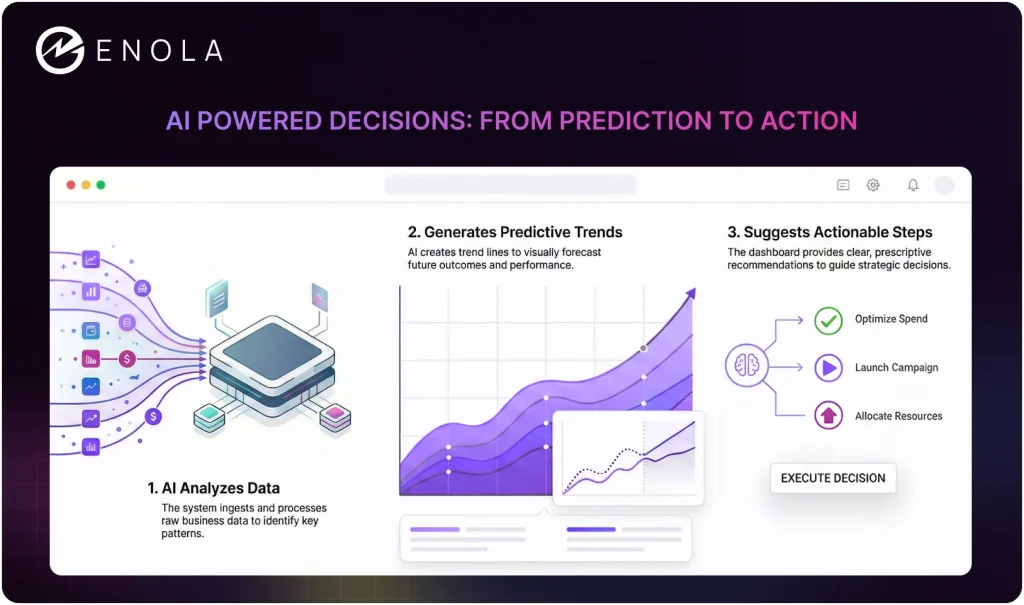
AI automates analytics by executing complex tasks that would have taken longer to do manually. The use of machine learning models enables a wide scope of data to be analyzed across various aspects, identifying hidden trends that define future behavior.
With the aid of predictive analytics using AI, analysts can assess trends related to the behavior of customers, business, financials, and the market. The model learns by becoming familiar with new information available in the market.
Prescriptive analytics builds on descriptive and predictive methods by turning forecasts into recommendations. While descriptive and predictive analytics focus on understanding and anticipating outcomes, prescriptive analytics goes a step further by suggesting what actions to take. This is where analytics moves beyond insight and becomes true decision support.
The Role of Decision Intelligence Platforms
With ever-increasing analytics capabilities, integration is necessary. An analytics platform for decision intelligence integrates data, analytics, analytics models, and business context into the same space. The platform ensures the smooth flow of insight from analysis to action.
Decision intelligence systems connect predictive models with business goals. They allow analysts to weigh the trade-offs they face. This can be achieved through a combination of AI business intelligence and well-structured reasoning.
Analysts will have fewer hours spent on synthesizing knowledge and can focus more on the analysis of implications and strategy.
Explainability and Trust in AI Decision Intelligence
As AI’s role in analytics grows, explainability is becoming essential. A data analyst needs to know why the AI system made a particular discovery or suggested something. Black box results hurt credibility and adoption.
Contemporary AI-driven decision intelligence platforms focus on transparency through the display of drivers, correlations, and assumptions related to predicted outcomes, which helps users verify their accuracy using their knowledge and domain skills.
Explainable analytics helps ensure that AI improves analytical judgment rather than substituting for it, saving the integrity of the analysis in critical decision contexts.
Practical Applications of Predictive and Prescriptive Analytical Capabilities
Decision intelligence becomes truly valuable when organisations move beyond traditional analytics and start acting on predictive insights. Instead of simply analysing data, businesses can anticipate issues and make better choices before problems appear.
Some of the most practical benefits include:
- In operations: Predictive models identify bottlenecks before they disrupt workflows.
- In finance: They anticipate periods of market volatility, helping teams manage risk more proactively.
- In customer analytics: They flag early signs of churn, giving businesses time to intervene and retain customers.
The prescriptive insights continue to enhance the benefits by bridging the predictions with the recommended course of action to take, and by embracing both predictive and prescriptive analytics, the organization can transition from insight to execution.
AskEnola and The Shift to Decision Intelligence
AskEnola has been created to facilitate a seamless transition between descriptive analytics and decision intelligence. The tool primarily aims to turn data into understandable insights that correspond with analytic processes. Using predictive modeling, contextual explanation, and structural reasoning, AskEnola enables AI to support business intelligence.
By this, analysts can concentrate on the interpretations rather than the complexity involved in the process.
Preparing for the Future of Decision Intelligence
As analytics continues to evolve, businesses need to focus on getting the basics right – data quality, data management, and how well insights are actually used. Decision intelligence is not just about building predictive models; it also depends on strong processes and, just as importantly, on how accurately those insights are interpreted.
Analysts are at the forefront of this change. As the discovery process is automated by the use of AI, the analyst becomes the leader in insights, with the job of validating predictions and aligning with strategy.
Analytics has evolved from describing the past to shaping the future. This has been significantly enhanced by AI. AI decision intelligence is where the intersection of analytics, predictability, and action takes place. This enables organizations to make decisions with certainty. With the evolution of AI-based predictive analytics, the power and importance of analytics shift from the outcomes obtained to the outcomes they drive.
AskEnola explains how the new-age decision intelligence platform supports accurate predictions and maintains analytics integrity. The coming era for the analyst, for 2026 and beyond, is defined by decision intelligence.
Related Blog: