Modern organizations generate vast amounts of data every day—sales data, customer data, product data, marketing data, and financial data—just to name a few, in huge quantities. The real challenge is how to convert this data into clear decisions that help in the growth and progress of the business or organization. This is where structured frameworks become important.
In today’s competitive environment, data driven decision making in business is no longer a choice; it is essential for operational efficiency and strategic clarity.
What Is Data Driven Decision Making?
In simple terms, data driven decision making is defined as the process of making decisions based on data, metrics, and analysis, rather than gut feelings and assumptions.
Businesses that practice data based decision making are the ones that first analyze performance, market, and other data before making decisions in the business or organization.
The advantage of this approach is clarity. Instead of relying on fragmented reports or subjective opinions, decision makers can rely on consistent evidence that supports business goals.
Why a Data-to-Decision Framework is Important
Most businesses worldwide can gather data. However, few are able to leverage their data for meaningful results. Most data is available in various forms but lacks a clear path to action. A data-to-decision framework bridges this gap.
The importance of a good data-to-decision framework is that it helps businesses focus on the right metrics and generate meaningful insights that can drive business decisions. Rather than analyzing data without context, businesses can use analytics for decision-making in a focused manner that is in line with their revenue generation goals.
Without this structured framework in place, businesses often face a lot of problems in terms of reporting and decision-making. With one in place, teams move from raw numbers to clear actions much faster.
Key Business Metrics to Track
For a data to decision model to work well, companies need to monitor some key metrics that show how they are performing and how much room for growth exists. Important metrics include:
Revenue growth: Indicates how fast the company is growing and which products/channels generate the most revenue.
Customer acquisition cost (CAC): Can be used to assess how well your marketing efforts are converting into new customers.
Customer retention rate: Shows how successful a company is at retaining its customers over time.
Product or feature usage: Allows team members to see how customers are utilizing their products and where they might need to make changes.
Operational efficiency metrics: Measure internal performance and provide data to help companies make decisions that will improve their processes.
By tracking these metrics regularly, teams can produce accurate, data driven information that supports day-to-day decision making in businesses.
Stages of a Data-to-Decision Framework
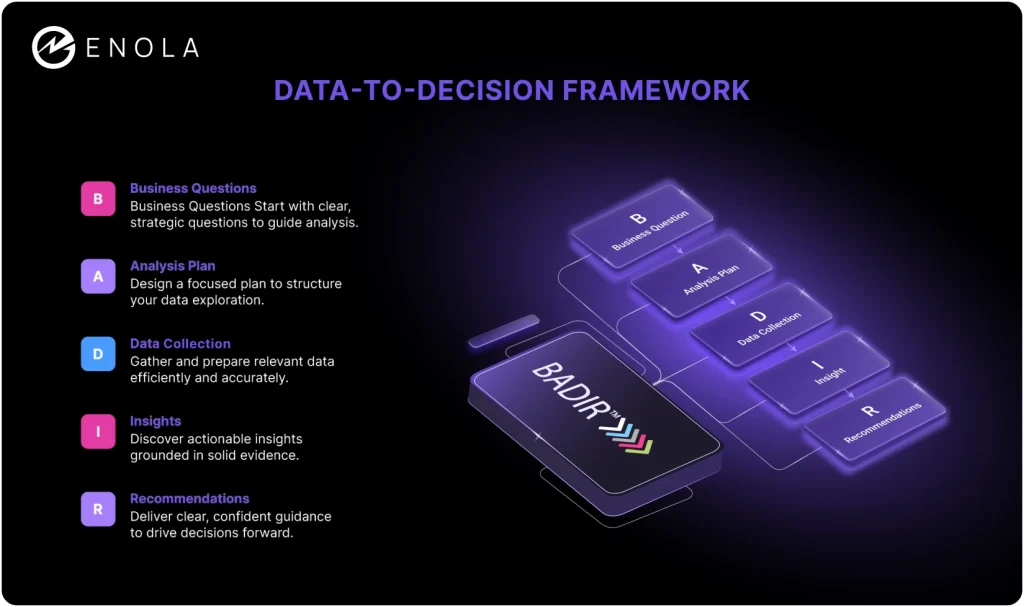
For a data-to-decision framework to be effective in any organization, it typically follows several structured stages:
1. Define the Business Question
Every data initiative should start with a clear business objective. This ensures that everyone involved in the process understands that the purpose of using data to make business decisions is to improve business outcomes rather than to generate reports that may not be useful in the process.
2. Identify the Right Data Sources
The second step in any data-to-decision process should be to identify the right data sources.
Data can be found in various sources in any organization, including CRM databases, product analysis databases, marketing databases, or financial databases.
The right data sources must be identified to make effective data-driven decisions.
3. Conduct Structured Analysis
The analysis stage involves interpreting the raw data into useful patterns and results. This stage involves extracting data-driven insights that reveal what is really going on in the business environment.
4. Translate Insights into Recommendations
While insights are important, it is equally important that they are translated into recommendations that decision makers can act on. This step bridges the gap between analysis and strategy.
Common Challenges in Turning Data into Decisions
While implementing data driven decision making, there are a number of challenges that are faced by organizations, even if they have a strong data infrastructure in place. One of the biggest problems that organizations face is data fragmentation, where the data is scattered across a number of different tools and is difficult to connect in a cohesive manner.
Another challenge is the reliance on specialized analysts, which can slow down analytics for decision making when business leaders must wait for reports or SQL queries.
Inconsistent interpretation of data is another challenge that is faced by organizations, where different teams interpret the data in a different manner, thereby compromising its effectiveness.
How AskEnola Accelerates the Data-to-Decision Process
AskEnola simplifies the process of converting data into decisions by providing the business world with an AI-based analytics layer that business teams can use. Instead of having to rely on analysts to get answers to business questions, users can simply pose questions in natural language and get the answers in real time.
Its BADIR™ framework structures every response around business questions, analysis logic, and actionable recommendations, helping teams move from data to decisions faster and with greater confidence.
Establishing a Sustainable Data-driven Decision Culture
For a framework from data to decision to be successful in the long term, organizations need to embed the process of making data-driven decisions into everyday decision-making. Encouraging teams to use verifiable sources of information rather than making decisions based on assumptions is an important step in developing an environment that values data.
Over time, this develops a culture where makingstrategies based on measurable data becomes a natural part of discussions. When team members develop their competency with structured analysis, using insights derived from data will eventually impact product development, marketing strategies, operations improvements, and revenue forecasting throughout the organization.
Turning Data Into Confident Business Actions
A data-to-decision framework allows organizations to effectively transform data into decisions without delays and guesswork. This framework helps businesses turn data into decisions by linking business questions, data, and analysis. When implemented effectively, this approach strengthens data based decision making and encourages consistent analytics for decision making. This can enable organizations to make decisions with confidence and act quickly on opportunities.
Related Blog:
Frequently Asked Questions
What is a data-to-decision framework?
A data-to-decision framework is a structured methodology for converting raw business data into actionable decisions. It provides a repeatable process that ensures analytical work starts with a clear business question, uses the right data, generates meaningful insights, and results in concrete recommendations — rather than open-ended data exploration. Frameworks like BADIR™ (Business Questions, Analysis Plan, Data, Insights, Recommendations) are designed to prevent analysis paralysis and keep every analytical effort tied to a real business need.
How do businesses make data-driven decisions?
Businesses make data-driven decisions by establishing a clear process: identifying the specific business question, determining which data is relevant, analyzing that data to surface insights, and translating insights into recommendations for action. The most effective organizations use structured frameworks and AI analytics tools that automate the data retrieval and analysis steps — allowing decision-makers to focus on evaluation and action rather than data wrangling.
What is the BADIR™ framework?
BADIR™ is a five-step analytics framework developed to structure the process of turning business questions into decisions. The acronym stands for: Business Questions (defining what decision needs to be made), Analysis Plan (determining the right analytical approach), Data (identifying and retrieving the relevant data), Insights (synthesizing what the data reveals), and Recommendations (defining the action to take). BADIR™ is used by data teams and AI analytics platforms to ensure analysis is always anchored to real business outcomes.
How long does a data-to-decision process typically take?
With traditional analytics methods, the data-to-decision process typically takes 3–10 business days — including time to submit a request, wait for analyst availability, pull and clean data, build reports, and review findings. With AI-powered analytics platforms that automate the middle steps, the same process can be compressed to minutes or hours. The primary remaining time is spent on the decision and recommendation phase, which requires human judgment and organizational alignment.