Data is now central to how businesses operate, compete, and grow. Business operations, competition, and growth rely on data, but data does not provide inherent value in itself. To derive value from data, organizations need structured methodologies to analyse and interpret data, to take numeric data and convert it into usable and real-world decision making processes. This is where a data analytics framework becomes vital to an organization.
Having a defined data structure helps teams analyze information consistently, identify patterns faster, and make decisions that are based on facts rather than assumptions.
As companies become more data-driven in 2026, understanding the 5 types of data analytics frameworks can help leaders choose the right approach for their business goals.
Below are the most widely used models that guide modern analytics strategies across industries.
What Are Data Analytics Frameworks?
A data analytics framework is an approach to organizing, collecting, and analyzing data from multiple sources so that they can be analyzed and interpreted in a consistent manner. Businesses follow a process that connects the business question with the appropriate data, analysis method, and insight, rather than randomly analyzing a data set.
Simply put, it is a structural model for how data should be examined for the purpose of finding a solution to a specific business problem. The use of these frameworks results in the generation of consistent, valid, and aligned with business goals, making them critical for modern, data-centered decision-making.
1. Descriptive Analytics Framework
The descriptive analytics framework focuses on understanding what has occurred in a business. It facilitates the collection of historical data and consolidates it into reports, dashboards, and performance summaries.
Typically, this is the first phase in many data analysis frameworks as it provides the answers to key performance indicators, fundamental questions such as:
– How did sales perform during the last quarter?
– Which marketing campaigns generated the most leads?
– What were the best selling products during the last year?
By summarizing past performance, descriptive analytics lays the foundation for more advanced analytics. Many companies employ the descriptive analytic framework to track KPIs, analyze operational efficiencies, and increase transparency of their business.
2. Diagnostic Analytics Framework
Once businesses understand what happened, the next step is to figure out why it happened. This is the role of diagnostic analytics. Diagnostic analytics goes deeper into the data to find out what caused the different events. Drill-down analysis of data, correlation analysis, and data segmentation are among the many diagnostic analytics techniques used today.
For example, if a company’s marketing team discovers that their website traffic increased last month, diagnostic analytics can be used to determine whether traffic came from SEO improvements, paid advertising, social media or referral traffic.
In many modern types of data analytics, diagnostic frameworks help organizations identify problems quickly and define processes that require action.
3. Predictive Analytics Framework
Predictive analytics focuses on forecasting future outcomes based on historical data, statistical models and machine-learning models. It helps in business strategy, forecasting and risk management.
Some common applications of predictive analytics are:
- Forecasting product demand
- Predicting customer attrition
- Estimating revenue growth
- Predicting supply chain disruptions
Predictive analytics will continue to grow in future markets as organizations enter fast-paced markets and need to predict emerging trends for competitive advantage.
4. Prescriptive Analytics Framework
Unlike predictive models, prescriptive models go beyond providing forecasts of business outcomes; they also recommend actions to improve those outcomes.
This model combines predictive insights with optimization algorithms and decision modeling. The goal is to determine the best possible course of action.
For example:
- Suggesting the optimal pricing to achieve the maximum revenue.
- Suggesting marketing channel allocation for better ROI
- Recommend how to optimize supply chain operations to reduce total costs.
By utilizing prescriptive analytics, organizations are able to quickly transition from insight to action and realize operational improvements directly attributed to those actions based on how they are utilizing their data.
5. Cognitive and AI-Enabled Analytics Framework
The fifth model represents the evolution of analytics in the AI era. By leveraging AI and natural language processing technologies to analyze, interpret, and generate insights from data, cognitive analytics automatically provide answers to business-related questions.
With cognitive analytics, users no longer need to wait for analysts to produce reports before receiving answers to questions about their organizations; they can simply ask their questions and receive immediate contextualized insights.
For example:
– What caused the decline in revenues in a certain area?
– What customer segment is driving the highest growth for our company?
– What factors are affecting product conversions?
As organizations continue leveraging AI-enabled platforms to facilitate timely and accurate decision-making, cognitive analytics are rapidly becoming the most advanced forms of data analytics toolsets.
How AskEnola Simplifies Modern Analytics Frameworks
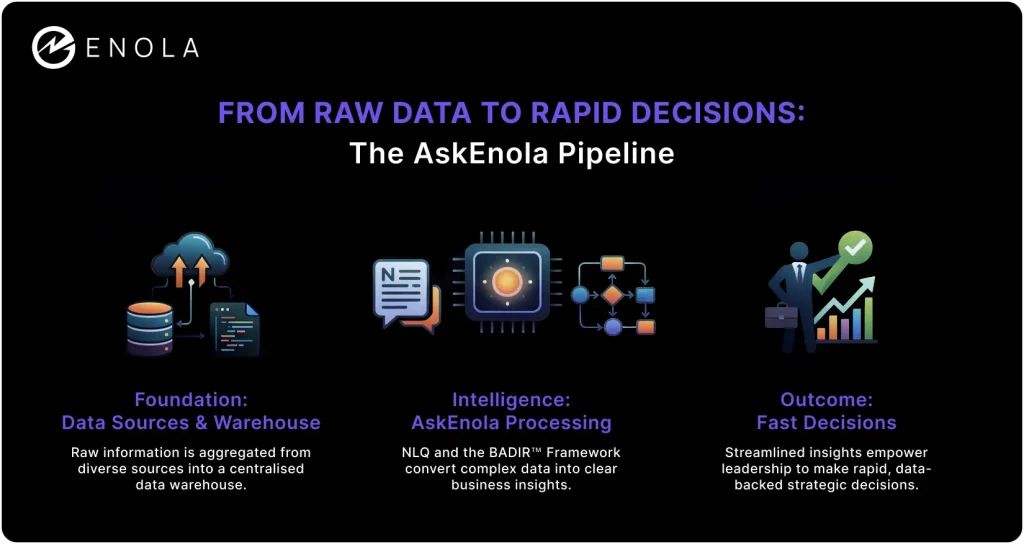
Organizations nowadays commonly encounter difficulties implementing analytics frameworks, as these processes are generally slow, fragmented, and require an analyst’s input to create reports, queries, and dashboards.
AskEnola changes this by transforming complex analytics workflows into a simpler, more business-centric experience. Users can ask questions in plain language and receive structured insights within seconds rather than waiting for reports or technical teams.
Using its proprietary BADIR™ framework, AskEnola ensures that every query asked follows a clear set of logical steps: First, It starts with the business question; second, apply hypothesis-driven analysis; third, retrieve the appropriate data from your connected data warehouses; and finally, returnwith insights tied to the business KPIs previously outlined, as well as actionable recommendations to help you implement these strategies.
The result is faster answers, reduced analyst dependency, and a decision process that moves at the speed modern businesses require.
Why Businesses Must Adopt Structured Analytics Frameworks
As the need for swift and certain decisions increases and business data continues to grow, businesses can no longer just rely on ad hoc reporting or manual analysis. Instead, having a clear understanding of multiple analytical frameworks is essential because it allows organizations to establish the framework for their approach to business questions and derive value from data.
The right data analysis framework enables businesses to turn raw data into fast insights, improved strategy, and greater confidence when making decisions.
In 2026, structured analytics frameworks are the foundation of modern decision-making as speed and clarity become the defining factors for competitive advantage.
Related Blog: