In today’s organizations, data is the driving force behind all pricing and customer experience-related decisions. However, many executives still find themselves using the terms “analytics vs statistics” synonymously.
Although these terms are closely linked, they are not the same thing. A clear understanding of the differences between analytics/data analysis and statistics is essential if you are seeking faster and more accurate decisions instead of reports that raise more questions than answers.
This article will explore the differences between data analysis and statistical analysis in simple, business-first terms.
What Is Data Analysis?
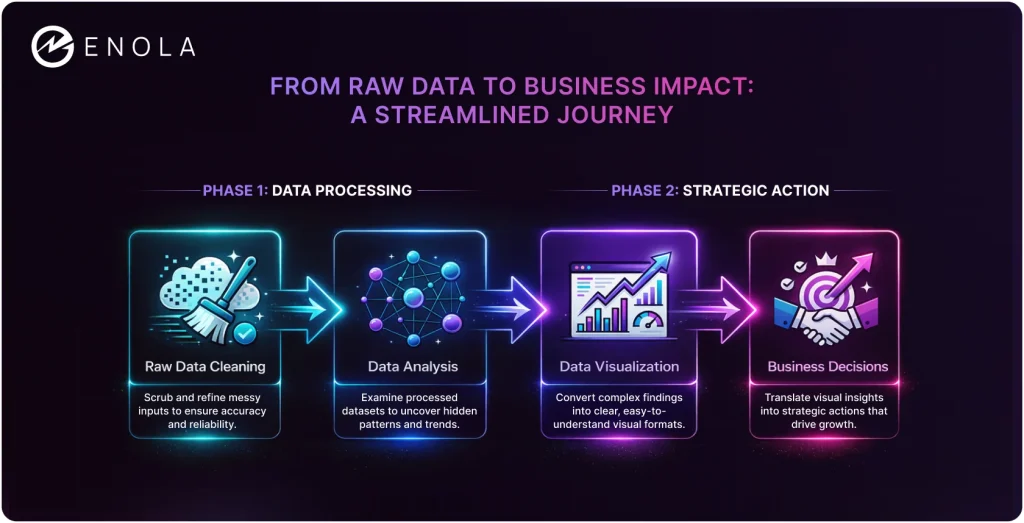
Data analysis is a wide-ranging field of study that aims to convert raw data into meaningful information. It encompasses the collection, cleaning, processing, analysis and visualization of data to provide answers to business questions. In reality, data analysis is where business context meets numbers.
When executives and teams refer to data analytics and statistics, data analysis is the action part of the equation. It enables executives to make sense of what is happening in the business, why it is happening and what should be done next. Data analysts typically work with large datasets from various sources such as product usage data, CRM systems, marketing software and financial applications.
Some of the most common types of data analysis include:
- Descriptive analysis, which provides an overview of past performance.
- Predictive analysis, which predicts possible future outcomes.
- Prescriptive analysis, which provides recommendations based on insights.
The key difference between data analysis and statistical analysis is speed, simplicity and application. Insights are only useful if they are easily understood as well as acted upon by decision-makers.
What Is Statistical Analysis?
Statistical analysis is more technical and mathematical. It involves using probability theory, statistical models and hypothesis testing to reach conclusions from data. Instead of looking at everything in the data, statistical analysis tends to test very specific hypotheses.
In the data analytics vs statistics discussion, statistics responds to questions such as:
- Is this result statistically significant?
- Is this trend likely to occur by chance?
- Can we generalize from a sample to a larger population?
Statistical analysis uses methods such as regression analysis, confidence intervals, variance analysis, correlation coefficients and hypothesis testing. Historically, statisticians have analyzed carefully chosen samples, not huge datasets.
Although statistical analysis informs business decisions, results tend to be technical. Unless translated into business speak, statistical results tend to be underutilized by the business leadership.
Data Analysis vs Statistical Analysis: Main Differences
While there is some overlap between data analysis and statistics, the distinction between the two becomes apparent when comparing scope, methodology and purpose.
Scope of Work
Data analysis encompasses the entire process from data to insights. Statistical analysis is a part of this process, specifically for validation and inference. When comparing data analysis vs statistics, data analysis is more encompassing and business-oriented.
Type of Data
Data analysis involves complex data from various systems. Statistical analysis involves structured samples for specific tests.
Approach
Data analysis involves flexible tools and techniques. Statistical analysis involves strict mathematical models and assumptions to ensure accuracy and reliability.
Business Purpose
The purpose of data analysis vs statistical analysis is quite different. Data analysis is for quick decision-making. Statistical analysis is for proving whether the results are accurate and reliable.
Skill Sets and Tools Used
The skill sets used also show the difference between analytics and statistics.
Data analysts apply technical knowledge and business acumen. They employ SQL, BI tools, analytics software and visualization software to present findings effectively.
Statistical analysts are highly dependent on technical knowledge and statistical software. Their strength is in accuracy and technical rigor, not speed or narrative skills.
In contemporary business, data analysis and statistics are most effective when combined. Accurate data analysis helps spot interesting patterns to investigate and statistics verifies if those patterns are true when examined closely.
Where Each Is Typically Applied
Knowledge of practical applications helps clarify the differences between data analysis as well as statistics. Data analysis is commonly applied in:
- Marketing performance optimization
- Product usage and feature adoption analysis
- Revenue and funnel analysis
- Customer experience tracking
On the other hand, statistical analysis is commonly applied in:
- Clinical trials and medical studies
- Policy analysis and public sector planning
- Scientific studies
- Quality control and experimentation
In business settings, statistical analysis is typically used to complement data analysis, not substitute for it.
Why the Difference Matters for Decision-Makers
The difference between data analysis and statistics matters to leaders. It has a direct impact on the speed and certainty of decision-making.
While statistical analysis may be incomplete, it can also be time-consuming. This can delay decision-making. On the other hand, data analysis may be superficial and misleading if not validated.
The best-performing companies use data analysis to provide quick insights and statistical analysis where accuracy and risk are of prime importance. This is crucial in high-growth and high-data settings.
How AskEnola Bridges Data Analysis and Statistics
AskEnola removes friction between data analysis and statistical analysis by combining business context, analytics and statistical rigour through its BADIR™ framework. Leaders ask questions in plain English and AskEnola structures the analysis, selects the right data, validates insights and delivers decision-ready recommendations without dashboards, SQL or analyst dependency.
Making Sense of Data Without Slowing Down
The data analysis vs statistical analysis debate overlooks the bigger picture, which is all about making better decisions. Businesses do not succeed by opting for either of the two options here; they succeed by leveraging data analysis and statistics to make clear decisions related to business.
Today’s decision-making requires speed, certainty as well as relevance. When insights are late or complex, they are worthless. Solutions that integrate data analysis along with statistical analysis and keep the spotlight on business are revolutionizing the way leaders work.
If your teams are more focused on discussing data than acting on it, it is high time that you change the way data analysis vs statistical analysis is presented across your business.
Book a demo or request a free trial to see how AskEnola helps leaders move from questions to decisions within seconds.
Related Blog: