For data-driven organisations, there is no debate about whether analytics should be used. Rather, the question is how best to apply it faster, more accurately as well as more profoundly.
Understanding the difference between business intelligence and business analytics is essential knowledge for business leaders. This is because although both practices involve taking raw data and transforming it into business related insights, each has different strategic objectives.
What Is Business Analytics?
Business analytics generally entails data analysis using various statistical tools and techniques to effectively predict and forecast. It seeks to recognize patterns and forecast results as well as advise on actions to enhance business.
Analytics exists at four levels:
- Descriptive analysis explains what happened
- Diagnostic analysis explains why it happened
- Predictive analysis forecasts what may happen
- Prescriptive analysis recommends what to do next
The value is in the measure of the impact. Some significant business analytics benefits include improved forecasting accuracy, more effective resource allocation and quicker strategic decisions. It’s utilized for risk modeling, demand forecasting, pricing optimization and churn prediction.
What Is Business Intelligence?
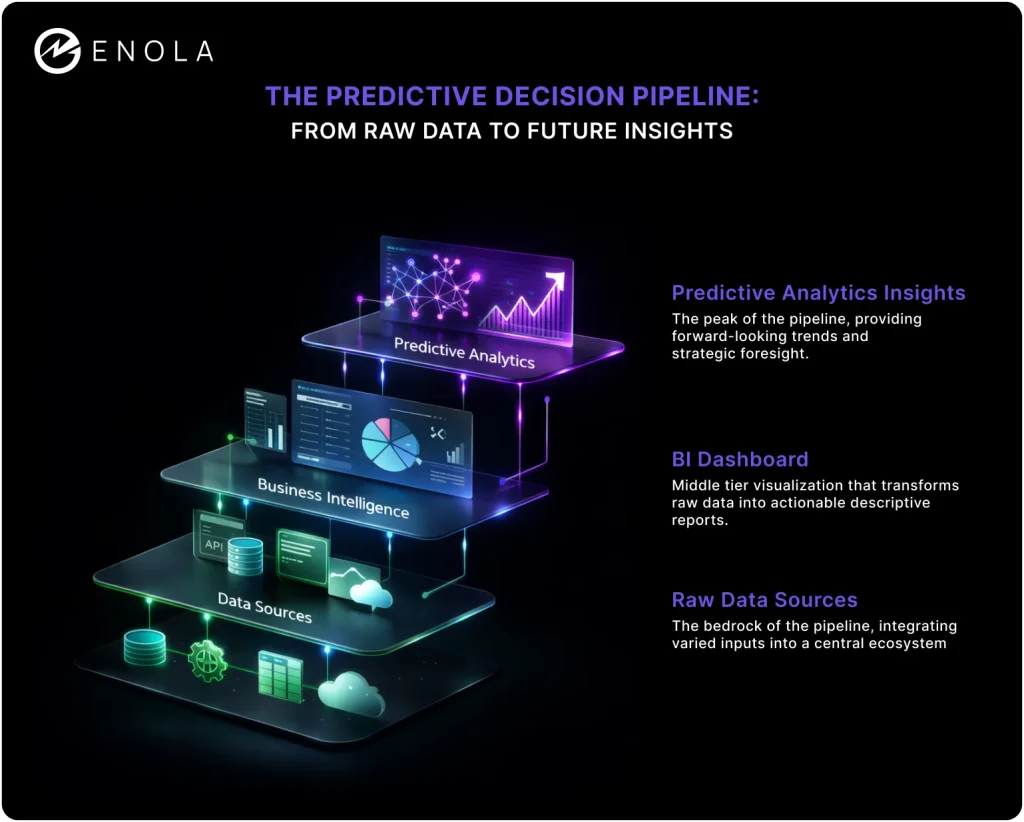
Business intelligence means a group of frameworks, technologies as well as processes used for gathering, organizing and visualizing data so that it can be viewed by the stakeholders involved. B.I. focuses on reporting and monitoring, not predicting.
Typical BI Components:
- Dashboards for real-time KPI tracking
- Data visualization tools
- Automated reporting pipelines
- Data integration frameworks
“What should we do?” is answered by analytics, whereas “What is happening now?” is answered by BI. Therefore, both are important components of the contemporary decision-making paradigm, enabling effective business intelligence and business analytics strategies.
Key Difference Between Business Analytics And Business Intelligence
The primary difference between business analytics and business intelligence lies in intent and analytical depth.
| Aspect | Business Analytics | Business Intelligence |
| Purpose | Optimise decisions | Monitor performance |
| Focus | Predictive and prescriptive insights | Historical and current data |
| User | Analysts, strategy teams | Executives, managers |
| Output | Models and recommendations | Reports and dashboards |
In simple terms, BI summarises data, while analytics interprets and extends it. When evaluating business analytics vs business intelligence, companies must consider whether they need monitoring visibility or decision guidance. Most high-growth organisations require both simultaneously.
How They Work Together in Practice
Even though the separation between BI and analytics at a conceptual level helps, in real life, they run as one integrated system. BI is the data caretaker: collecting, cleaning and showing the numbers. Analytics is where models and algorithms jump in to make that same data reveal opportunities.
Take a dashboard that flags a drop in month-on-month revenue. Analytics digs into the why, forecasts what may happen next and proposes fixes. That blend shows why BI and analytics aren’t rivals for budget but partners that amplify each other.
When to Use Each Route
Choosing between the two depends on the question you are trying to answer when it comes to your business.
Use BI when you need to:
- Real-time performance monitoring
- Standardized reporting
- Compliance tracking
Use analytics when you need:
- Forecasts and predictions
- Model scenarios
- Strategic optimization
Understanding the difference between business analytics and business intelligence helps the organization invest in tools that match their decision speed. Firms that rely only on BI often see what happened too late. Firms using analytics without BI risk modelling unreliable data.
Why Modern Leaders Need Both
Digital enterprises generate terabytes of data from the use of products, marketing activities, customer actions to operations. Leaders must interpret all this information at once if they have to remain competitive.
Most of the goodness happens when analytics sits atop a good, solid set of trustworthy BI data pipelines. Without good reporting, predictive insights lose all credibility. And dashboards without analytics lock you into rearview mirror views of the world.
That’s why the real strategic question isn’t business intelligence vs. business analytics; it’s how well you weave them together to shorten decision cycles and boost accuracy.
How AskEnola Unifies BI And Analytics
Traditional stacks separate reporting tools, analysts and modelling environments, which slows execution. AskEnola consolidates these layers through its BADIR framework that links business questions directly to analysis, data, insights and recommendations. Leaders can query data in plain English and receive decision-ready intelligence instantly, eliminating reporting delays and analyst dependency.
Choosing the Right Strategy for Your Organization
Choose the approach, weighing decision complexity, data maturity and the speed at which you must act. Stable operations may use more BI for monitoring, whereas fast-growing, often volatile environments benefit more from analytics-driven foresight.
But the best strategy combines both. A fully grown data setting applies BI for visibility as well as business analytics for action. That integrated approach makes insights timely and actionable, not just accurate.
Finally, mastering how BI and analytics fit together lets leaders build data systems that enable real decisions, not just reports. Where reporting, prediction and recommendation layers all align, companies gain a real, measurable edge by shifting from reactive management to proactive strategy.
Ready to replace dashboards and delays with instant decision intelligence? Book a demo with AskEnola today!
Related Blog:
Frequently Asked Questions
What is the difference between business analytics and business intelligence?
Business intelligence (BI) focuses on describing what has happened by aggregating and reporting historical data through dashboards, scorecards, and reports. Business analytics goes further — it uses statistical methods and predictive models to explain why things happened and forecast what will happen next. In practice, BI answers ‘What were our sales last quarter?’ while analytics answers ‘Why did sales change and what will they be next quarter?’
Which is better: business analytics or business intelligence?
Neither is universally better — they serve different purposes and work best together. Business intelligence is essential for standardized reporting and monitoring known KPIs. Business analytics is more powerful for investigating anomalies, identifying opportunities, and making forward-looking decisions. Most modern organizations need both: BI for operational monitoring and analytics for strategic decision-making. AI-powered platforms increasingly combine both capabilities in a single conversational interface.
Can AI replace traditional business intelligence?
AI is fundamentally reshaping, rather than outright replacing, traditional business intelligence. Static dashboards are being replaced by conversational AI interfaces that answer questions dynamically. Manual report generation is being automated by AI that generates analysis on demand. However, BI’s core function — providing a governed, consistent view of business metrics — remains essential. AI enhances this function by making metrics more accessible and adding forward-looking predictive capability.
What tools are used for business analytics vs business intelligence?
Traditional BI tools include Tableau, Power BI, Looker, and Qlik — these excel at visualization, dashboarding, and standardized reporting. Business analytics tools include Python-based platforms, R, and increasingly AI-native platforms like AskEnola that combine natural language querying with predictive and causal analysis. The clearest trend in 2026 is the convergence of BI and analytics into unified AI platforms that handle both historical reporting and forward-looking analysis through a single conversational interface.