In dynamic organizations, the availability of data is no longer a concern. The issue is how to convert this data into decisions on time. As organizations grow, the intricacy of metrics, dashboards, and reporting grows as well, which sometimes becomes a hindrance to decision-making.
For this purpose, organizations are exploring various analytics models that claim to provide more autonomy to the decision-making process. It is essential to understand how these models differ to formulate a data strategy that helps organizations grow rather than hindering them.
What Is Self-Service Analytics?
A self-service data analytics platform provides drag-and-drop dashboards, pre-built visualizations, filters, and some level of guided reporting. When logging in, users can select data sources and build their own views. Self-service analytics enables non-technical users to explore the data, create their own dashboards, and create reports without depending heavily on IT or data teams.
Benefits of Self-Service analytics:
- Decreased dependence on Data Analysts
- Faster Reporting
- Increased visibility of data across departments
However, self-service analytics still requires users to understand metrics, data structures, and relationships between tables. It simplifies reporting, but it does not automatically interpret business intent.
What Is AI Analytics?
If self-service tools democratized dashboards, AI analytics is redefining how decisions are made. AI powered data analytics is more advanced than simply using charts; it uses natural language processing, machine learning and automated reasoning to answer business related questions while providing contextual insights. Rather than having to manually build dashboards, users will be able to simply type their question in simple English and receive an answer to their query, along with insights on how to act on it and why.
AI for data analysis does not just visualize numbers. It identifies patterns, explains drivers, and suggests how one should move forward. The paradigm has changed from “explore and interpret yourself” to “ask and receive decision-ready insights.”
Differences Between Self-Service and AI Analytics
User Involvement vs Business Focus
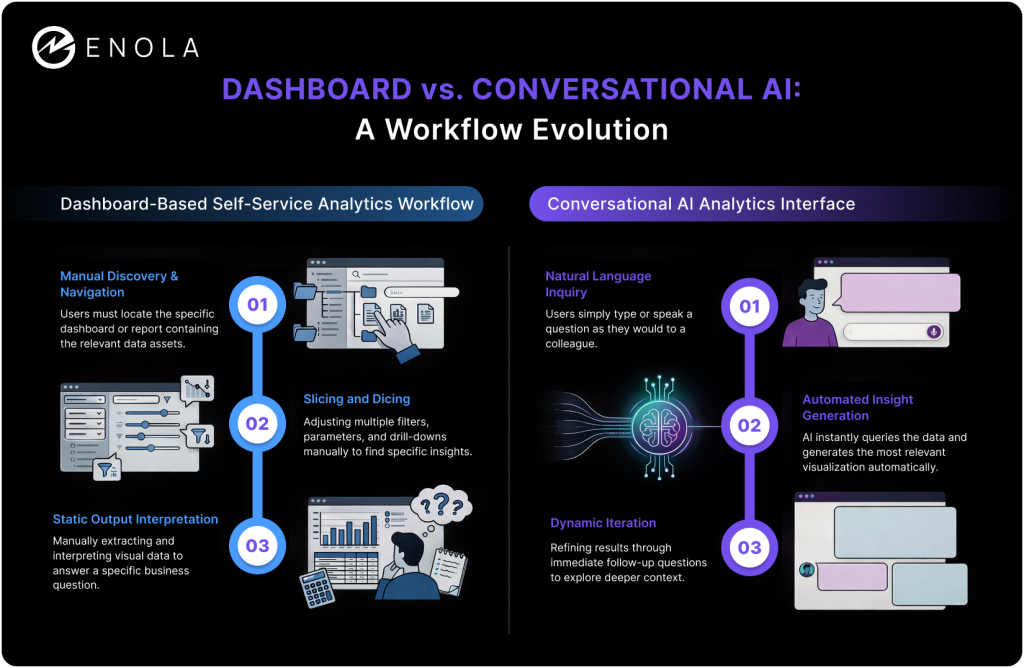
With self-service data analytics platforms, the user is required to know how to filter, which metric to select, and how to analyze their data. Users can explore the data freely but are responsible for interpreting the results independently.
AI powered data analytics focuses on business intent. A user can ask, “Why did revenue drop in the North region last quarter?” The system will understand and perform a pre-defined analysis, thereby reducing cognitive load and guesswork when performing data analysis.
Speed to Insight/Achieve Insights
Self-service analytics provide faster reporting time than traditional BI processes; however, users are still required to spend time navigating around the different dashboards or validating their findings.
The speed to insight achieved through AI analytics is much faster than self-service analytics. Once you learn how to use AI analytics, the biggest differentiator becomes clear: receiving instant, contextual answers. Therefore, the process of providing insight moves from developing reports to delivering insight in seconds.
Skill Requirements
Self-service analytics expects users to have basic data knowledge. Even if they aren’t writing SQL, they still need to understand things like metrics, dimensions, filters, and logical operations.
AI analytical data has eliminated a lot of these barriers. It provides the means of processing a natural language request for data and converts it to a structured query to a data warehouse. This makes advanced analysis accessible to founders, CXOs, marketing heads, and finance leaders without any kind of technical training in order to perform analysis at an advanced level.
Depth of Analysis
The benefits of self-service data analytics are most significant for descriptive analyses. Users can always answer the question “what happened” by examining dimensions, looking for correlations, or breaking up the data into views.
AI analytics provides diagnostic and prescriptive insight as well. It helps identify changing patterns and provides guidance on the next step to take. This is unlike the traditional approach, which would require one to dig through reports in order to identify unusual patterns, relationships, and trends.
Reliability and Governance
Sometimes, a self-service analytical data platform can contribute to inconsistent results. There could be multiple definitions for KPI from different users of the self-service analytical platform, as well as multiple ways to apply filters or interpret an actual result.
Modern AI analytical platforms utilize centralized and governed metrics in determining the definition of KPIs. When AI analytical data is put into production correctly, it will generate a consistent and standardized set of insights aligned with standard business definitions to limit errors and misinterpretations.
How AskEnola Elevates AI Analytics for Enterprises
With the unique BADIR framework, AskEnola takes AI powered data analytics beyond simple conversational queries. Instead, every question has four segments of analysis: analysis, data selection, insight discovery, and recommendation generation. AskEnola is built for high-growth, high-density data companies with a direct connection to their data warehouse and is very reliable to give decision-ready, reliable insights – no need for complex dashboards or heavy reliance on data analysts.
Every query is structured in such a way that it provides the user with clear measurement metrics to help in making effective decisions. Instead of generating generic summaries, AskEnola generated insights on the basis of clearly defined KPIs and decision contexts. Thus, misinterpretation is significantly reduced, ensuring all outputs are aligned with actual business objectives.
Selecting the Best Approach to Modern Decision Making
When it comes to modern decision-making, the real question to ask yourself isn’t about the functionality of both, but rather the impact of using both services through your team’s daily function with data.
If your need is improving visibility and speed to retrieve reports in order to assist with overcoming basic reporting bottlenecks, there are self-service data analytics platforms that can help you achieve this objective by allowing for greater access to reports across all departments.
On the other hand, if you are looking for quicker decision-making, more accurate solutions, and less back-and-forth with analysts, than AI powered data analytics is the most effective solution. being designed around the speed and accuracy of the analytics.
As data grows more complex, the advantage goes to organizations that reduce friction between questions and answers.
Related Blog: