In today’s landscape, organizations no longer struggle with collecting information; they struggle with extracting meaning from it quickly enough to shape strategy. The volume of data that is generated by product usage, customer behaviour, financial performance, and operational processes has increased rapidly, making the current methods and practices of analysing this data inadequate to support their needs. AI analytics is an emerging trend that will enable organisations to capitalise on the many opportunities for future market success.
AI analytics is the use of artificial intelligence technologies — including machine learning, natural language processing, and predictive modeling — to analyze data, identify patterns, and generate actionable insights faster and more accurately than traditional business intelligence tools.
At AskEnola, this shift reflects what many analysts experience daily: The need for tools that reduce manual effort and make insights easier to access. The platform follows the principle that data should feel conversational and immediate, not hidden behind layers of dashboards or technical steps. This approach mirrors the broader industry movement toward real-time, AI-supported decision-making.
Defining AI Analytics
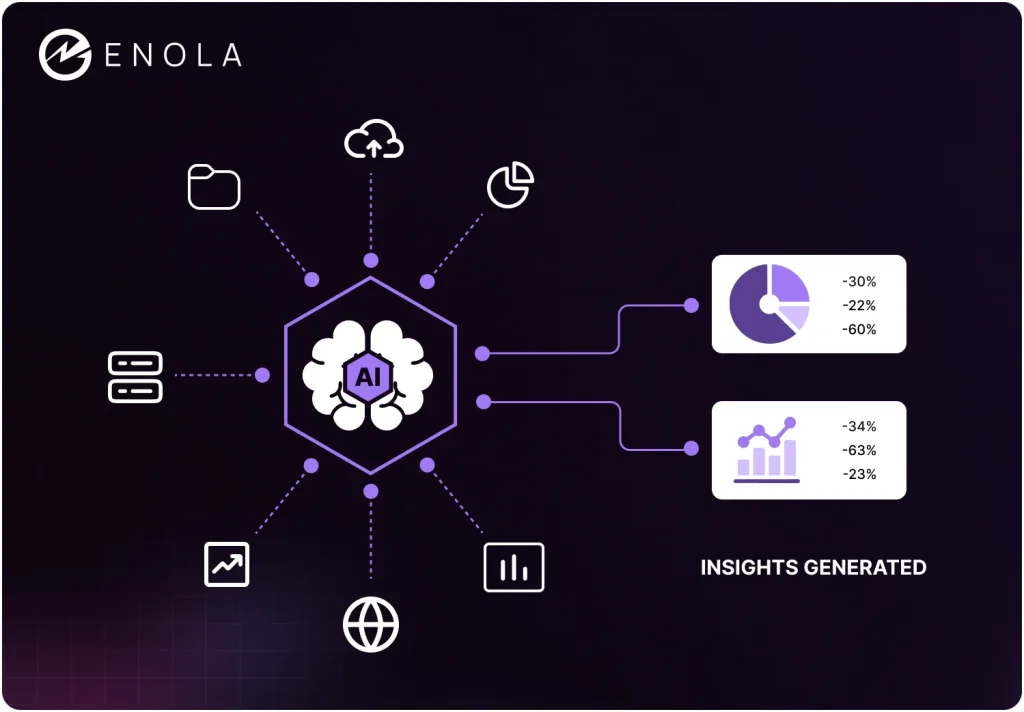
AI analytics refers to the use of artificial intelligence, including machine learning and natural language processing, to improve upon the process of manual analysis. With AI analytics tools and solutions, organisations can now use AI technologies to automate and improve the analytics lifecycle through the use of an innovative approach, rather than simply using spreadsheets, dashboards, and the sequential querying of SQL to obtain insights. AI analytics solutions utilize data patterns to learn and, consequently, to provide users with the capability to generate insights with little to no human intervention.
Where traditional analytics answers “what happened,” AI analytics accelerates the far more valuable questions:
- Why did it happen?
- What’s likely to happen next?
- How should the business respond?
For market analysts, this is a substantial change from how they viewed their profession. Instead of producing historical reports based on precedents, AI systems generate future-oriented, actionable insights for analysts to use in combination with forecasting and assessing risk for the organization at scale.
AI Analytics Solutions vs. Traditional BI: A New Standard of Intelligence
When comparing AI analytics to Traditional BI, one of the biggest differences between the two is that while BI has always been focused primarily on reporting, visualization, etc., AI business intelligence systems have evolved into a much more agile and innovative product.
Here are some of the key features of both of these systems:
Traditional BI
- Has predefined dashboards and static model views.
- Uses manual queries to build visualizations or create reports.
- Generally, provide only descriptive insight.
- The interpretation of the information is left to the analysts to decide.
AI BI
- Uses historical data to learn and make automatic adjustments.
- Can answer natural language questions without needing coding.
- Provides predictive and prescriptive information.
- Eliminates a lot of mundane tasks for analysts so they can focus on strategic things.
For analysts in competitive or fast-paced markets, these differences significantly improve how deeply you can research data, how quickly you can make decisions, and how accurately you can develop a strategic plan.
How AI Is Used in Data Analytics
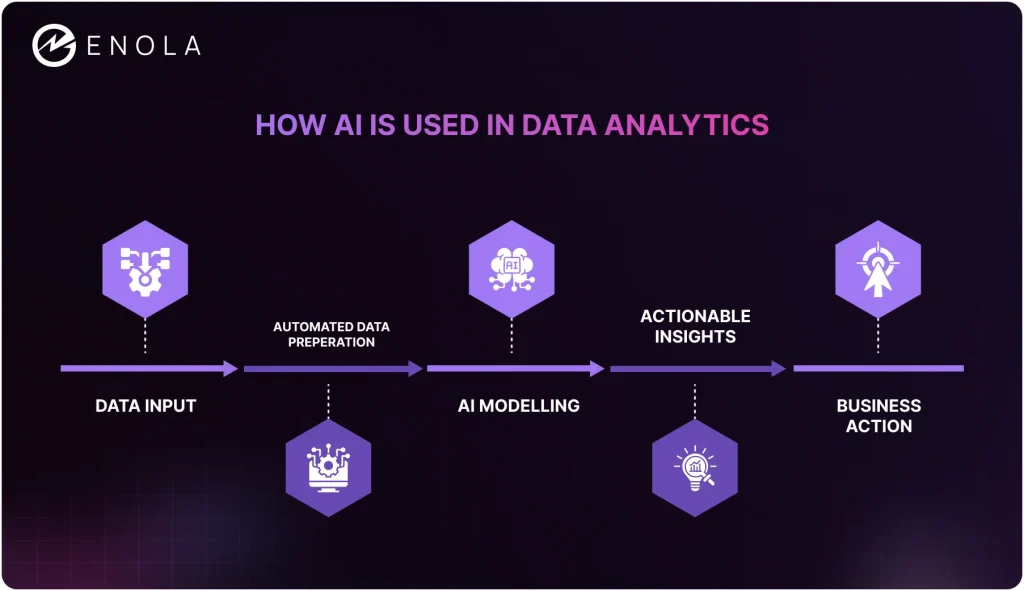
Let’s take a look at AI’s role within data science to provide insight into what capabilities support the success of high-performing data analytics solutions:
1. Automated Data Preparation
A key innovation introduced in 2025 is Natural Language Analytics. Instead of having to write complex SQL queries or scroll through multiple dashboards, analysts can pose questions in everyday spoken language and immediately receive an answer, including visuals and breakdowns. This creates fewer barriers for non-technical stakeholders as well as improves access to the information needed by analysts who are working with their teams.
2. Natural-Language Querying
In 2025, the emergence of natural language analytics will also significantly reduce the barriers for non-technical users when accessing data by answering questions in a conversational way. This helps to lower barriers for non-technical stakeholders and improves accessibility across teams.
3. Pattern Recognition Using Machine Learning
The use of Machine Learning Models to identify data trends and patterns is another example of how machine learning is being utilized within organizations. Some of these include:
- Hidden relationships of variables
- Emerging trends in behavioral patterns
- Anomalies that signal a risk or an opportunity
- Patterns at the group level through clustering
4. Predictive Analytics:
You can use AI models for data analysis to generate insights beyond the past; these models estimate future events. For instance, you could use predictive algorithms to anticipate demand, pricing changes, and other customer/user behaviour patterns. Additionally, prescriptive models take predictive algorithms one step further by providing recommendations based on simulated and statistical likelihoods.
5. Transparent and Detailed Insights
Modern AI analysis platforms provide insight into how specific models arrived at each prediction and/or insight. This type of detailed information can be critical for analysts who need to validate the accuracy of results before advising their business management teams.
Benefits of AI Analytics for Market Analysts
1. Reduced Time-to-Insight:
Using AI analytics, analysts no longer have to build out or wait for multiple data teams or for their dashboards to provide insights. Instead, they receive insight within seconds of inputting their information, rather than days.
2. Increased Analytical Capability:
AI allows analysts to examine an increased number of variables when analysing data; therefore, it broadens their capabilities. It can analyse and detect minute changes across millions of data points; consequently, it enables more effective hypothesis generation and testing.
3. Increased Forecasting Accuracy:
Machine learning models continuously refine themselves by processing new data; therefore, AI provides a model that can adapt to changes and be more reliable than ever before. This adaptability is crucial in terms of being able to effectively forecast in volatile markets.
4. Reduced Operational Overhead
AI eliminates repetitive work like running recurring reports, merging datasets, and updating dashboards, and lets analysts focus on strategic modeling and high-value interpretation.
How to Use AI for Data Analytics in Practice
The practical side of how to use AI for data analytics follows the following clear workflow, regardless of industry:
- Connect Your Data Sources
Whether working with cloud warehouses or CRM/financial systems, integration creates a unified environment for analysis. - Ask Questions or Set Analytical Goals
AI systems interpret natural-language queries or predefined objectives to determine the appropriate analytical approach. - AI Builds the Analytical Pipeline Automatically
The system cleans data, selects features, identifies statistical methods, and assembles relevant ML models. - Review Predictions, Trends, or Explanations
Analysts interpret system-generated insights and validate them against contextual market knowledge. - Take Action or Model Scenarios
With insight in hand, analysts can forecast outcomes, test assumptions, or advise leadership teams on strategic pathways.
This workflow transforms analytics from a manual checklist into a collaborative, intelligence-driven process.
The Future of AI Analytics in 2025
AI analytics is gradually becoming a significant part of modern business intelligence systems. As companies move toward centrally collecting large numbers of records or “big data”, seeking to expedite the process of obtaining information from these records and increasingly relying on tools for forecasting, data scientists will work more closely with AI technologies rather than simply considering them an afterthought.
At AskEnola, this future is already in motion. We promote an experience where insight discovery feels natural and conversational. Instead of asking analysts to adapt to complex tools, AskEnola adapts to the analyst, helping them move from static reporting to dynamic, real-time intelligence that strengthens every decision they make.
Related Blog:
Frequently Asked Questions
What is AI analytics?
AI analytics is the application of artificial intelligence technologies — including machine learning, natural language processing, and predictive modeling — to the process of analyzing business data. Unlike traditional analytics, which requires human analysts to manually query data and build reports, AI analytics automates insight discovery, pattern recognition, and recommendation generation. This makes data analysis faster, more accessible to non-technical users, and capable of processing larger datasets than manual methods allow.
How is AI analytics different from traditional data analytics?
Traditional data analytics relies on human analysts to write SQL queries, build dashboards, and manually interpret charts. AI analytics automates these steps using machine learning models that can identify patterns, detect anomalies, and generate insights without manual query writing. The key practical difference is speed and accessibility: traditional analytics takes days and requires technical expertise, while AI analytics can answer complex business questions in seconds and is accessible to non-technical users through natural language interfaces.
What are the main use cases of AI analytics?
The main use cases of AI analytics include: revenue analysis (understanding what’s driving or hindering revenue growth), customer churn prediction and segmentation, operational efficiency monitoring, supply chain optimization, marketing attribution, and financial forecasting. AI analytics is particularly valuable in situations where the business question is complex, the relevant data spans multiple systems, or the answer is needed faster than a traditional analyst request cycle allows.
Is AI analytics only for large enterprises?
No — AI analytics is increasingly accessible to small and mid-sized businesses. While early AI analytics platforms required significant data infrastructure and technical teams, modern cloud-native AI analytics tools connect directly to existing data warehouses and require minimal setup. Many platforms offer per-user pricing that scales with team size, making enterprise-grade analytics accessible to companies with 10 employees as well as 10,000. The primary requirement is having your business data in a structured format, not a large IT budget.
What is the best AI analytics tool for beginners?
For beginners without SQL or data science backgrounds, the best AI analytics tools are those with natural language interfaces that accept plain English questions and return plain English answers. AskEnola is designed specifically for this use case — connecting to your existing data warehouse and allowing any team member to ask business questions without technical training. Other beginner-friendly options include Microsoft Copilot for Power BI and ThoughtSpot’s search interface, though these require more initial data model setup than conversational AI-native platforms.