Modern organizations inundate themselves with data, but data does not produce value by itself. The key lies in the ability to rapidly transform information into insights that drive business-related decisions. This is where self-service analytics upends the conventional model. Decision makers can then access, explore and understand their data in real-time without waiting for analysts or IT.
Self-service analytics is a data analysis approach that empowers non-technical business users to access, explore, and visualize data independently — without needing to submit requests to a data team or write SQL queries.
Knowledge of what self-service analytics is has now become a prerequisite for any leader in pursuit of speedier insights, greater agility and clarity of operations. It therefore represents a shift from the use of reports towards data independence.
What is Self-Service Analytics?
At its heart, self-service analytics describes computing technologies that enable business users to access and analyze an organization’s data without programming, SQL or technical expertise. In this sense, self-service analytics defines an important category of business intelligence technologies that put the power of analytics into the hands of business decision makers.
With self-service data analytics, an individual can query, report, see trends as well as analyze their performance metrics on demand. They can review the data and respond appropriately instead of waiting several days for answers.
This methodology fundamentally changes the approach to analytics as a business discipline from a centralized operation to a decentralized one.
How Self-Service Analytics Works
Self-service analytics is underpinned by a well-structured ecosystem, ensuring accurate, secure and accessible data.
Data Pipelines
Behind any self-service analytics system, there is a web of pipelines that fetch, filter and arrange the data coming from different sources, like CRMs, financial programs or marketing software. These pipelines standardize raw data so that business users see reliable information rather than fragmented datasets.
Analytics Interfaces
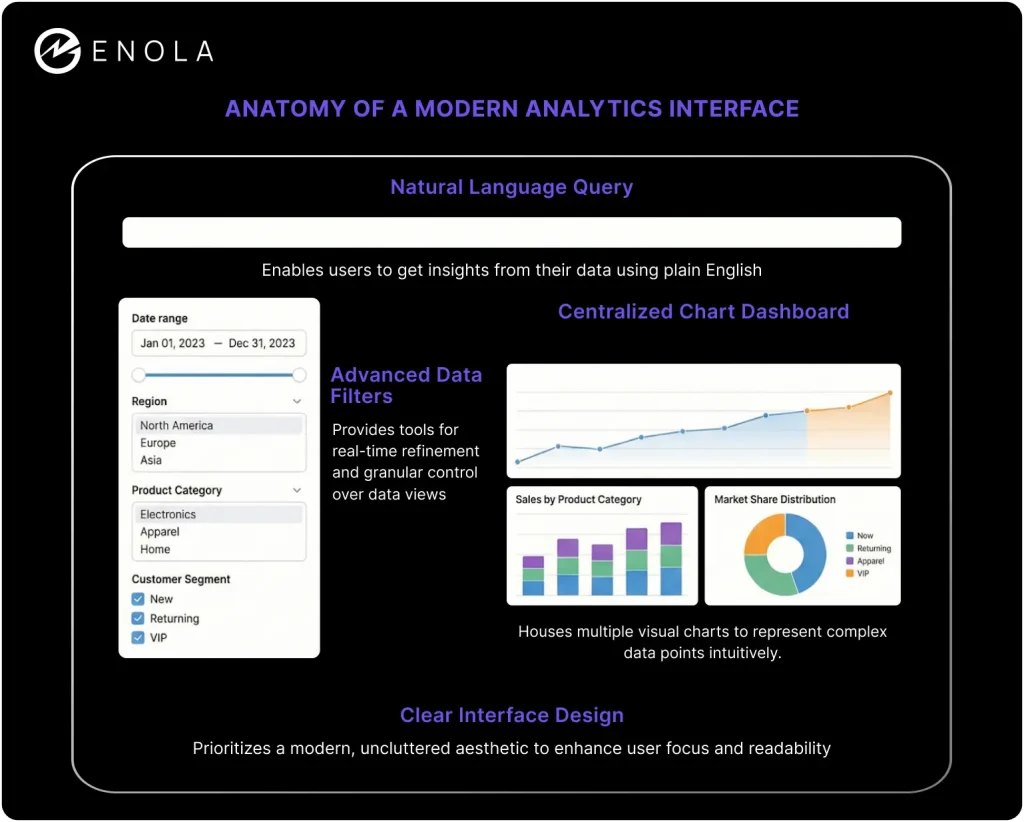
The user layer of business intelligence self-service analytics platforms presents data through intuitive dashboards, natural language queries or visual exploration tools. These interfaces translate complex datasets into understandable insights so that non-technical teams can perform analysis confidently.
Key Features of a Self-Service Data Analytics Platform
A modern self service data analytics platform is built on the pillars of usability, speed as well as reliability and can, therefore, include features like data modeling, visualization, access along with AI-driven analytics, with the best platforms actually executing questions written in plain language and converting them into structured queries.
These features ensure that self service business analytics is not just accessible but also trustworthy. When users trust the data, they act faster as well as with greater confidence.
Benefits of Self-Service Analytics
The benefits of self service analytics extend beyond convenience to influence operational efficiency and bottom-line strategic success.
First, decision-making speed accelerates significantly. There is no wait for reports to materialize because insights are on tap. Second, there is an increase in productivity; analysts are free to focus on complex modeling, away from policing or responding to simple inquiries. Third, data literacy improves across the organization because more employees interact with data daily.
A vital edge among the benefits of self service analytics is the concept of alignment. Ideally, with a unified data environment that is governed, various departments have access to the single truth. This, therefore, removes mixed reports and incorporates consistent metrics for leaders. And finally, scalability improves. In other words, when the size of an organization increases, self-service analytics will data access to scale without needing a corresponding growth in the number of analysts.
Types of Analytics Enabled
There can be multiple layers in self-service environments, which guide the business function decisions.
Descriptive analytics describes what has already occurred using historical data. Diagnostic analytics aims to explain why an event occurred by identifying correlations and root causes. Predictive analytics uses statistical models to predict what might occur next. Prescriptive analytics advises us on how to perform a task by making use of scenarios.
By leveraging self-service of business intelligence tools, marketers, finance teams, product management personnel as well as management officials can access these analytical techniques without going through technical support.
How AskEnola Powers Reliable Self Service Analytics
AskEnola operationalises self service data analytics through a conversational interface that lets leaders ask complex business questions in plain English and receive decision ready insights in seconds. Its BADIR framework structures analysis from business question to recommendation, ensuring outputs are relevant, explainable and accurate while eliminating analyst dependency and reporting delays.
Making Data-Driven Decisions with Confidence
Organizations that understand self-service analytics see it as a strategic capability rather than just another reporting capability. With self-service analytics, insight generation is decentralized, making it more accountable and efficient in execution. With a good self-service analytics system, every decision can be made based on evidence rather than guesswork.
It’s no longer an option for data-rich companies, but rather a competitive requirement for self-service analytics. When management can individually investigate metrics, assess scenarios as well as confirm their business strategies, they become less reactive and more proactive.
The true value of business intelligence self service lies in its foundation of balancing accessibility and governance. It enables and empowers the team at the same time. This is how an organization achieves timely decision-making along with direction.
Go ahead and book a demo with AskEnola to experience faster, decision-ready insights powered by reliable self-service analytics.
Related Blog: