The analytics landscape is dramatically shifting in 2026. The age of static dashboards and manual reporting is being replaced by intelligent systems catering to self-service capabilities. At AskEnola, we see the picture clearly: now the word self-service analytics is moving beyond mere jargon to being the new norm. Using advanced AI analytics tools and conversational agents, new-age solutions empower every user to explore data, derive insight, and act in real time. These capabilities mark the next leap made in AI-data-analysis tools and in the value any analytics exercise delivers.
The Traditional Model and Its Limits
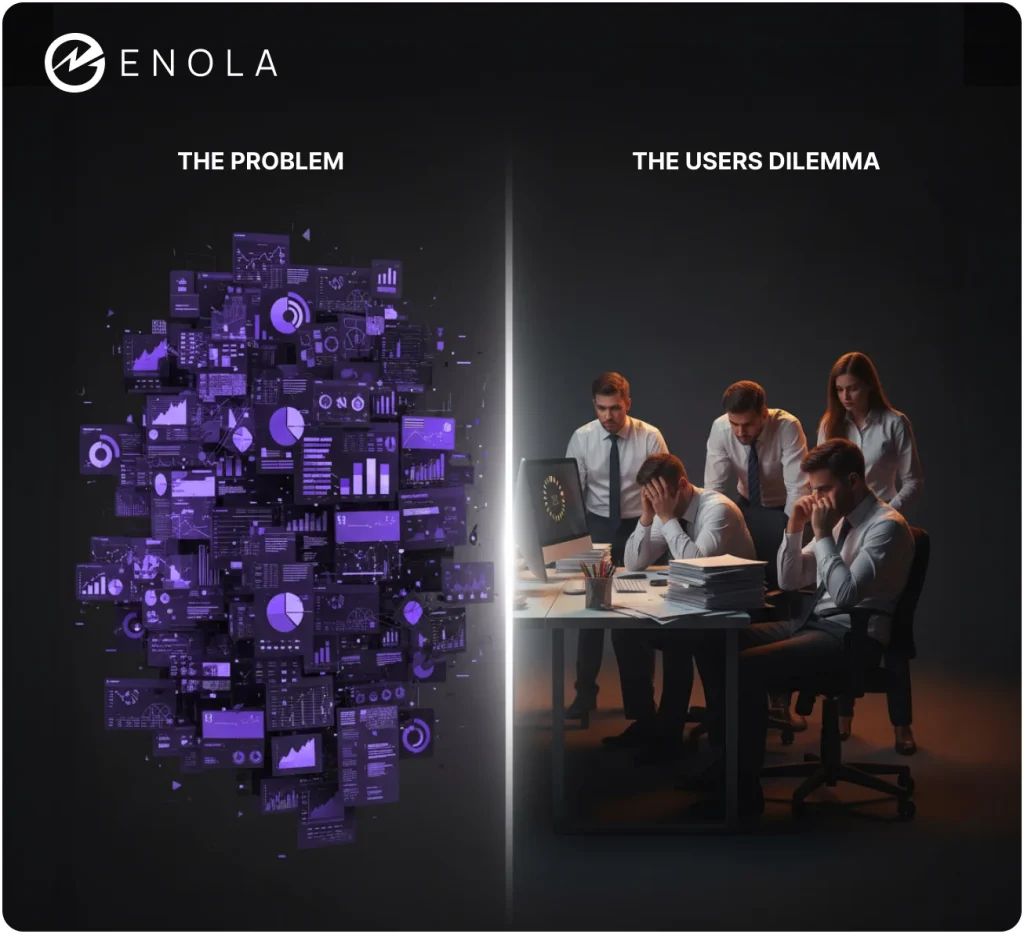
For years, market analysts relied on dashboards – static reports with scheduled refreshes, fixed visuals, and a lot of manual interpretation. They served well for basic KPI tracking, trend lines, and simple animated visuals. However, the list of limitations was long: dashboards were often slow to update, lacked flexibility, needed an additional analyst or IT team, and basically looked at what had happened rather than what might come next.
The traditional model faces trouble when customer behavior, product adoption, and market conditions change every hour. Traditional dashboards also find it difficult to fulfill the true self-service analytics expectation or keep up with business speed requirements.
Enter AI Agents and Next Gen Self-Service Analytics
In 2026, the arrival of AI agents has changed the ability of individuals to consume data and take action on analytics. These AI agents now form the backbone of next-generation self-service analytics, allowing users to ask questions in plain English, get instant answers, and make decisions without waiting for custom reports. The key capabilities include:
- Conversational Querying: Interaction with the system is natural, i.e., “What happened to our churn last week, and why did it change?” with answers given without any SQL writing or dashboard navigation.
- Automated Analysis: The AI does not simply fetch numbers but looks for patterns, anomalies, and trends. That much makes behind-the-scenes power work of advanced AI analytics tools.
- Real-Time Insights: Data updates continuously, enabling users to act on fresh, up-to-the-minute information instead of outdated snapshots.
- Actionable Recommendations: Insights come along with what is to be done next—such as filtering suggestions, targeting shifts, and scenario plans-which help close the gap from insight to action.
Altogether, the systems of self-service AI analytics will redefine what self-service analytics means. Until now, humans built dashboards; yet with self-service AI analytics, the system builds insights while the user makes decisions.
Why Market Analysts Should Care in 2026
The GenAI-led shift in the US markets is a strategic one, reshaping long-term planning, decision-making, and how organizations compete. Some of the factors driving this shift are:
1. Increased Speed and Agility
When insights arrive in real-time, analysts and business stakeholders working on it from that perspective can move faster. They can run tests on particular hypotheses, switch strategies, and take on any kind of disruption before the competition.
2. Broader Access and Adoption
Traditionally, dashboards would serve those with technical skills. Now, AI-agent-driven tools allow marketing, product, finance, and operations biz users to pull up insights for themselves. This democratizes data and, in turn, raises analyst status from report builders to steering analysts.
3. Deeper Insights Delivered Automatically
The best AI data analysis tools provide more than just numbers. They also interpret them. For instance, an agent can notice in retention in a segment, associate that with a change in pricing that occurred recently, and recommend running a re-engagement campaign. This chain of insight to action actually supplants traditional dashboard-to-interpretation workflows.
4. Cost-Efficiency and Scale
Building and maintaining multiple dashboards for each team is resource-intensive. AI agents cut down overheads, allowing analytics to scale with fewer humans, fewer dashboards, and fewer manual interventions.
What to Expect from AI-Powered Self-Service Analytic
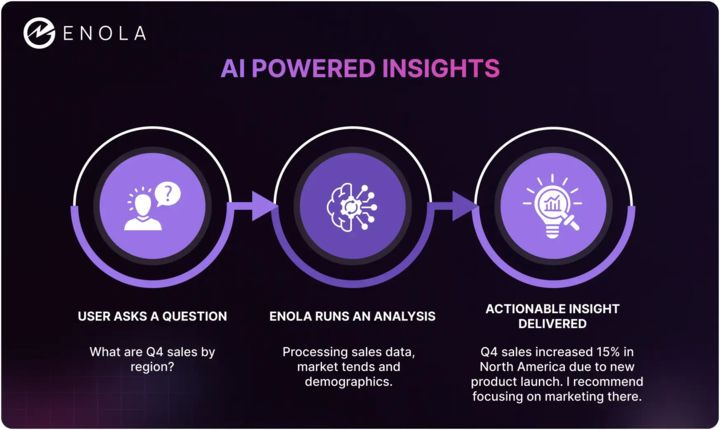
We present what AI-powered analytics tools are achieving today and what needs to further evolve:
- Automated semantic layers: The system understands business terms, KPIs, and context, so the users don’t have to build data models themselves.
- Adaptive agents: These learn from past questions and increase their understanding of business context over time, potentially becoming less and less irrelevant when answering.
- Embedded recommendations: Apart from suggesting what could occur, agents also recommend actions suitable for self-service.
- Cross-domain insight: Instead of silo dashboards, AI agents pull insights across marketing, product, finance, and operations for holistic decision-making.
- Governance built in: To trust these systems, they should be aligned with business goals, data secured, and audit trails preserved. A properly implemented system embeds these features, so the term self-service is never synonymous with uncontrolled.
This evolution exhibits the true benefits and the future of self-service analytics: they will eliminate the need for dashboards, giving way to real-time insight and action.
Implementing Self-Service AI Analytics – Practical Tips
Image placeholder: Checklist for implementation, data readiness, and training of users, governance, and continuous improvement.
Some major points the analysts need to keep in mind to steer the change in the market:
- Ensure data readiness and hygiene: Real-time or near-real-time analytics require clean and well-integrated data sources. Investing in data pipelines, metadata models, and semantic layers is an option.
- Start with high-value use cases: Choose questions that matter to business decisions, for example, retention risk, product adoption, and campaign ROI. Proving value early builds trust.
- Train users and do change management: Even the best AI agent will still need its users to change their mindset-from waiting for dashboards to asking questions directly and acting on the responses.
- Ensure governance and transparency: AI-driven analytics ought to be explainable. Analysts must verify the assumptions of AI, watch out for bias, and ensure the analysis suits a business goal.
- Iterate and evolve: Self-service analytics is not “set-and-forget.” Keep monitoring adoption, fine-tune the conversational models, add new data sources, and evolve as business needs change.
From an effective standpoint, self-service analytics is shifting more towards AI, giving advantages with speed, agility, deeper insights, and cost-effectiveness.
How AskEnola Facilitates This New Self-Service Analytics
At AskEnola, we built a platform for this modern age of analytics. This AI agent connects to your data warehouse and learns your business context so it may bring the non-technical users to simply ask questions in plain English. Behind the scenes, our analysis engine goes through a structured approach that guarantees that every insight aligns with business goals.
Our method allows every user to move from question to decision in just a few minutes, whether they are business leaders or analysts. Self-service analytics becomes real, not just a dream. Organizations get actionable intelligence in lieu of creating overhead in manual reporting and dashboard workflows.
Self-service AI analytics is a truly transformative change in how organizations operate. With the right tools, business users now ask questions and get answers, and act on them in real time. Gone are the days of waiting for dashboards or manual queries. Market analysts willing to embrace this change will prepare themselves and their organizations for a future with faster decisions, deeper insights, stronger adoption, and enhanced business outputs.
At AskEnola, we stand for such transformation. We believe that data-driven decision-making should be accessible, immediate, and tied directly to business outcomes. Self-service should be freedom, not friction. Analytics should be action, not delay. This is what the next generation of analytics means in 2026 and beyond.
Related Blog: