
In the year 2025, companies moved faster than ever in their operations. The data coming from various sources, like sales databases, marketing platforms, product telemetry, and finance systems, is enormous, and businesses are now asking for quick and actionable insights. The opportunity lies in the potential of data to guide strategy; the challenge lies in turning raw data into meaningful insight quickly. That’s where no-code data analytics comes in.
At Ask Enola, we continue to demonstrate that real transformation comes from combining proven analytics frameworks like BADIR™ with AI-driven intelligence, enabling analysts to move from static dashboards to dynamic and interactive insights. Today’s no-code and AI analytics platforms have evolved into strategic engines for analysts and leaders who want speed without sacrificing rigor.
What Is No-Code Data Analytics
No-code data analytics means enabling data analysis without requiring users to write SQL queries, scripts, or code. Instead of wrangling data pipelines or building dashboards manually, analysts as well as business users simply connect their data sources and begin querying via intuitive interfaces, using conversational, natural-language, or visual to get charts, metrics, and insights on demand.
AI analytics and no-code AI have made the potential of no-code analytics even more powerful. AI is not only able to visualize past trends but is also able to spot the patterns, mark anomalies, and recommend what to do next via predictive forecasting. This transition makes analytics a dynamic, future-oriented approach rather than a passive and retrospective one.
What brings this shift at the present time? The amount of data being generated is vast. On the other hand, competition and the market’s ups and downs make it necessary for companies to make real-time decisions, while traditional BI tools’ static dashboards showing yesterday’s performance struggle to keep up. With no-code analytics platforms, you not only democratize access to data and actionable insights but also reduce the “data ticket” backlog and accelerate decision cycles.
Benefits of No-Code Data Analytics
Traditional analytics often involves assembling dashboards: you build queries, define KPIs, design visuals, wait for reports, and then interpret the results. This process historically required technical skills or heavy analyst involvement, and even after that, dashboards offered limited flexibility.
By contrast, no-code analytics platforms are built to address these problems head-on:
- Flexible, on-demand queries that enable you to ask new questions anytime.
- Data flows instantly or very quickly, and the insight is available as the events happen.
- Access to data is made easy, and various data sources are merged under uniform standards.
- Insights and narratives are provided along with the metrics, not just “why” but also “so what.”
To sum up, no-code data analytics redefines analytics as a strategic enabler, no longer a passive back-office task.
The Rise of AI-Powered No-Code Analytics
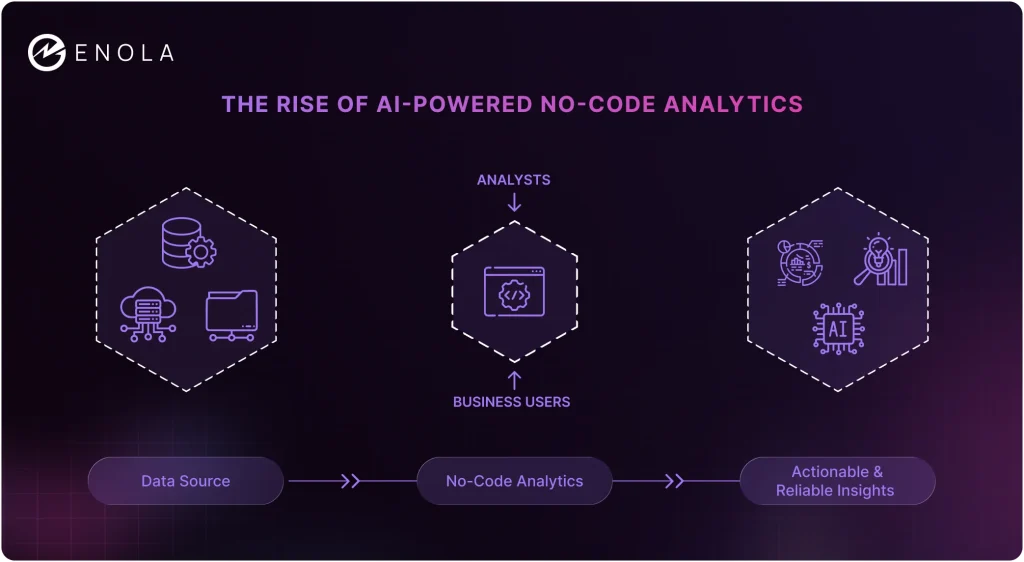
2025 marks a tipping point in analytics: the convergence of no-code capabilities and advanced AI. The emphasis shifts from “make dashboards faster” to “automate insight generation.” Today’s analytics are not just tools for graphical representation of data but entities that possess intelligence and can therefore interpret, recommend, and even foresee the outcomes.
With the no-code AI, the user doesn’t only see numbers; he gets the answers too. This includes identifying the cause of an event, conducting driver analysis (e.g., identifying the factors that mostly affected conversion), carrying out segmentation automatically, spotting unusual patterns, and even forecasting future trends. Moreover, AI analytics platforms have also become more popular amongst such approaches that prioritize data governance, security, and enterprise integration.
For example, a top-quality no-code analytics platform will seamlessly integrate with your chosen data warehouse, be it Snowflake, BigQuery, Redshift, Azure Synapse, or any other SQL-based warehouse, without the need for movement of data or risking its export.
This is great news for market analysts since they will be able to make quicker choices, cover wider areas (marketing, finance, sales, product), and depend less on the specialized data engineers.
What Analysts Should Know Before Adopting No-Code Analytics
Here are some practical considerations to maximize value and avoid common pitfalls before you leap into no-code analytics.
Data Readiness and Governance
A no-code analytics platform fully supported by AI works best only when it is continually supplied with consistent, well-organized data. Therefore, different data sources, the different schema used, or the lack of good data hygiene can lead to a lack of trust in the results. Standards for data definitions, access control, and lineage are very important for accurate outputs and governance.
Organizational Readiness and Buy-in
The move from dashboards and scheduled reports to self-service, conversational analytics is a major shift. The role of the analysts will change from “report builders” to “insight strategists.” Nevertheless, transparency and accountability will need to be maintained for sharing and making decisions based on machine-generated insights.
Strategic Use, Not Just Ad-hoc 1uestions
The strength of no-code analytics is not just rapid querying but strategic insight as well. Replace the question “what happened” with “why did it happen,” “what could happen next,” and “what should we do.” The structured analysis approach, starting with a business question and going through analysis to insights and recommendations, keeps analytics in line with business goals. This mirrors the rigorous methodology many leading platforms adopt.
Human + AI, Not Human vs AI
No matter how far technology has advanced, human context and judgement will always be needed. AI-powered analytics should not replace human strategic thinking but complement it. Use machine speed and precision to surface insights, apply human domain knowledge before making high-stakes decisions.
A Step-by-Step Path For Using No-Code Data Analytics
Here’s a clear roadmap to help you begin your journey with no-code data analytics and no-code AI:
Inventory and audit your data sources
List all the data sources one by one that are used in different departments like marketing, sales, finance, etc. Verify data quality, and also watch data definitions, naming conventions, and column consistency.
Choose a no-code analytics platform
Look at the different options that are available and put a key on the one that offers AI-driven insights, working with your data warehouse, and meeting the security and compliance standards. Seek natural-language interfaces, built-in reporting, real-time or near-real-time data support, and the capability for custom metrics.
Begin with core business questions first
Rather than using such dashboards, start with your strategic questions: “Which product category had the biggest share in growth this quarter?” “Why has there been a rise in churn after last month’s price hike?” “Which region’s ads did not perform well, and what is the reason?” Use the platform to develop visualizations, narratives, and actionable recommendations.
Validate and iterate
Compare the results of the platform with those of historically or already known outcomes to gain confidence. Then, expand the usage in various departments of the company: marketing, sales, finance, and product; inviting non-tech leaders to pose their questions.
How AskEnola Powers The Future of
The rise of no-code data analytics, powered by no-code AI and AI analytics, represents a paradigm shift. In 2025, businesses don’t just gather data, they interrogate it, in natural language, in real time, across silos. They move from dashboards to decision engines; from static reports to dynamic, narrative-rich insights; from historical snapshots to predictive foresight.
At Ask Enola, we recognize that modern analytics demands more than faster dashboards; it demands tools that think, adapt, and respond the way analysts do. Our platform brings together no-code data analytics and advanced AI analytics to help teams move from static reporting to dynamic, conversational insight. By allowing users to ask questions in natural language and instantly explore patterns, drivers, and anomalies, we reduce the friction between curiosity and clarity.
By embracing no-code data analytics, analysts free themselves from the burden of repetitive reporting. In short, the future of analytics isn’t more complexity; it’s making data accessible, understandable, and decisive. And with the right platform and mindset, you’ll be ready to lead.
Related Blog: