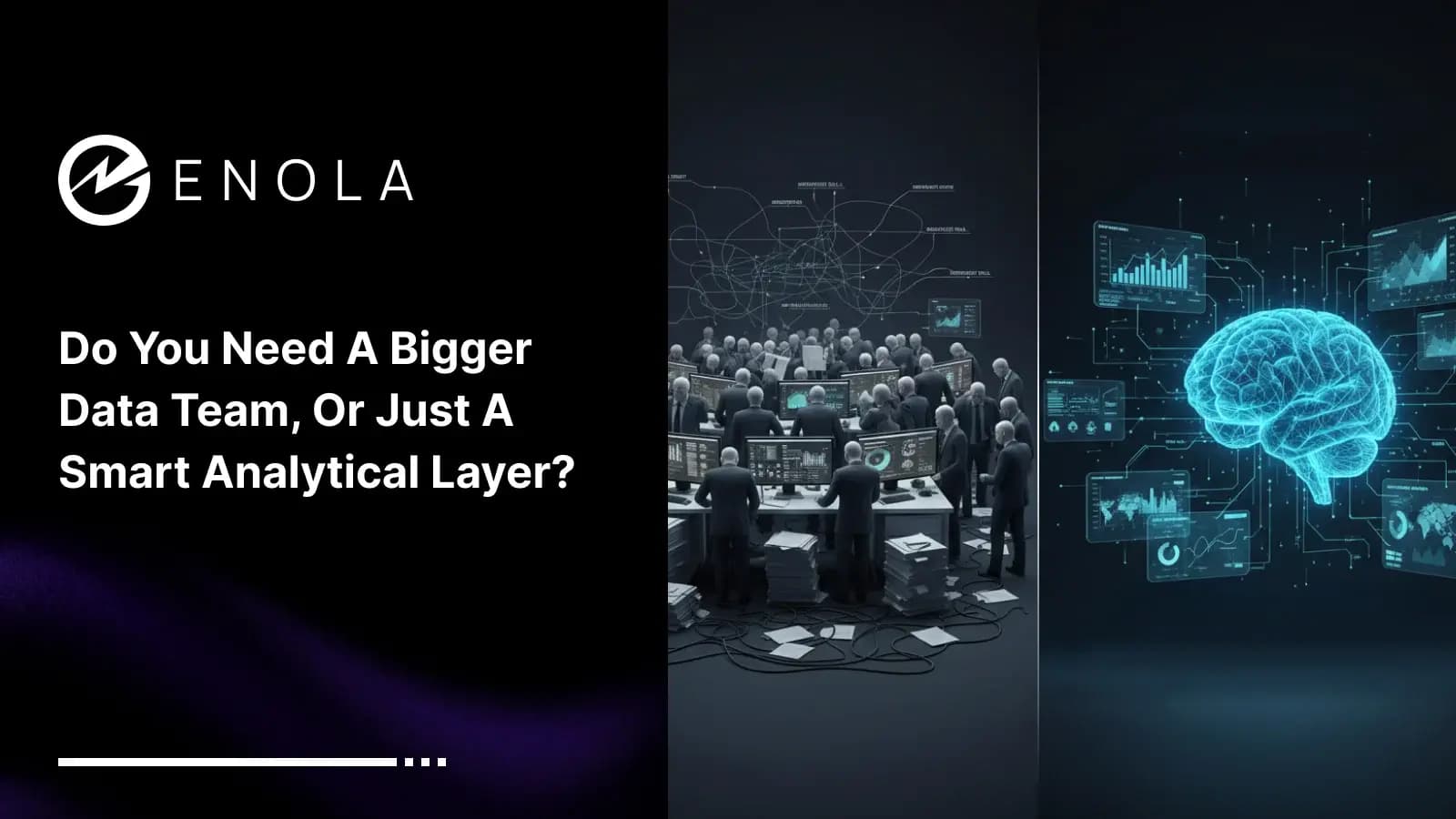
I have spent more than two decades watching companies assume that the only path to better decisions is more analysts. If you double the team, you get double the insight. That is the theory. Yet when I look inside the organizations struggling the most with decision speed, they already have a great analytics team. What do they not have? A system that helps business users and those analysts think together in a coordinated way.
People tend to picture analytics as a collection of tools. Dashboards over here. Data pipelines over there. A data warehouse or lake somewhere in the corner. All of it is necessary, and none of it is sufficient. The part that determines whether a question turns into an answer is something most teams never name: the analytical layer.
This is the layer that interprets the business question, understands the data landscape, applies structure, checks assumptions, and translates results into decisions. When this layer is weak or scattered across too many hands, insight slows down, no matter how many analysts you hire. The bottleneck is not people. The bottleneck is uncoordinated reasoning.
A senior analytics leader once told me, half joking, that his team spent more time figuring out what they were trying to answer than actually answering it. He was not wrong. Teams waste hours arguing metric definitions, clarifying business scope, hunting for the right tables, rewriting outdated logic, and debating whether a correlation is real or a data artifact. None of this is visible in dashboards, yet all of it determines the quality of the final answer.
The irony is that most companies think they have a data problem when, in fact, they have a reasoning problem.
The Myth of the Bigger Team
When deadlines pile up, the reflex is simple. Hire more analysts, expand the BI team, bring in another data engineer, and keep hoping that throughput increases with payroll. It rarely does.
New analysts join an environment where institutional knowledge sits in scattered documents, legacy dashboards, stale SQL, and a handful of subject matter experts who spend their days translating the same rules again and again. The cognitive load never lifts. The team expands, but the analytical bottleneck stays exactly where it was.
Insight does not grow in proportion to headcount. It grows in proportion to how well a team can coordinate its reasoning across people, data, and tools.
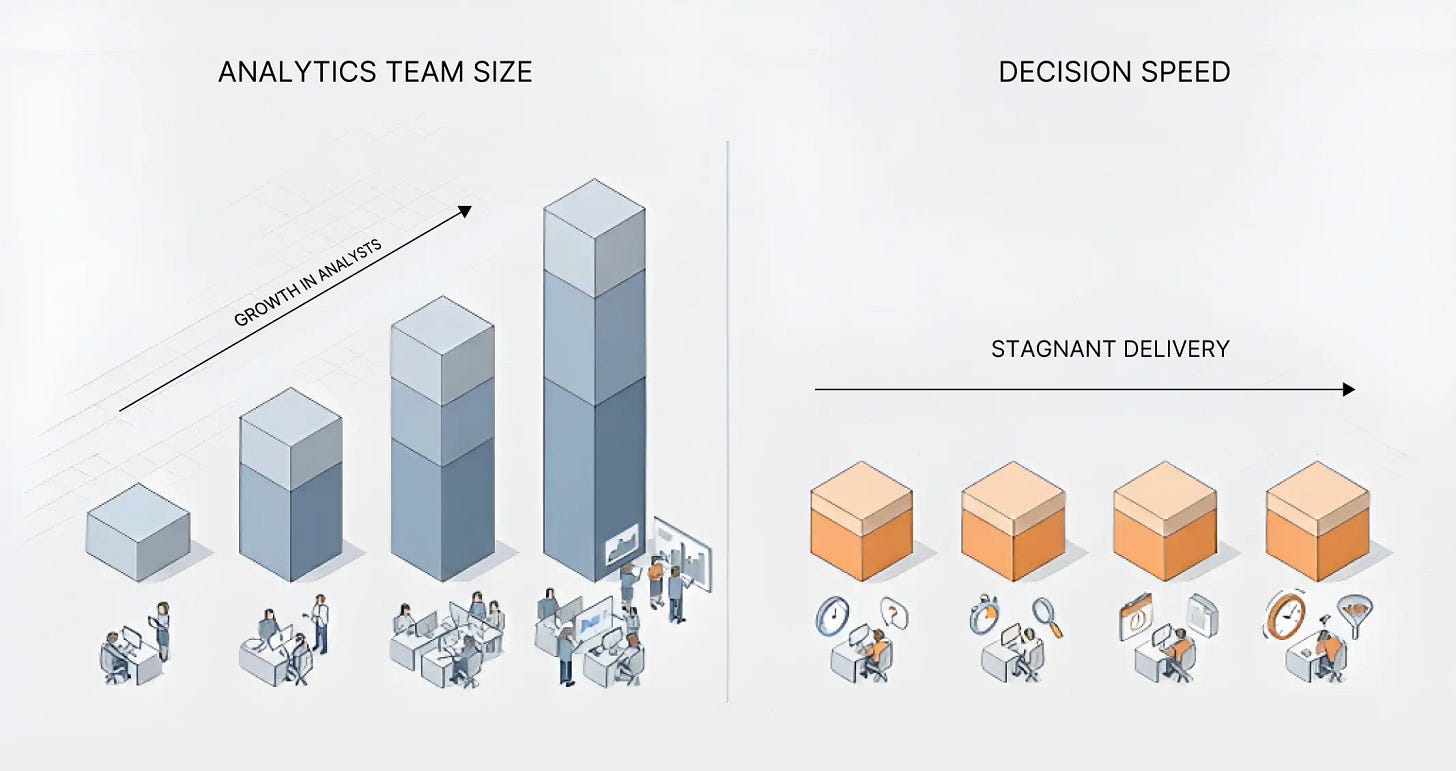
I often ask leaders a simple question. If ten analysts all tackled the same problem, how many would follow the same approach? Each analyst carries a different mental model of the business, a different memory of which metrics have quirks, and a different intuition about which data source to trust. They are all bright people solving the same puzzle in ten different ways.
That difference is not a failure of talent. It is a failure of orchestration.
Where the Real Bottleneck Lives
The analytical layer is the part of the process that turns a vague business question into a specific, testable analysis plan. It is the part that matches the intent of the question to the right metrics, the right tables, and the right methodology. It is also the part that keeps everyone honest about assumptions and constraints.
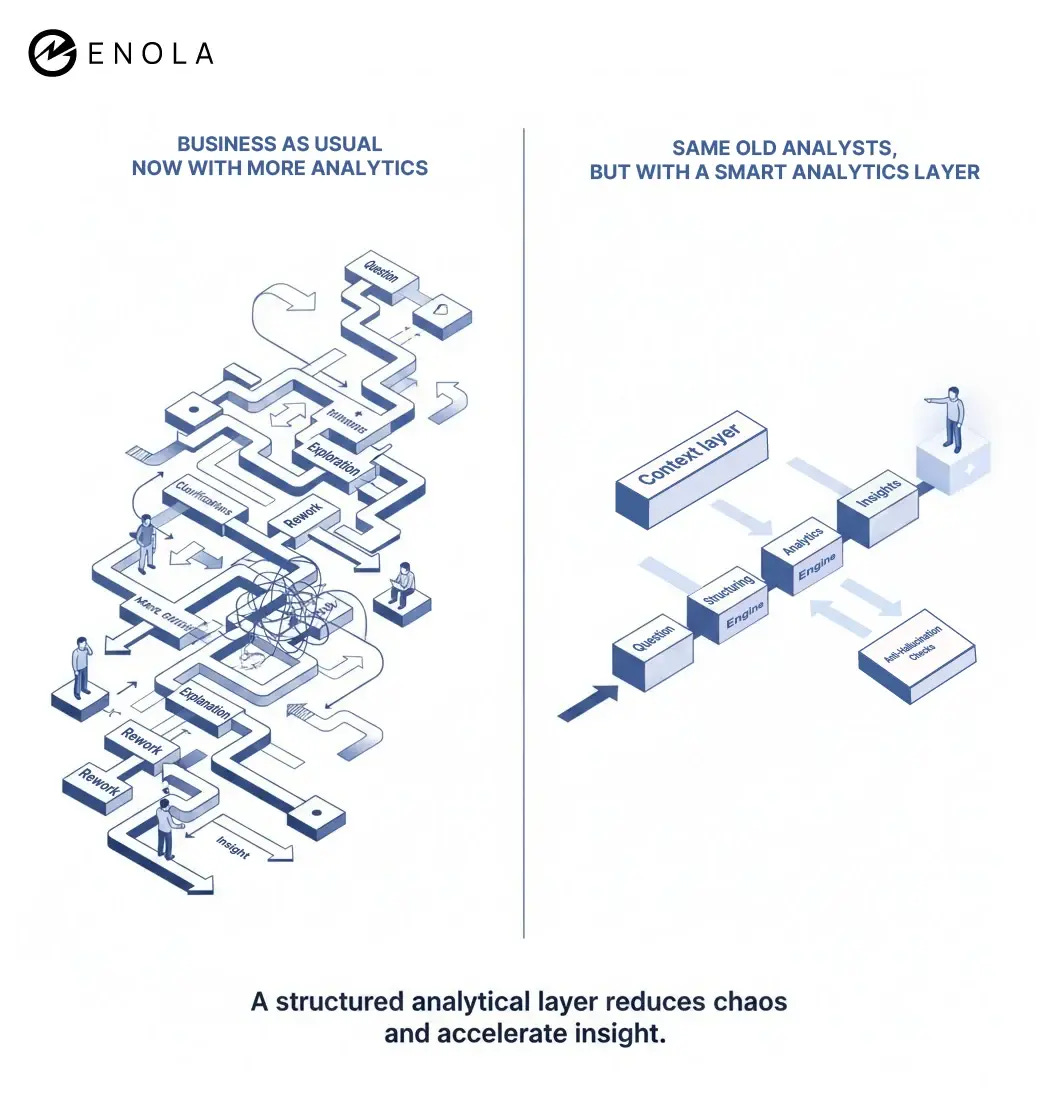
Most teams do this work manually. A PM asks a broad question. An analyst rephrases it. Someone clarifies the scope. Someone else asks about the timeframe. The analyst identifies possible drivers. A rough plan is formed. More clarifications follow. By the time the analysis starts, half the cycle has already been consumed by process instead of thinking.
This is where AI has the potential to change the game, although not in the way many people expect. The value is not in replacing analysts. The value is in supporting the analytical layer so that analysts can spend their time interpreting business impact rather than wrestling with structure.
The new generation of analytical engines does something different from traditional GenAI. These systems do not simply answer questions. They run the reasoning sequence. They interpret the question. They check context. They design the hypothesis table. They map the right fields. They select the methodology. They validate the output. That orchestration is what expands capability without expanding headcount.
I watched this play out recently in an e-commerce business that wanted to understand its 2024 revenue drivers and use those insights to plan for a 10 percent increase the following year. A typical team would gather the analysts, pull reports, debate the time window, dig into SQL, and spend days refining priorities before any analysis even began.
Instead, the analyst began with a simple question to an analytical system. The system clarified the business scope, the stakeholders, the timeframe, the internal factors worth testing, and the criteria for validation. It built a structured hypothesis table across product categories, promotions, customer income levels, regions, and customer education.
Once the analysis started, the engine executed the tests end-to-end. The results were clear.
Three product categories accounted for over 60 percent of revenue. High-income customers delivered significantly higher revenue per transaction. Promotions produced modest gains. Geography and education added incremental impact.
The real breakthrough came when the system translated those findings into business action. Expand investment in the highest performing categories. Target high-income segments with tailored campaigns. Increase promotion participation in specific customer cohorts. Quantify the expected lift from each action and tie each one to the 10 percent growth goal.
This is the analytical layer in action. The reasoning is not diluted by endless back-and-forth. The analyst stays in control of the business logic. The system handles the coordination that usually drags a team down.
If you want to see what this analytical layer feels like in practice, you can try Enola, an AI Super-Analyst. Just upload a CSV, ask a real business question, and watch how quickly the structure appears. It is a small glimpse into what the future of analytics looks like.
One analyst with this kind of support can outperform an entire team that works through manual workflows. Not because the analyst is smarter, but because the layer above the data is.
What a Smarter Analytical Layer Looks Like
The smartest systems today are built around two capabilities that teams have struggled to scale on their own.
The first is context. A good analytical layer is connected to a context layer that preserves knowledge about metric definitions, table structures, data lineage, and business rules. It knows which fields map to which concepts. It understands how revenue is calculated in your company and how customer segments are defined. This is the guardrail that keeps the analysis grounded in the real business rather than generic assumptions.
The second is orchestration. Good analysis always involves a chain of steps. Interpret the question. Define the hypotheses. Select the data. Validate the assumptions. Run the test. Review the output. Translate it into decisions. When these steps function as a single coordinated workflow, quality rises and time falls.
Analysts are not replaced. They are elevated. Their judgment becomes the input and the reviewer. Their time shifts from building scaffolding to evaluating impact. The team becomes smarter without becoming larger.
Where This Leaves Business Leaders
I tell executives something that usually surprises them. You do not need more analysts to make your organization smarter. You need to reduce the cognitive waste that drains the analysts you already have.
Every leader wants a team that can move from question to answer without friction. That requires an analytical layer that can hold context, orchestrate reasoning, preserve institutional memory, and support the natural way humans solve problems.
The companies that build or adopt this layer do not race to add more people. They race to add more intelligence to the process itself.
That is the shift that will define the next era of data-driven decision-making.
This post was originally published on Piyanka Jain’s Substack.
Related Blog: