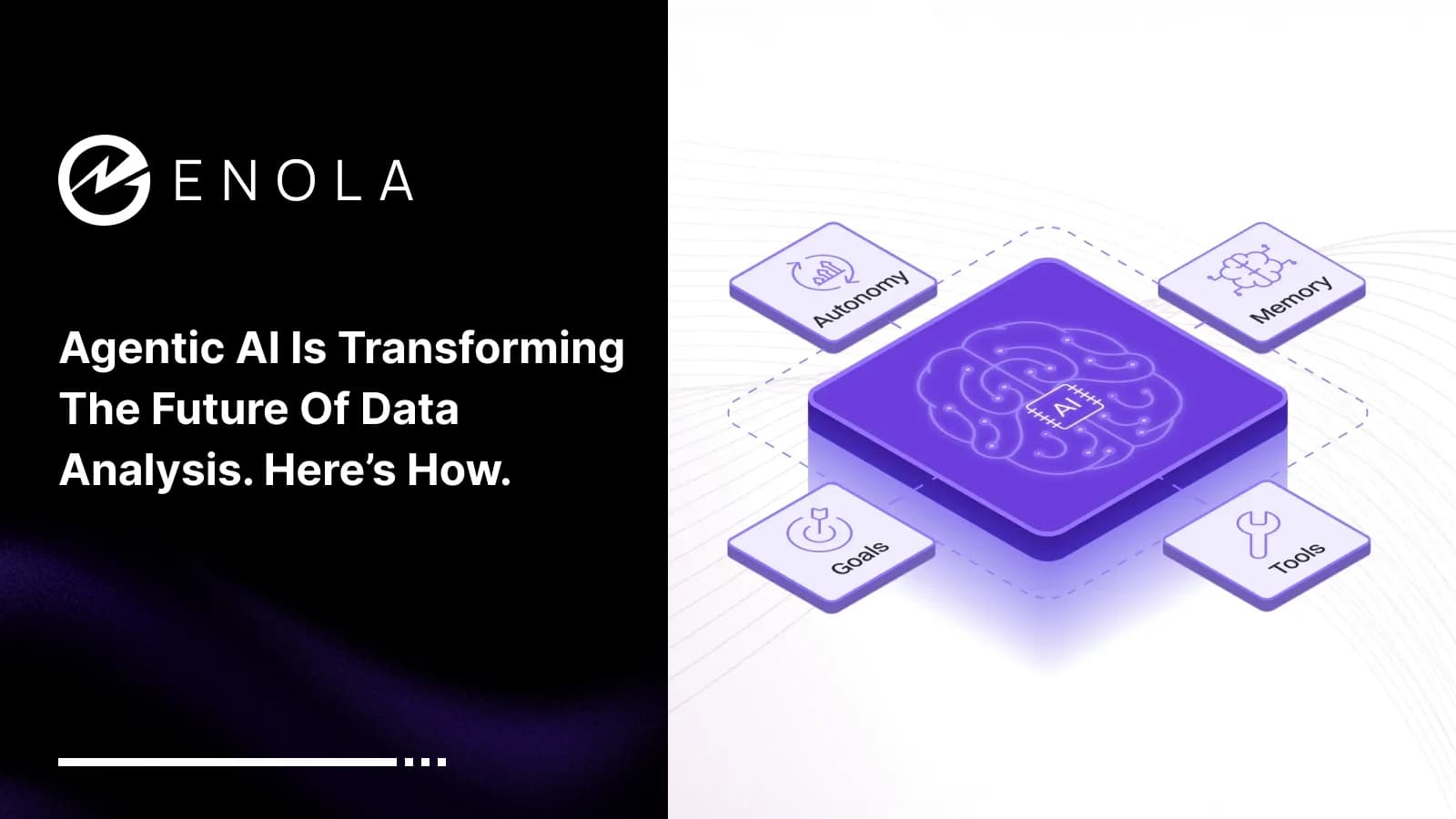
As markets adopt quicker decision cycles and real-time competitive intelligence, the way data analysis is conducted is shifting dramatically. The development of proactive agentic AI systems that respond and act in advance of queries has showcased a coordinated outlook on what the future of data analytics will look like.
As businesses manage bigger datasets, more complex customer journeys, and rapid market shifts, a common question arises: “Will AI replace data analytics?” The answer is no. AI doesn’t replace the need for human-led analysis or judgment. However, agentic AI is transforming how analysis is performed, how insights are generated and acted upon, and how teams interact with enterprise data. Instead of replacing analytics, AI is reshaping the analytical process itself, automating routine interpretation, accelerating decision cycles, and enabling analysts to focus on strategic thinking.
At AskEnola, we see agentic AI as the next major leap towards artificial intelligence in data analysis. This evolution transforms analytics from a retrospective function into a dynamic, forward-looking decision partner.
Limitations of Traditional Data Analysis
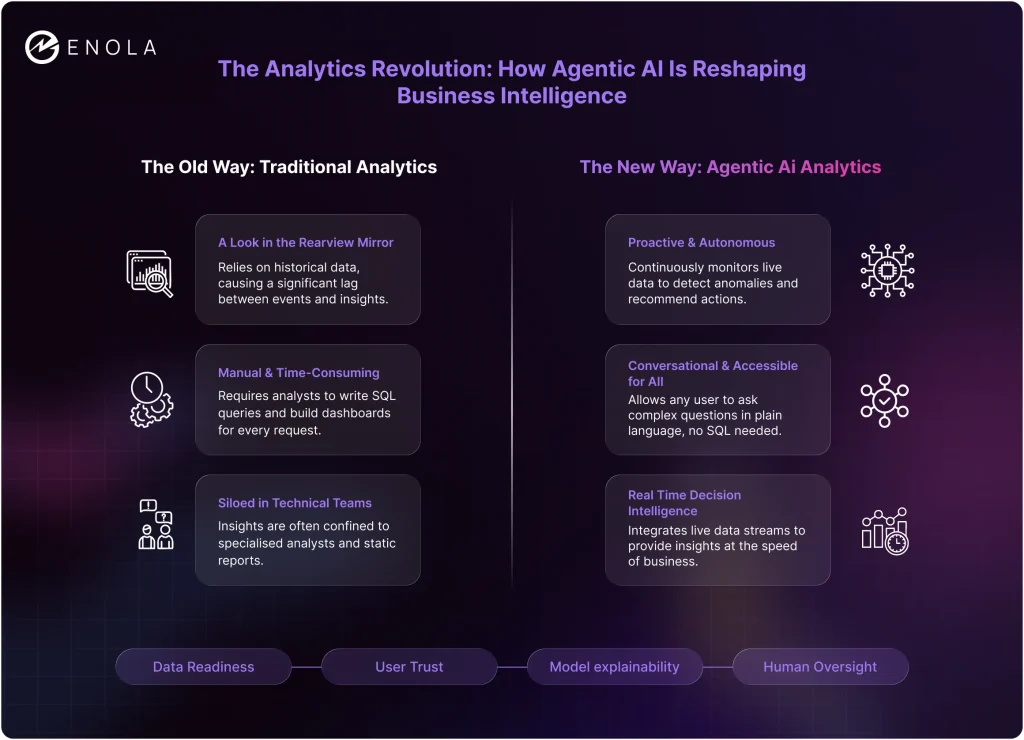
Analytics teams have traditionally operated through manual dashboards, slide reports, and data extracts to monitor business performance – they have always looked in the rearview mirror in some ways. Be it analyzing a week’s worth of revenue, looking back at churn for a month, or tracking behavior trends over a quarter, traditional analytics inherently use data snapshots that lag actual business conditions.
For analysts scrutinizing customer behavior, product performance, market fluctuations, etc., these delays are huge in terms of business impact. Even a delay of a few hours could mean a missed opportunity, a strategy decisively drifting into the wrong direction, or a slow response to competition.
Traditional processes do not merely require manual intervention. The analysts have to set up dashboards, write SQL queries, and interpret insights accumulated for long hours; in some cases, the very work of clarifying requirements form a non-analyst business user could take days. These limitations are precisely where Agentic AI is looking to set up a strategic frontier for the future of analytics.
What Makes Agentic AI Different?
Agentic AI represents a new category of analytical intelligence. Instead of solely creating visualizations or summaries, the agentic AI system functions as a collaborative analytical partner, enhancing the process of understanding and decision-making. They can significantly help:
- Continuously monitor live data streams
- Detect anomalies and emerging patterns autonomously
- Explain insights in plain language
- Predict likely outcomes
- Recommend specific actions based on context
- Trigger workflows or alerts when conditions change
This is a step beyond traditional automation. Agentic AI combines real-time ingestion, natural-language reasoning, and machine learning to transform analytics from passive reporting to proactive intelligence.
Live Analytics That Keep Pace With Business
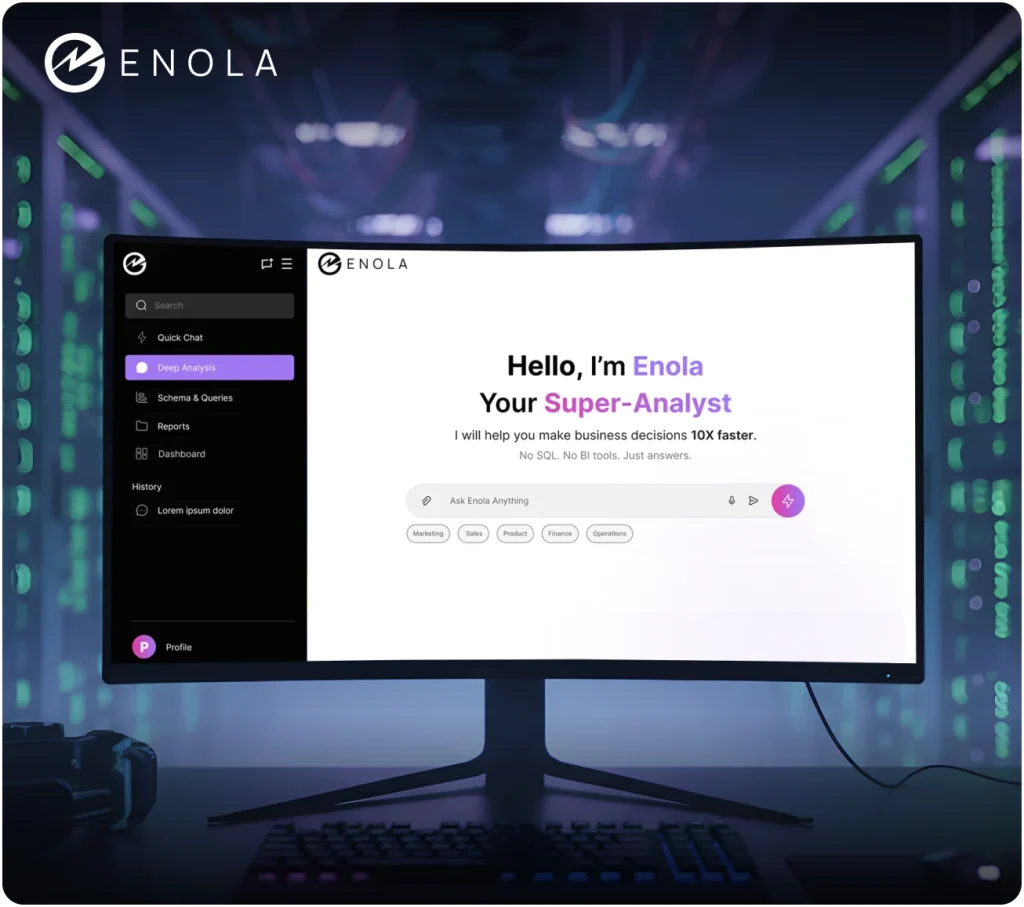
Agentic AI utilizes real-time insights through the integration of streaming data from CRM, marketing platforms, product telemetry, and operational systems. This real-time visibility is essential for the data analysis future, where speed of reaction directly impacts revenue, customer engagement, and market positioning.
Natural Language Interaction for Every User
One of the most transformative capabilities of agentic AI is natural-language querying. Analysts and non-technical teams alike can ask conversation questions such as:
- “What customer segments are trending down this week?”
- “Explain why revenue dipped yesterday.”
- “Show a forecast for Q2 based on current demand.”
No need for SQL, dashboard building, or manual translation. When given an input, a conversational agent recognizes the intent and answers it well with the most relevant data charts and the ensuing narrative. By so doing, this AI tool undoubtedly extends the access of generative AI for data analytics to all levels of the organization, not only to data analysts.
Proactive Insights and Recommendations
Traditional dashboards show metrics; agentic AI working with the right contextual and analytical layers can explain meaning and suggest actions. These systems continuously scan data for correlations, behavior shifts, and deviations from expected performance. When a change occurs, the AI not only highlights it but also provides root-cause analysis and prescriptive recommendations.
Scaling Insight Across the Organization
Democratization is a key advantage of agentic AI in analytics. No longer will insights be confined to dashboards, spreadsheets, or specialty tools. In addition, now all employees can ask questions in this place, with or without tech expertise, for this is the component of actionable data.
Instead of spending hours generating reports, analysts can focus on strategy, modeling, experimentation, and cross-functional coherence. Agentic AI will handle what most analysts find mundane and routine, thereby leaving them some time to steer the company’s decision-making.
This is the point at which the question “Will AI take over data analytics?” becomes pertinent: AI will undertake the task of managing repetitive and manual work for humans to dedicate themselves to decisions of high impact that require experience and context.
Challenges to Consider As Agentic AI Evolves
While the momentum is clear, organizations must address several considerations as they adopt agentic AI:
- Data readiness: Ingesting the same is made more complicated by demanding unified, accurate, and well-governed data.
- User adoption: Teams must believe in the quality of intelligence produced by AI-backed insights. This means an acceptance of moving from reporting to intelligence.
- Explainability: The black-box model is unacceptable. Transparency in the way insights were derived brings confidence.
- Human oversight: AI guides; humans decide. But oversight must still exist for very important reasons, such as ensuring ethical judgment, maintaining accountability, and preventing errors or biases from going unchecked.
AskEnola’s Role in Shaping the Future of Agentic Analytics
At AskEnola, we believe the next decade of analytics will be defined by proactive, intelligent systems that support real-time decision-making. Our platform represents this shift by replacing manual workflows with an adaptive, conversational, and autonomous intelligence engine designed for analysts and business users alike. This approach reduces the gap between insight and execution, a key requirement for organizations navigating the data analysis future.
With support for real-time ingestion, anomaly detection, root-cause exploration, and proactive alerting, AskEnola helps analysts spend less time on repetitive analysis and more time guiding strategy.
As agentic AI becomes central to the future of analytics, AskEnola’s mission is clear: empower every business user to make confident, data-driven decisions at the speed of modern business. The emergence of agentic AI is the foundation of a smarter, more responsive era of analytics, and AskEnola is committed to leading that evolution.
Related Blog: