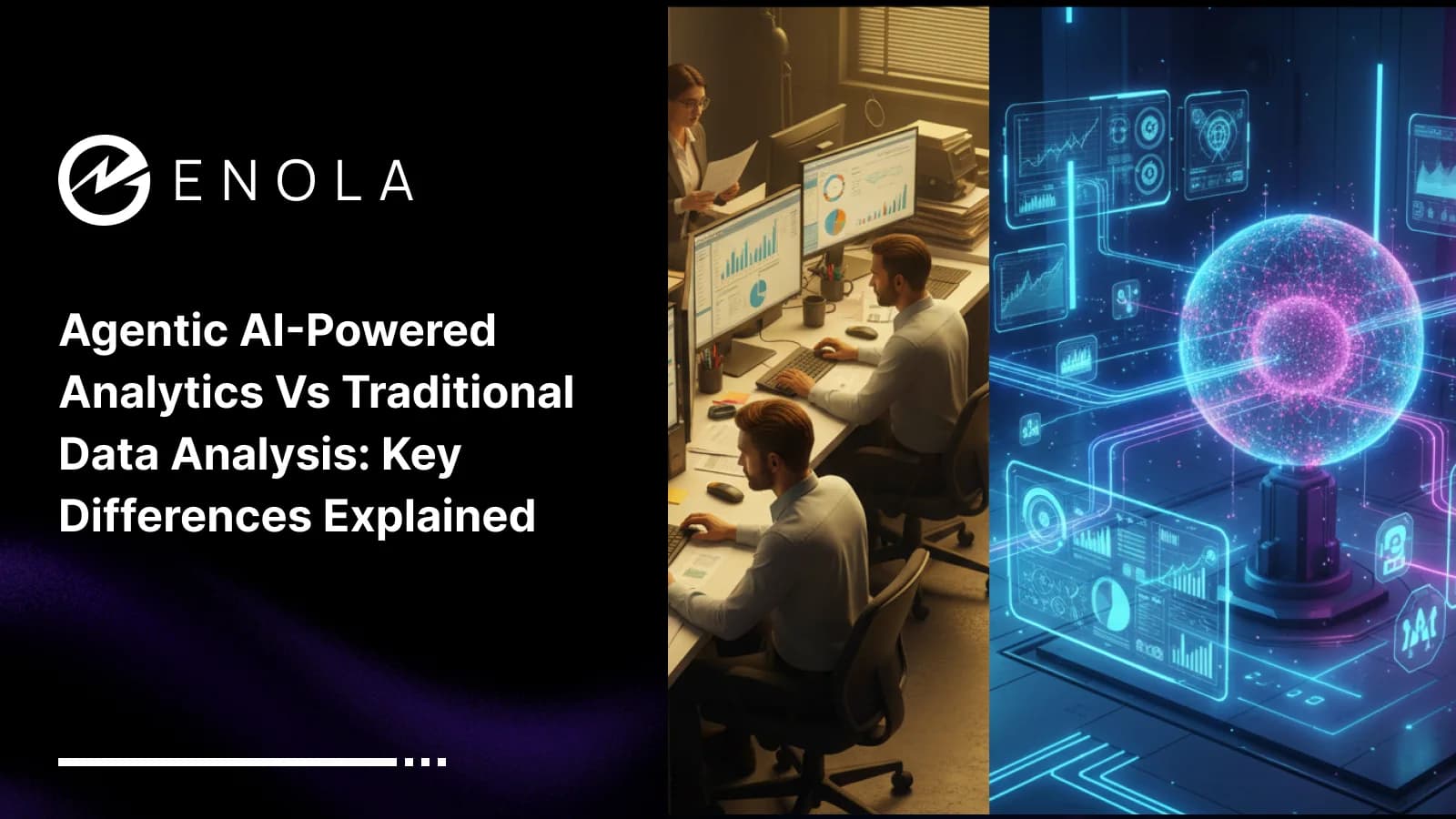
The roles of data analytics and artificial intelligence are advancing rapidly, and 2025 has been a pivotal year for businesses seeking faster, more intelligent, and more purposeful insight. Traditional data-analysis methods, once widely relied on to understand business performance, are now becoming less effective as companies need real-time insights to keep up with the large volume of data.
The development of agentic AI-powered analytics represents a new generation of analytics that provides businesses with a new approach to generating, interpreting, and implementing analytics. Traditional analytics require human intervention to generate reports, whereas agentic AI leverages independent data monitoring, real-time intelligence, and contextual decision-making in order to make recommendations and trigger actionable decisions.
At AskEnola, we see this shift with clarity. Agentic AI is becoming the baseline for modern decision-making. With AI-driven analytical engines and conversational interfaces, modern AI analysis systems enable every user to explore data, uncover patterns, and respond in real time.
Let’s explore how agentic AI-powered analytics differs from traditional data analysis and what this shift means for organizations.
What is Traditional Data Analysis?
Traditional data analysis relies on structured workflows: collecting data, cleaning it, preparing models, creating dashboards, and interpreting results. Analysts manually review the dataset, formulate queries, and create a report or presentation of insights. This process works well for retrospectively evaluating past performance or tracking an organization’s day-to-day activities, but traditional data analysis becomes more challenging as companies need to make decisions and take action quickly. With large volumes of data and a rapidly evolving marketplace, traditional data analysis often falls short of the speed and reliability required for companies to scale as quickly as needed.
In many instances, the results often lag behind real-time events. For analysts navigating fast-changing consumer behavior, competitive moves, or economic signals, this results in slower response cycles and missed opportunities.
What is Agentic AI-Powered Data Analytics?
Agentic AI introduces a fundamentally different approach to AI in data analysis. Unlike traditional systems that only answer queries, agentic AIs act as independent analytical agents, continuously learning, reacting in real time, and suggesting relevant decisions based on data. This is not just automation of analytics; it is the use of adaptive intelligence to accomplish this.
The combination of agentic AI’s machine learning algorithms, reasoning models, and real-time monitoring creates an integrated ecosystem. For organizations that compare data analytics vs artificial intelligence, agentic systems showcase how AI elevates analytics from descriptive tasks to dynamic decision engines.
Related Blog: What Is AI Analytics? A Complete Beginner’s Guide
Key Differences Between Agentic AI and Traditional Data Analysis

While traditional analytics techniques help groups organize and interpret information, agentic AI systems evaluate, learn, and execute activities independently, at a rapid pace. This transformation is not only technical but also changes the way analysts obtain their information and the pace at which they can use it. Below are some key differences between agentic AI & traditional analytics
1. Proactive Intelligence vs Reactive Reporting
Traditional analysis is inherently reactive. Analysts would check their KPIs, build dashboards, and run queries manually. While these reports may provide insight into trends, they take time to build.
Agentic AI provides the ability to proactively monitor real-time data streams and identify shifts as they happen, alert users before they become a problem, and highlight new opportunities by analyzing frequent patterns. The concept of proactive intelligence is crucial for organizations looking to analyze AI and analytics while evaluating how AI will shift the focus from “what occurred” to “what action should be taken now”.
2. Broader Data Coverage and Interpretation
While traditional analysis is strongest with structured data, it often overlooks valuable unstructured signals, such as text, voice transcripts, behavioral patterns, logs, or social sentiment.
Agentic AI can interpret all of these data types with ease. By merging data analytics and artificial intelligence, organizations can uncover deeper narratives behind customer behavior, operational issues, or market fluctuations.
3. Autonomous Decision Cycles vs Manual Workflows
Traditional analytics workflows require analysts to execute nearly every step manually, data preparation, exploration, interpretation, and communication.
Agentic AI automates much of this lifecycle. It detects anomalies, runs simulations, generates recommendations, and in some cases initiates automated responses. This allows analysts to focus on strategic reasoning rather than operational tasks, making AI-powered data analytics a catalyst for productivity and higher-value analytical work.
4. Real-Time Responsiveness vs Batch Processing
Traditional forms of data analytics often use the concept of batch processing or scheduled updates. This means that information collected by traditional analytics tells you about the past, but does not provide you with the latest information about what is happening right now.
Agentic AI processes information immediately based on current market movements, customer signals, and operational disruptions as they occur. This agility is an advantage when comparing data analytics vs artificial intelligence capabilities.
5. Scalability Without Additional Complexity
As companies begin to integrate new sources of data, it becomes increasingly difficult to maintain traditional workflows. As you add more sources of data, you require additional engineering, integration, and manual upkeep.
Agentic AI automates many of these processes for engineers, allowing teams to significantly increase their analytical coverage while reducing the additional workload associated with maintaining traditional workflows. With the use of Agentic AI, market analysts can gain greater insight and create more frequent reports while reducing friction throughout the reporting process.
How Agentic AI Redefines Modern Market Analysis

- Stronger Strategic Leadership and Influence
Agentic AI allows analysts to shift from report creators to strategic advisors. Instead of spending hours generating routine dashboards, analysts can focus on long-term planning, risk analysis, and growth strategies.
- More Accurate and Adaptive Forecasting
When forecasting models update continuously, predictions become far more reliable. Agentic AI adjusts instantly as new data arrives, resulting in projections that reflect real-time market and consumer dynamics. This empowers analysts to evaluate scenarios, anticipate disruptions, and propose evidence-backed recommendations with higher confidence.
- Improved Decision Quality and Consistency
Agentic AI strengthens decision-making by grounding recommendations in current and complete data. Patterns that traditional analysis might miss are surfaced immediately, reducing the chance of bias or oversight.
The Future of Agentic AI in Analytics
Artificial Intelligence is evolving rapidly, driven by new technologies that enable organizations to operate at greater speed, automation, and sophistication in an ever-evolving environment. Agentic AI does not replace the analytical skill set of an analyst; rather, it offers a way to take analytical skills to the next level by allowing the analyst to gain greater insights from their data, act more quickly, and lead their organizations strategically.
At AskEnola, this evolution defines our perspective. Data should support every decision the moment it’s needed, not after the moment has passed. Self-service should feel like empowerment, not another process to manage. Analytics should help teams act with confidence, not wait for confirmation. That’s the transformation shaping the future of intelligent decision-making in 2026 and beyond.
Related Blog: