In the U.S market today,, where speed, accuracy, and insight determine competitive advantage, the classic analytics dashboard finds its role being challenged. With businesses generating data at unprecedented rates, relying on static charts and manual interpretation is no longer sufficient. At AskEnola, we believe that AI in business intelligence is changing the very way people make decisions. In the past, dashboards used to be look-back tools, but today organizations require real-time decision-making systems. This shift is driven by AI-powered analytics that replace dashboards with intelligence engines that act in lockstep with the speed of business.
The Limitations of Traditional Dashboards
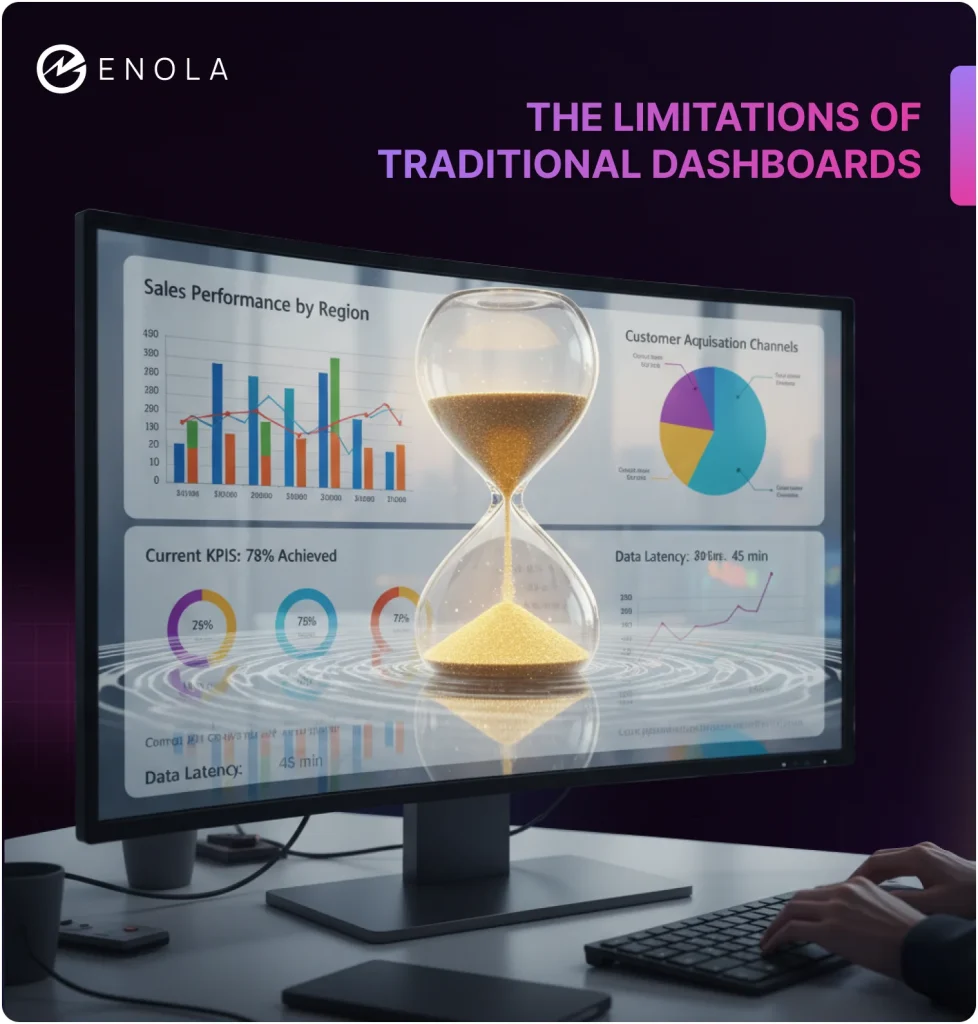
For years, dashboards have been helping analysts. They collect, display key performance indicators, and trend lines for users to look at trends existing in the business metrics. By norm, the very nature of a dashboard is a retrograde mechanism. It is a reflection of what has gone by and considers data that is at least hours away, if not days. For the market analyst tasked with studying factors such as shifts in customer behavior, competitive positioning, or market adoption, that delay is profound.
Besides that, dashboards require manual setup most of the time. Analysts specify the measures, create the visuals, create the queries, and then review them regularly. This workflow delays insights that are scaled down and constraints decision-making to what has already happened in the past. If business variables were to change rapidly, these insights would be worthless by the time this change settled down.
The Rise of AI-Generated Dashboards and Decision Engines
Enter the era of AI dashboards and intelligent decision engines. These systems are far beyond mere display. They gather data, many times with real-time capability, apply machine learning and predictive models, automatically bring forth actionable insights, and suggest “next steps” for the user to implement. In essence, a dashboard gets thrown out of the window for a highly interactive platform wherein dynamic processing of context is given instructions to generate strategy and tooling for skip-dashboards of AI analytics workflows.
By virtue of the new generation of AI-generated dashboard systems, market analysts are liberated from spending multiple hours on building visuals; instead, they ask questions in interpreted results and act upon recommendations. It being a shift means that now the tool itself does not simply sit there watching; rather, it takes on an active role, espousing a future view of dashboards: that dashboards are alive, adaptive, and made for decision-making rather than monitoring.
Key Technologies Driving the Shift
Multiple new technologies are driving the evolution toward AI-first, real-time analytics.
Data streaming and live ingestion
Modern architectures support the streaming of data from marketing platforms, from product telemetry and customer events, and third-party sources. This, in turn, helps AI-powered business intelligence systems to continuously consume fresh information, in lieu of working with information updated in batches overnight.
Anomaly and pattern recognition
AI models, in a feed-the-data paradigm, will always be on the lookout for patterns, deviations, and emerging trends. A conventional dashboard just presents the numbers. AI engines interpret those numbers and flag what matters most.
Natural language query and conversational analytics
Some analysts would probably phrase it differently in plain English: “What customer segment is declining this week, and what is the recommended action?” The system returns with insights, visualizations, and the next best steps for any coursework or clients, really. And so it moves from static dashboards to decision-making tools in real-time and interaction.
Prescriptive analytics and decision recommendations
The next-generation platforms don’t limit themselves to “Here is what happened.” They go one step further: “Here is what you should do next.” This is how AI-analyzed analytics truly switch an organization from passively reporting to actively supporting decision-making.
Real-Life Applications for Market Analysts
Here is how this technology brings real business value across several areas:
1. Campaign performance in real time
Instead of waiting to check a dashboard after the campaign has run, analysts get to see the performance within minutes and get alerted if there is a drop in response. Also, the system recommends relevant adjustments. We support AI-based dashboards that go from monitoring to recommending.
2. Customer churn and retention
AI models monitor customer usage, support interactions, satisfaction, and behavioral shifts in real time so that when risk indicators are triggered, analysts can receive actionable insights and implement retention initiatives proactively.
3. Product adoption and feature rollout
AI analytics deliver immediate adoption metrics on segments, usage patterns, and feedback scores for new features or releases. Analysts can jump to recommending further messaging, targeted outreach, or product changes much faster than regular dashboard approaches.
4. Revenue forecasting and scenario simulation
Static forecasts are replaced with dynamic models that update with streaming data. The analyst might implement a set of “what if” scenarios leading to decisions regarding channel, promotions, or pricing through AI in business intelligence.
Each application offers insight into the dashboard metamorphosis into a living decision engine capable of enabling faster and more informed choices based on the current context rather than historical hindsight.
Why This Matters Now
The U. S. market environment requires agility and insight. Market analysts are loaded with the duties of creating value fast, responding to competitive disruptions, and adjusting strategy based on real-time signals. In this context, a pre-pandemic view of dashboards is not relevant any longer.
When analytics is AI-powered, organizations transition to capabilities that unlock the fast movement of ideas and acting upon the intelligence. Analysts become partners in strategy rather than reporters. Decisions go from reactive to proactive. The shift from monitoring to decision making is not an option; it is a necessity.
Challenges and Considerations
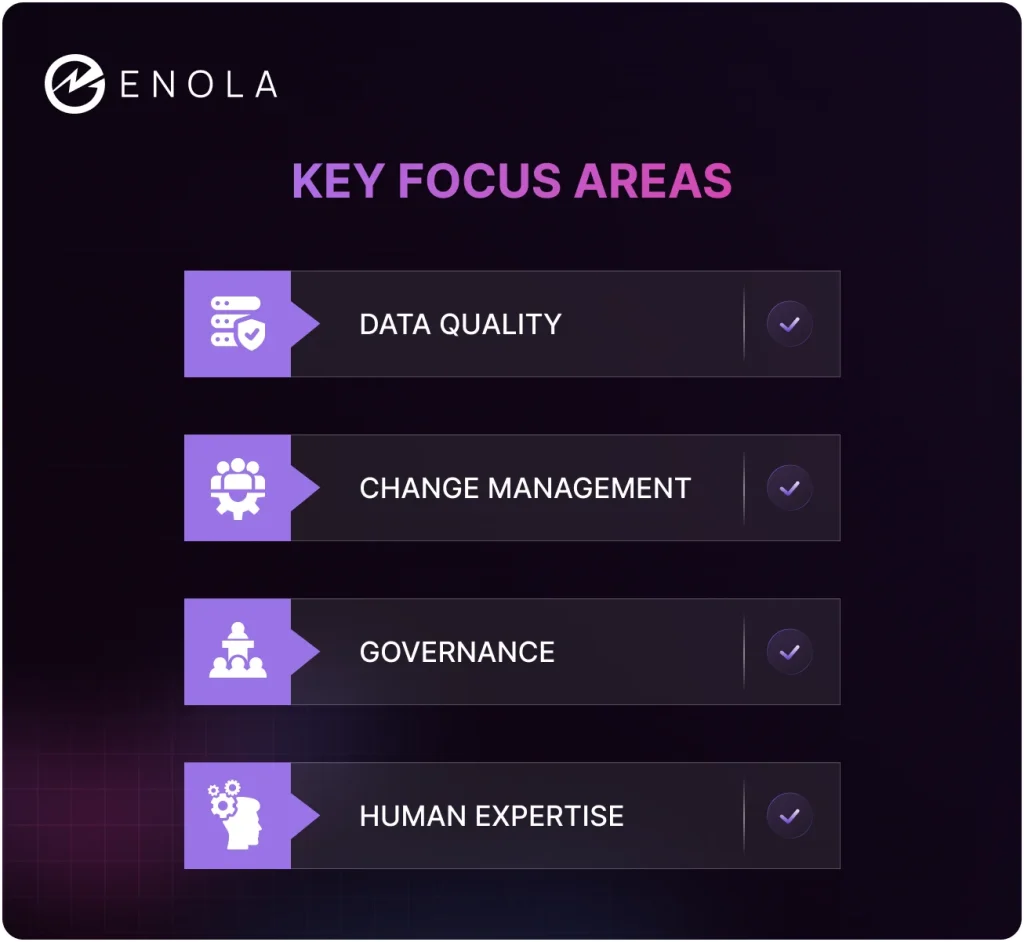
While the benefits are apparent, a lot more goes into successfully implementing an AI system that replaces dashboards with decision tools:
Data readiness
Real-time ingestion requires comprehensive data pipeline management, source integration, cleansing, and alignment. Without reassuring quality, data-based insight can become faulty or misleading.
User adoption and trust
On becoming analyst-level business persons have to come to an understanding of trusting an AI recommendation. It could also be considered a behavioral shift from “I look at a dashboard” to “I act on AI insight,” which requires training, transparency, and change management.
Governance and explainability
In instances of AI-recommended decisions, the underlying logic must be made available for scrutiny and justification. Market analysts must ensure that all insight flows are auditable and in line with the business objectives.
Human oversight
AI never replaces human judgment. An ideal outcome is that human expertise, domain knowledge, and strategic thinking work hand in hand with AI for decision-making, where AI provides speed and precision.
AskEnola’s Approach to the Future of Dashboards
At AskEnola, we know that a smarter world will have decisions instead of more charts. Our solution has replaced static analytics with a decision engine on the fly, built for analysts and business leaders across U. S. markets.
With us, analysts could openly ask questions and get insights within seconds, and recommendations ready for implementation, eliminating the time analysts spent building or simply waiting for dashboards. From a technical viewpoint, the system integrates AI in business intelligence workflows, thereby diminishing the gap between insight and execution.
Our model ensures that any AI-generated dashboard is of the highest grade and incorporates a smart narrative with concrete recommendations for next steps instead of merely presenting some renderings. For an analyst studying market trends, customer behavior, or revenue strategy, this means less time building reports and more time guiding strategy.
Time is elusive, and data is in abundance. Hence, an ordinary dashboard is obsolete. The transition from dashboards to AI analytics is a strategic imperative rather than a technological upgrade. Market analysts that go about using ai powered analytics are setting their companies up for smarter decisions that move faster and are based on real-time insight.
With AskEnola, we empower you to go beyond monitoring into action. Real-time intelligence. AI-powered decisions. A future in which decisions are no longer delayed but are decisive. The time has come to replace dashboards with decision engines.
Related Blog: