
In today’s fast-moving business world, data is the backbone of every strategic decision that one makes. From revenue forecasting to understanding customer behavior, organizations rely on accurate insights to stay competitive. However, growing volumes have made manual analysis cumbersome and prone to error. This is where AI in data analytics is moving companies forward: automating complex tasks and revealing insights that were once hard to uncover.
A combination of data analytics and AI helps companies to process information faster, perceive trends well in advance, and make informed decisions with full confidence. For the market analyst, AI-powered analysis represents a shift from reactive reporting toward proactive and predictive decision-making.
AI in Data Analytics: A Background
Over the last few years, AI has greatly influenced data analytics across industries. Contemporary businesses use AI algorithms to work with big datasets, eliminating human intervention and increasing precision.
Traditional analytics used to take hours in data cleaning, generating reports, and testing models manually. AI performs these tasks on the fly by learning from historical data, spotting anomalies, and building insights in seconds. Meanwhile, with natural language processing (NLP), one can now ask questions in natural language and receive visual responses filled with meaning in an instant.
These developments have allowed analysts to spend more time working strategically and interpreting results rather than just performing monotonous work.
How to Use AI in Data Analytics
In order to understand how AI might be used within data analytics, one must first examine the different stages where AI creates added value.
1. Data Collection and Integration
AI systems primarily work with data pulled from multiple sources-clustered from cloud databases, CRMs, and social platforms-to standardize under one banner for analysis.
2. Data Cleaning and Preparation
The algorithms detect and repair data errors, missing values, inconsistencies, and the like at the same time, improving accuracy, saving time.
3. Exploratory Analysis
Some AI analytics tools detect correlations among the variables, choose the most conspicuous, and reveal hidden relationships in datasets.
4. Predictive and Prescriptive Modeling
AI predicts the outcomes based on trends, differing from traditional quantitative models, and prescribes the best alternative to choose from to achieve desirable results.
5. Visualization and Reporting
AI data analysis software translates the insight into visuals—thereby facilitating easy understanding and faster decision-making.
The purpose behind these few steps is to provide organizations with the best mechanism to decide, combining automatic analysis with an interpreting human factor.
Benefits of Using AI to Analyze Data
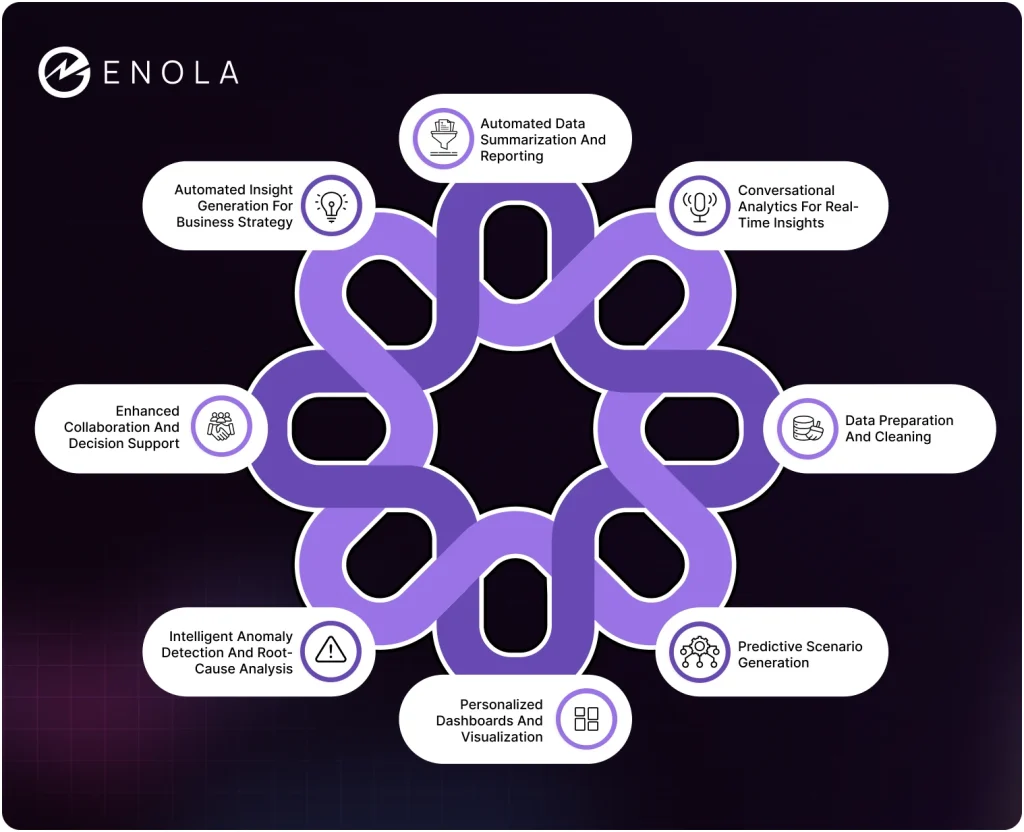
The benefits of using AI to analyze data are beyond automation. These are some of the key reasons:
- Speed: AI completes the analysis in minutes, whereas it would have taken humans hours.
- Accuracy: Automated processes reduce human bias and ensure uniform results.
- Scalability: AI-based analytics tools can process huge amounts of data, ranging from the terabytes of raw data to gigabytes or megabytes of well-modified data.
- Predictive Insights: AI predicts the outcomes so that the business can take proactive measures.
- Accessibility: These tools have a natural language interface so that even non-technical users can explore complex data.
Incorporating AI into analytics enhances the organizational ability to act and look into the future.
Choosing the Right AI Analytics Tool
Choosing the appropriate AI analytics tool depends on the business objective and the nature of the data being dealt with. You should choose for:
- Ease of Use: The platform should feel intuitive — ideally offering no-code or low-code options so that even non-technical teams can use it effectively.
- Integration: It must integrate seamlessly with existing data warehouses such as Snowflake or BigQuery to ensure unified data access.
- Scalability: The tool should be capable of handling large and growing volumes of data without compromising performance.
- Automation: Look for solutions that can automatically clean, analyze, and visualize data to minimize manual effort.
- Customization: The ability to create tailored dashboards helps teams focus on the metrics that matter most to them.
If chosen well, the right tool effectively bridges the gap between the technical and the strategic.
Applications of Data Analytics and Artificial Intelligence
Data analytics and artificial intelligence are applied in many industries:
- Marketing: Forecasts customer preferences and optimizes campaigns.
- Finance: Detects fraudulent transactions and foresees risks in the market.
- Health care: Analyzes patient data for quicker and accurate diagnoses.
- Retail: Demand forecasting, inventory management, and logistics.
- Customer Support: AI-powered chatbots analyze queries and propose solutions.
All these applications show that AI builds immediate and strategic value on data.
Challenges and Considerations
Some challenges, though, do remain when using AI to analyze data:
- Data Privacy: The organizations should maintain the regulations, be it GDPR or CCPA.
- Bias in Models: The actual result can be misrepresented if the training dataset is skewed.
- Human Oversight: The human analyst should be able to confirm and judge the AI-derived insights, largely from a contextual perspective.
- Cost: Acquiring AI software for advanced data analysis and infrastructural development, with end-user training, comes at a price.
Therefore, a balanced approach should be sought between automation and human judgment for responsible and effective use of data.
The Future of AI Data Analysis
At the end of 2025, AI analytics will become the standard. The AI data-analysis software in the future will be able to anticipate the user’s needs, automatically bring insights forth, and provide explanations in plain language.
In the next phase of AI-driven data analysis, artificial intelligence will act as a true intelligence partner—working alongside human analysts rather than just serving as a tool. By 2026, AI and data analytics will enable faster, smarter, and more adaptive decision-making across industries.
GenAI is now a mainstream technology and no longer needs to be considered experimental. Adopting AI data analytics allows businesses to automate workflows, make decisions, and recognize patterns of innovation. How AI is used in data analytics is what turns an organization and its analyst from merely an information storehouse into actionable knowledge. AI is now empowering data analysis, not only making it faster but also making it considerably more intelligent.
Related Blog: