In 2026, organizations will rely more than ever before on fast, accurate, and context-rich insights to drive decision-making through rapidly shifting markets. As the volume increases while timelines for decisions shrink, analysts are moving away from traditional reporting methods and shifting to more advanced solutions powered by artificial intelligence.
AI does not replace the analytical process but complements it by automating the slow and iterative steps, thus surfacing patterns that would take a human much longer to find. This evolution is now changing how to use AI in data analytics in ways that will be practical and meaningful. To marketing analysts, there was a need to understand such applications to fulfill expectations in today’s decision-making environments.
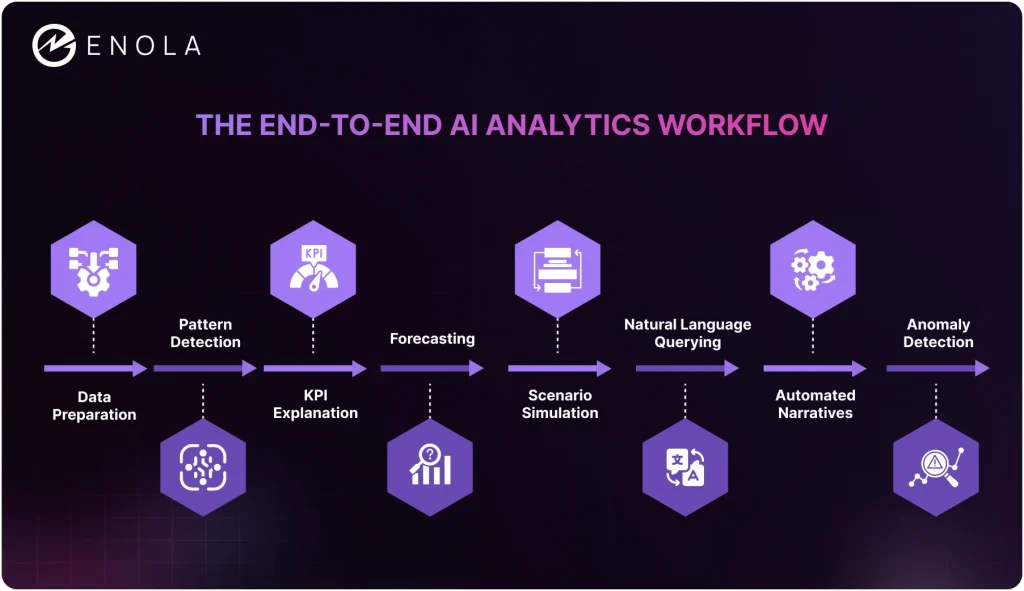
Following is a list of eight different and effective ways in which businesses can use AI for data analytics in 2026.
1. Automated Data Preparation and Cleansing
Data preparation remains one of the most time-consuming activities in analytics. Multiple sources of data, different formats, and inconsistent fields force analysts to spend hours cleaning a dataset before they can actually begin analyzing it.
AI considerably simplifies this step. Intelligent algorithms detect missing values, reconcile inconsistencies, standardize categories, and validate field relationships. Rather than investing hours in the preparation of data, analysts can comprehend insights and shape strategic narratives.
This is one of the most immediate, practical uses of AI for data analytics within an organization: reducing manual overhead while improving data accuracy.
2. Intelligent Pattern Detection and Correlation Analysis
AI systems analyze hundreds of variables simultaneously to create relationships that are not obvious by traditional analysis. This could refer to unexpected shifts in consumer behavior, hidden correlations between product characteristics and response rates, or subtle changes in the market dynamics driving demand.
This capability enables analysts to have a more complete view of the business. It also empowers teams to refine their hypotheses faster, enrich forecasting models, and make better decisions with richer evidence.
AI accelerates this shift from superficial reporting to deep, meaningful interpretation that lies at the heart of today’s modern AI for data analytics practices.
3. Real-time KPI movement explanations
For fast-moving businesses, knowing why the KPIs moved is as important as knowing that they moved. Traditional BI Dashboards require manual interpretation of the changes by analysts and multiple queries to drill down to root causes.
AI does this by providing instantaneous, context-aware explanations whenever the key metrics move. No longer does an analyst need to use SQL or manual drill-downs; rather, their clear summaries flag the main contributors behind the movement.
This is a real pragmatic case of the use of AI in data analytics to enable decisions more swiftly and confidently; it means teams act upon the discovery of opportunities or anomalies with clarity, not uncertainty.
4. Predictive Forecasting of Market and Revenue Trends
Predictive analytics has reached a high level of maturity in 2026. AI models process historical data, seasonal patterns, user behavior signals, and external market indicators to make accurate forecasts about revenue, churn, inventory demand, or pricing outcomes.
Unlike static models, AI continuously adjusts to new data, therefore enhancing the reliability of forecasts. To a market analyst, this provides a solid foundation for strategic planning, budgeting, and the analysis of long-term growth.
With Predictive Intelligence, messaging accuracy, efficient resource allocation, and competitive positioning drive the benefit for organizations. It continues, therefore, to be one of this year’s most interesting applications of AI for data analysis.
5. Scenario Simulation and What-If Analysis
AI-powered scenario modeling creates a shift in how analysts think about risk and opportunity. Rather than building manual simulations, analysts ask AI to generate what-if insights based on possible decisions.
For example, teams may examine:
- How a price shift can affect conversion rates
- How marketing reallocation might impact customer acquisition
- How shifting product investments might change retention
AI assesses multivariate datasets all at once for simulations that would usually require years of in-depth statistical training. This enables analysts to help leadership make more informed decisions through data.
6. Natural Language Querying for Data Fluency Across Teams
One of the biggest bottlenecks with data analytics has always been accessibility. Stakeholders outside of analytics generally lack the technical capabilities to either run queries or make sense of dashboards. In 2026, AI bridges that gap.
Modern platforms understand questions in natural language and convert them into analytical actions. Business users can ask such questions as:
What happened to our sales last week?
“Which customer segments have the fastest growth rate?
“What is the revenue forecast for Q4?
This removes the dependency on analysts for any data request and allows teams to demand access to all types of data in a technically frictionless manner. As a result, analysts will have more time for higher-level interpretation of the results, rather than routine reporting.
This evolution signals a major forward step for AI in data analytics, enabling deeper collaboration across the organization.
7. Automated Insight Narratives for Clearer Communication
Analysts do spend a lot of time converting data to stories. Leadership teams need answers, explanations, and recommendations rather than raw metrics.
AI is helpful in this stage by building automated narratives of insights that translate the findings back into plain English. The narratives describe what happened, why it happened, and what actions might be helpful to consider.
This feature strengthens executive communication, helping analysts to deliver insights at scale. It ensures consistency in the way insights are communicated across teams and business units.
Automated narratives exemplify how AI can be leveraged in data analytics to drive clarity, speed, and alignment across the organization.
8. Proactive Anomaly Detection and Risk Alerts
AI does a great job of monitoring extensive datasets for unusual behavior. Whether it is fraud signals, sudden spikes in customer churn, operational inefficiencies, or unexpected drops in engagement, AI alerts analysts before issues escalate.
Unlike rule-based alerts, modern AI systems today perform a dynamic evaluation of behavior. They understand natural fluctuations and trigger alerts when the anomalies are statistically significant or relevant for business. It provides early visibility of risks to analysts and allows teams to take proactive steps rather than just reactive ones in mitigating challenges. One of the most critical usages of AI for data analysis in 2026 is proactive anomaly detection, especially within high-stakes industries.
AI has become an indispensable partner for market analysts. As businesses demand speedier insights, better explanations, and stronger forecasting, demands for sophisticated analytics have grown rapidly. From this, these eight unique applications underscore the expanding role of AI for data analytics and practical ways analysts may apply AI to elevate decision-making across the organization using data analytics.
While AI supports everything from preparation to developing narratives, analysts can invest more time and energy in what matters: interpreting insights, driving strategy, and confidently guiding leadership. Companies embracing AI-driven analytics will continue developing even more acute foresight, reinforcing their competitive advantage, and developing deeper insight into their information, starting in 2026 and thereafter.
Related Blog: