The use of AI has completely changed the manner in which companies obtain and understand data. Now, Generative AI data analytics is re-charting how companies uncover insights and patterns hidden in vast datasets.
In the case of market analysts, the use of Generative AI in data analytics has meant a radical shift from manual analysis to intelligent collaboration. Instead of doing reports line-by-line, professionals can now ask their questions in normal language and get context-wise responses that help speed up the decision-making process.
Here are the foremost generative AI use cases in data analytics, where the technology is sorting out the future of analysis and strategy on its own.
1. Automated Data Summarization and Reporting
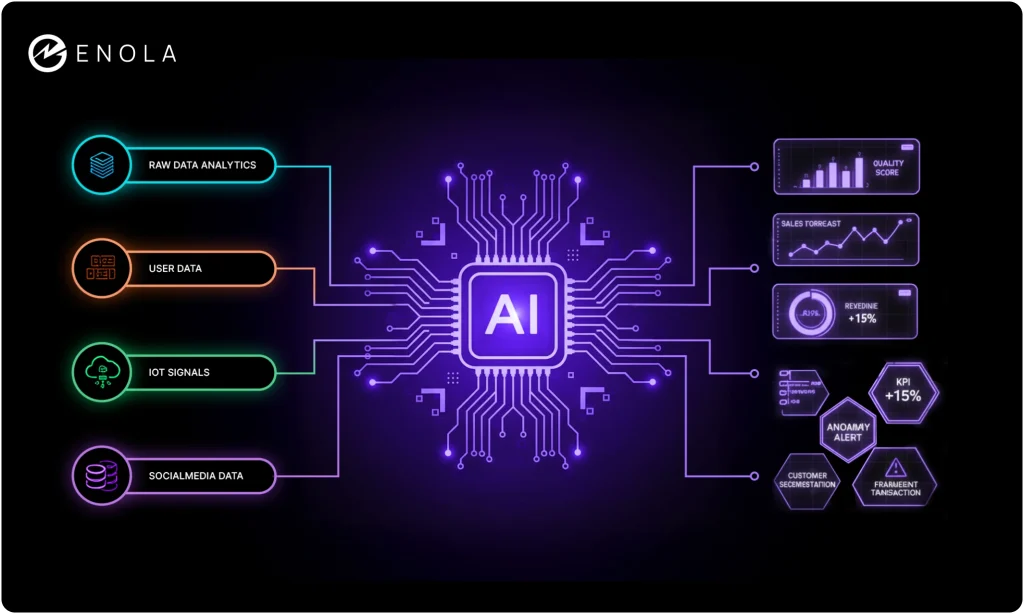
Automated summarization is one of the most popular analytics use cases for Generative AI. Every day, businesses produce vast amounts of data that are mostly left unreported due to the slow manual reporting process.
Generative AI can read and understand full datasets and then produce very brief, human-like, readable summaries that point out trends, anomalies, and opportunities. Data analysts no longer need to create every report manually. Rather, they can ask questions like, “Can you Q3 performance by region?” and get back a contextual conversation that pinpoints high-growth areas or weak markets.
This results in reducing the time cost, getting better accuracy, and achieving more engaging storytelling in analytics reporting.
2. Conversational Analytics for Real-Time Insights
Traditional dashboards were not user-friendly and required technical adjustments, plus the use of manual filters. With the emergence of Generative AI, it is now possible to have a dialogue with the analytics. The users’ questions can be in natural language, and they will receive instant and visual responses.
For instance, the system is capable of looking into all data pertaining to sales, stock, and customers, then producing a visual explanation along with the main numbers supporting the question, “Why did revenue fall in the Northwest region last quarter?”
The use of Generative AI in data analytics has taken away technical barriers and has made it easy for every user, not just data analysts, to get insights quickly. This transition makes it possible for companies to use the AI-based data communication system to make immediate, real-time decisions.
3. Data Preparation and Cleaning
Data preparation often eats up a larger chunk of the time allocated for analysis. Even before extracting knowledge from data, analysts will have gone through a long processing cycle comprising cleaning, formatting, and structuring.
Generative AI is transforming the entire data preparation process by recognizing missing parts, standardizing formats, and spotting mistakes throughout datasets. It progressively learns through past cleaning patterns and thus improves accuracy.
To illustrate, the AI can point out and rectify duplicate records or apply the same date format consistently. Thus, the resulting datasets are much cleaner, less manual effort is required, and analysis is quicker and more trustworthy.
With this Generative AI application, the analytics foundation is made more efficient, and the decision-makers can give their undivided attention to the strategic aspect instead of dealing with operational matters.
4. Predictive Scenario Generation
The forecasting of future events is regarded as the most important aspect of data analytics. By generating many “what-if” scenarios, the process is made more intricate through the implementation of generative AI.
To illustrate, a company could pose the question, “What are the consequences of a 10% increase in production costs?” The AI is able to quickly produce forecasts that include profit margins, inventory levels, and customer demand, all with visual aids.
The implementation of predictive scenario modeling brings the advantages of uncertainty management, risk evaluation, and outcome optimization to companies. It is hard to overstate its significance, as among all data analytical use cases, this one is characterized by allowing organizations to be proactive rather than reactive.
5. Personalized Dashboards and Visualization
Generative AI is the driving force behind adaptive AI-powered dashboards that change according to user behavior and learning profiles. These dashboards not only eliminate the need for static views but also keep on refreshing themselves with the latest data and the user-specific insights.
For example, if a market analyst constantly checks certain KPIs, the AI will automatically give priority to those metrics. At the same time, it will recommend new visualizations or reports owing to the data trend that is developing.
Personalization not only boosts effectiveness but also makes the whole process of analytics more interactive. Gradually, dashboards become more intelligent and aligned with corporate objectives.
6. Intelligent Anomaly Detection and Root-Cause Analysis
Unusual data points are primarily detected by traditional anomaly detection systems but usually without any background information. Generative AI data analytics does this better by not only discerning anomalies but also giving them an intelligent explanation.
For instance, if AI marks an abrupt decline in the number of people visiting a website, or if it marks increased costs, the AI will explain that in terms of the related variables. It might mention that a certain campaign has ended or that the stock of the product is running low.
This allows the analyst to grasp not only that an error had occurred but also the reason for that. One of the most impactful examples of generative AI in fast-paced business settings is context-aware anomaly detection.
7. Enhanced Collaboration and Decision Support
Generative AI encourages collaboration since it lets various parties do their thing with the insights from AI. What teams would do in the past with exchanging reports can now be done by discussing the visuals and narratives created by AI on the live dashboards.
This common engagement makes communication of data understanding and the rotation of ideas and discussions more fluent between the scientists and the decision-makers. The top management can devote their attention to the major results, while the data staff will be validating the AI findings and enriching the context with the help of AI.
This type of working together not only closes the gap between data meaning and decision-making but also adds to the analytics initiative value.
8. Automated Insight Generation for Business Strategy
Generating AI for your data analytics is basically turning data into actions. To go beyond merely stating the facts, the AI systems are now also able to give suggestions regarding the next steps.
For example, machine intelligence may produce a document that reads, “Customer involvement has decreased by 7% as a result of delayed replying. Cutting down the end time by one minute could lead to a 5% increase in participation.”
This is a major shift from observation to suggestion, hence making analytics a decision-making machine. It is the same thing as connecting the dots between the data patterns and the practical business moves, allowing companies to be quicker and more confident in their actions.
The Future of Generative AI in Data Analytics
By the end of 2025, Generative AI data analytics will be like oxygen to organizations that are highly dependent on speed and flexibility. In 2026, the world of analysts will be expecting an even greater connection with the language models and the interpretation of multimodal data.
The future technology would be doing text, pictures, and sound analysis at the same time, giving the insights that are one and the same with the complexity of the real world. These developments will allow the analytic field to go way beyond the numbers, thereby providing context, reasoning, and even foresight.
However, ensuring data transparency and maintaining human oversight will be essential as AI-driven analytics take a more autonomous role.
Generative AI is not a replacement for human researchers. Instead, it is a tool that extends their capabilities by opening up new ways of thinking and accessing the data via more artistic and strategic methods.
Generative AI is the one that shifts the paradigm of data analytics. The use of generative AI is not limited to automated summaries, data cleaning, and predictive modeling, but also includes its application in intelligent anomaly detection, which continues to expand.
With the combination of automation, personalization, and insight generation, companies are able to convert information into smart decisions faster than ever before.
Thus, the businesses adopting Generative AI for data analytics are not only getting efficiency but also obtaining clarity. The partnership between humans and AI at the time when the next analytics era begins is going to be the main factor in creating a smarter, faster, and more strategic future for every market analyst.
Related Blog: