In 2026, small businesses are expected to come under more pressure markets are changing faster now, customers are asking for more, and data grows at rates well beyond traditional tools’ capabilities to store, process, and analyze. The most common complaint we hear while working with small businesses is the fact that they can collect data, but very often fail to interpret it in time to act upon it.
That is where generative AI becomes an advantage for business: instead of teams creating dashboards or writing code, it can interpret data, explain trends, and deliver insights in clear language that decision-makers can act on. For small businesses unable to have dedicated analytics teams, the rise of AI analytics platforms has rewritten how they operate and compete.
It explains what small businesses should do to adopt AI-powered analytics, how they work, and how analysts can guide these businesses to use these tools to drive real business impact.
Why AI-Powered Analytics Matters for Small Business in 2026
After all, analytics has always been about examining data for meaningful patterns. The challenge with small businesses isn’t about understanding the value of analytics but finding the time, tools, and expertise to effectively do so. The traditional BI tools require setup, manual building of queries, and maintenance in an ongoing way. Most small teams simply do not have the bandwidth.
Indeed, Generative AI does alter the analytics process structure: instead of manually preparing and interpreting data by analysts themselves, AI does many of those steps automatically. In fact, that explains why AI-powered analytics tools have become so important for smaller organizations that want enterprise-level insights but don’t have enterprise-level resources.
There are three major shifts driving adoption in 2026:
Increasing Access to Knowledge
AI enables teams with non-technical backgrounds to ask plain English questions and receive instant interpretations, explanations, and suggestions of recommended next actions. In short, it opens analytics to business owners, marketers, operations managers, and sales teams.
Faster Data Interpretation
AI can also analyze years of historical data and recent performance, identifying patterns and anomalies in mere seconds. Speed is important for small businesses, where quick decisions are often needed just to be competitive.
Higher Accuracy in Decision Making
AI models can detect subtle trends that humans often overlook. This leads to better forecasting, more targeted marketing strategies, and more efficient operations.
Together, these shifts make generative AI more than a convenience. It becomes a strategic asset.
How Generative AI Enhances Analytics For Small Businesses
To understand how to use AI for data analytics, it helps to break down the different stages at which AI adds value.
Automated Data Preparation
Small businesses store data in many different tools. AI can automatically aggregate those sources, organize them, clean the data, and get it ready for analysis, therefore automating the most time-consuming part of analytics.
Instant Generation of Insights
Once the data are prepared, generative AI can analyze the trends, correlate the variables, and tell a story. Instead of showing a chart out of context, AI explains what changed, why it changed, and what the contributing factors were.
Predictive Modeling
It projects sales, inventory needs, marketing performance, or customer demand based on patterns of past behavior. This reduces the need for guesswork from small businesses and enhances planning.
Recommendation Systems
Modern AI analytics platforms go way beyond data summarization-they make suggestions that range from reallocation of marketing spend to adjustment in pricing, engaging a particular customer segment, and optimization of operations.
These capabilities make generative AI more intuitive, actionable, and aligned with business goals around data analysis.
Use Cases: How Small Businesses Can Apply Generative AI
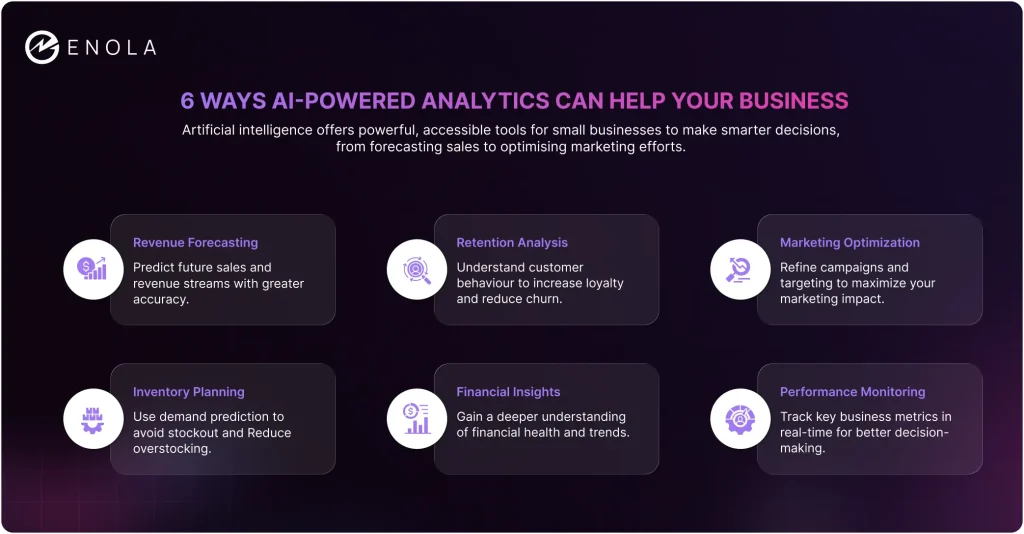
Generative AI can be adopted by small businesses in many industries regardless of size or technical maturity. Here are the most common and high-impact use cases for 2026:
1. Revenue Forecasting
Here, the AI tools empower small retailers, service providers, and subscription-based businesses to make more realistic revenue forecasts. Generative AI considers things like seasonality, customer behavior, marketing activity, and product performance to clearly predict revenues.
2. Customer Behavior and Retention Analysis
AI models show which customers will churn, what segments respond best to promotions, and which factors drive repeat purchases. This allows small businesses to create retention strategies without specialized analysts.
3. Marketing Optimization
Small businesses spread limited budgets across a variety of channels. AI-powered analytics tools can help identify which campaigns are working best, what keywords have generated conversions, and where to shift budgets for better ROI.
4. Operations and Inventory Planning
AI adds value to restaurants, e-commerce stores, and supply-driven businesses through inventory need predictions, the anticipation of stock shortages well in advance, and advice on the optimal amount of stock to hold. This avoids overstocking and hence minimizes any resulting wastage.
5. Financial Insight and Expense Analysis
AI can break down costs, highlight unusual expenses, and show trends in data behind profitability. Small teams, without a financial analyst, gain immediate clarity on where their money is going.
6. Performance Monitoring Throughout the Business
AI monitors these sources continuously and notices when something out of the ordinary occurs, such as when sales suddenly drop or website activity increases. Real-time monitoring enables taking quicker action with more control.
These use cases illustrate specifically how to apply AI for data analytics in the generation of concrete business value to the analyst who handles small businesses.
Why Generative AI Levels the Playing Field for Small Businesses
Large enterprises have long held an advantage in being able to afford data teams, data engineering, and complex BI tools. In 2026, small businesses will have access to that same power via simple, intuitive platforms that require no technical experience.
Generative AI helps small businesses:
- Compete with larger competitors
- Faster, yet more accurate decision-making
- Detect opportunities earlier
- Improve customer understanding
- Reduce operational waste
- Strengthen long-term strategy
This shift forms one of the reasons generative AI for businesses is now practical, scalable, and essential rather than experimental.
The Role of Analysts in the AI Adoption Journey
Analysts play a very important role in aiding the small business owner to understand what AI can do and how to effectively adopt it through the provision of advice, including:
- Choosing Data Analytics Tools for Small Business
- Identifying high-impact use cases
- Setting realistic expectations
- Training teams to ask the right questions
- Integrating AI insights into day-to-day operations
The analyst bridges advanced technology with real-world business decisions. Generative AI does not replace but elevates the strategic influence of analysts.
How AskEnola Supports Small Business Analytics
AskEnola solves exactly the problems faced by small businesses. Instead of forcing teams to build dashboards or understand technical workflows, AskEnola translates data into conversational insights that explain what’s going on and why. It connects to a variety of existing data sources, builds automated models, and delivers insights to help teams make confident decisions.
All that allows the use of AI effectively by analysts and business leaders without complexity. It becomes easy with AskEnola to turn raw data into clear, actionable intelligence for a small business that has ambitions for sustainable growth.
Generative AI is changing the way small businesses work with their data. With the proliferation of emerging AI analytics platforms and AI-enabled analytics tools, teams without technical resources can explore patterns, forecast outcomes, and make more robust decisions than ever before. It is a huge opportunity for analysts.
This can help a small business dive deeper into understanding its data, respond faster to market changes, and give it a chance to be competitive in such a highly dynamic environment. In 2026, data analysis powered by generative AI is more than a trend; it is the most apparent way for small businesses to go from reactive decisions to a forward-looking strategy.
Related Blog: