
If you lead projects, own product outcomes, manage teams, or make decisions that affect revenue, you already rely on analytics, even if you don’t deal with business analytics directly. As expertise gets more and more decentralized, courtesy of the recent advances in GenAI, analytics is no longer only for a small group of specialists. In 2025–25, more people across organizations are expected to interpret data, ask the right questions, and act on insight.
For example, recent industry surveys and studies show a big jump in enterprise AI and analytics adoption, underscoring that analytics literacy is now a core workplace skill, not a niche one. Still, more than 66% professionals in non-analytics fields like Sales and Marketing admit to feeling anxious when working with data.
Below are seven practical, high-impact business analytics skills you should learn in 2025. For each of them you’ll get a short, real-world scenario and one immediate action you can take this week.
1. Ask better questions and frame the problem clearly before analyzing data
Why it matters: Knowing what you want to learn is more important than knowing how to run a chart. Clear questions mean faster answers and less noisy analysis. This is also why proven frameworks like BADIR™ begin by clarifying the Business Question before everything else.
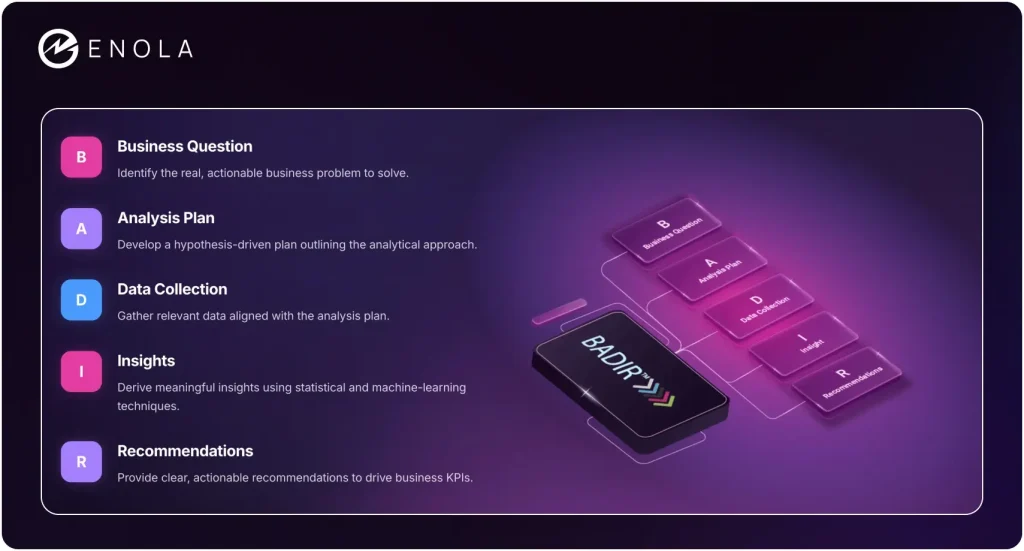
Scenario: You want to reduce churn for a subscription product. Instead of asking “What’s our churn rate?” try: “Which three customer actions in the first 14 days predict churn within 90 days?” That reframes the problem toward root causes and prescriptive solutions.
Actionable takeaway: Use the 5-question template: Who, What, When, Where, Why. Also, remember to clearly define what success looks like for you. Write your question in one sentence and state the metric that would prove you succeeded.
2. Read and build clear visuals because storytelling beats raw numbers
Why it matters: Decision-makers rarely need raw tables. They need a clear narrative and visuals that map to action.
Scenario: Sales leadership sees a revenue dip. A one-chart view that layers conversion funnel, cohort trends, and a short caption that says “drop started after pricing change in Region A” will prompt an immediate test, not a debate over source files.
Actionable takeaway: Learn two chart types well—line charts for trends and bar charts for comparisons. When you present results, start with a one-sentence insight, then show the supporting visual. While traditional business analytics tools may be difficult for non-analysts, there are plenty of solutions with no-code dashboards that can help you.
3. Spot data quality issues because quick checks save hours
Why it matters: Bad or missing data creates bad decisions. Non-analysts who can surface obvious data problems reduce rework and incorrect choices.
Scenario: You’re analyzing campaign performance and see a sudden 10x spike in conversions. A quick check reveals a missing conversion filter—bot traffic inflated the metric.
Actionable takeaway: Before trusting numbers, run three checks: verify date ranges, check for duplicates or zeros, and compare the same metric across two systems (for example, ad platform vs. CRM). If numbers disagree, flag it as a data-quality issue, not a conclusion.
4. Use no-code business analytics tools and get answers without SQL
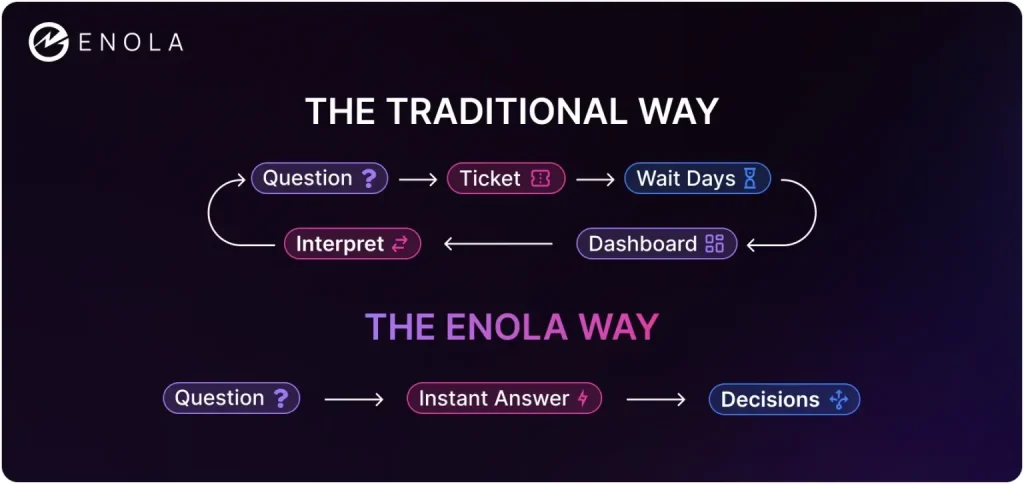
Why it matters: Modern no-code business analytics platforms let non-analysts run segmentations, build visuals, and export recommendations without writing code.
Scenario: As a product manager, you want to know how feature usage varies by plan. Using a no-code dashboard, you filter by plan, apply a cohort view, and export findings—all in one sitting.
Actionable takeaway: Pick a tool that connects to your data warehouse or CSVs and learn three tasks: filter by attribute, create a cohort, and export a chart. Search for “business analytics tools” reviews, try a 14-day demo, and practice with one real question. The right tooling will make analytics accessible and repeatable.
5. Think in outcomes; choose the right KPI and guardrails
Why it matters: Metrics can mislead. Selecting the right Key Performance Indicator (KPI) and a few guardrails keeps your team moving toward measurable outcomes.
Scenario: Marketing measures “leads” but the business needs revenue. Switching to a pipeline KPI—marketing qualified leads that convert to customers—redirects tactics and clarifies tradeoffs.
Actionable takeaway: For every decision, name one success metric and two guardrail metrics that prevent gaming. For example, success = new customers; guardrails = customer acquisition cost and trial-to-paid conversion.
6. Use basic statistics to read margins and probability
Why it matters: Small differences can be noise. Understanding significance, confidence intervals, and effect sizes prevents overreaction to random fluctuation.
Scenario: An A/B test shows a 3% uplift with small sample sizes. Without checking statistical confidence, you might roll this change company-wide and later regret it.
Actionable takeaway: Learn three terms: sample size, p-value (or confidence interval), and effect size. If you see a result without these, ask for the sample size and confidence interval before acting.
7. Translate between teams, from business questions to analytics requirements
Why it matters: Analysts and engineers need clear, prioritized asks. The faster you can translate business intent into data requirements, the faster you’ll get usable insight. Establish good communication between business users and analysts is, in fact, one of the top three challenges in getting the most out of an business analytics setup.
Scenario: You ask for “customer lifetime value” but the analytics team needs definitions: timeframe, revenue recognition rules, and cohort windows. A quick spec avoids back-and-forth.
Actionable takeaway: When requesting analysis, provide: the business question, success metric, timeframe, segments, and two sample rows of the data you expect. Use this short template to align on the first request.
A short checklist you can use today
Going out of your comfortable, non-analytics zone can be difficult. We understand that, and that’s why we have created this quick checklist that you can start using right away to make sure you crunch those numbers the right way.
- Write one measurable question and one success metric.
- Build one simple chart that proves or disproves the hypothesis.
- Run three quick data quality checks before presenting.
- If you don’t use SQL, pick a no-code analytics tool like Enola, and connect a sample dataset.
- Always confirm the sample size and confidence when looking at experiments.
Where to go next (realistically, and fast)
If you want a place to make your decision-making truly data-oriented, or if you just want to be comfortable with data, try using Enola, a guided, no-code analyst that is built to help business people ask practical analytics questions and get action-ready answers.
Business analytics in 2025 is not about becoming a data scientist. It is about becoming fluent enough to ask the right questions, read the right charts, and act on insight with confidence. Learning these skills will make your decisions faster, cleaner, and more defensible.
Start with one small question this week, and iterate from there.
Related Blog: