Artificial intelligence is no longer an experimental capability reserved for innovation labs. Artificial intelligence is at the heart of how we drive revenue today.
Leaders across sectors are recognising that AI and business performance are becoming inseparable because data-driven decision velocity determines competitive advantage. The organisations winning today are not the ones with the most data, but the ones that can interpret it fastest and act on it with confidence.
Understanding the relationship between artificial intelligence and business growth requires clarity on how AI analytics transforms raw data into profit, which is what matters most to businesses today.
AI Analytics and Revenue Optimization
AI analytics includes machine learning, natural language processing as well as prediction models. It acts like a filter to analyze the business data and customer information. In simple words, it helps to identify patterns in the data and translate them for business leaders to take immediate action.
The impact of artificial intelligence on business performance is most visible in revenue functions such as pricing, forecasting, marketing attribution and pipeline optimization; AI adds forward-looking decision intelligence. Planning is no longer reactive but predictive, which directly influences and shapes growth trajectories.
Organizations that combine AI strategies with a forward-thinking business approach do not treat analytics as a reporting obligation; they treat it as a decision engine.
Why Revenue Teams Put AI and BI First
Revenue leaders manage three constant stressors: time, data complexity and decision risk. An AI and analytics platform addresses all of these stressors by interpreting data, providing insights and streamlining actions.
Consider forecasting accuracy. AI models continuously retrain on live data, adjusting projections based on behavioural, operational as well as market signals. The result is faster planning and more refined revenue targets.
Another edge being offered is accessibility. With AI and business technologies, non-technical leaders can query data using natural language. This removes the high dependency on analysts and accelerates response time across departments. The impact of artificial intelligence on business agility becomes evident when teams can answer strategic questions instantly rather than waiting days for reports.
Real Revenue Levers AI Unlocks
AI is not a single-use case technology. It influences multiple revenue levers simultaneously. It can optimize customer acquisition cost by analyzing channel performance in real time. It can increase lifetime value by identifying churn signals early. It can improve pricing strategy by modelling elasticity against demand patterns.
But above all, AI brings tighter strategic alignment. When leaders in marketing, product, finance and operations all rely on the same level of intelligence, their decisions begin to align instead of diverging. That’s where AI intersects with the future of business leadership. The alignment of insights creates the alignment of execution.
Risks Leaders Must Manage
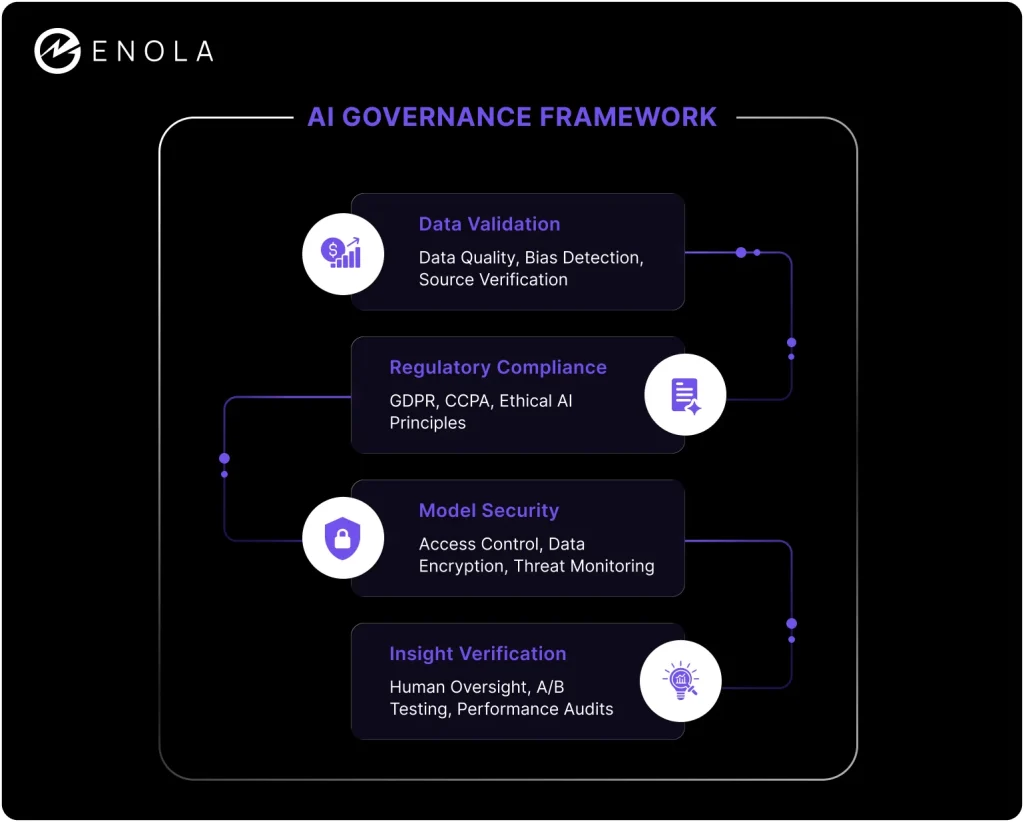
Despite its advantages, deploying AI analytics without governance introduces risk. Data quality issues can produce misleading outputs. Model bias can skew forecasts. Security gaps can expose sensitive information. Responsible adoption requires validation layers, auditability as well as enterprise-grade protection
That’s why the following question has to be asked: what is the future of AI in business?
Well, it’s all about reliability. Leaders need AI systems they can trust with decisions that matter the most. Accuracy, explainability along with traceability are now executive requirements, not technical preferences.
The credibility of a business with regard to artificial intelligence is based on whether the information can be justified. Machines that give answers without a clear logical trail lead to doubt rather than certainty.
Preparing for What Lies Ahead: The AI Future in Business
One of the most important questions executives often ask is about the expected role of AI in businesses. The answer to this issue is evolving and it looks more certain by the day. The primary interface between executives and data will be AI. Executives will be able to converse with intelligent systems instead of wading through reports.
This will dramatically change the notion of AI and business operations. Decision cycles shrink from weeks to minutes. Strategy debates will transform from rigid slides to fluid, thought-provoking conversations. More actions will stem from decisions and fewer from data collection.
The effectiveness of such a transformation undertaken by AI would, therefore, vary based on how advanced an organization is in its adoption curve. Early adopters would gain speed and such speed would only continue to compound, while late adopters would find it hard to keep up.
How AskEnola Turns Questions Into Decisions
AskEnola is built for leaders who need answers, not dashboards. Its BADIR framework structures every query around business context, analysis logic, data selection, insights and recommendations. The platform connects directly to enterprise warehouses, interprets questions in plain English and delivers decision-ready intelligence in seconds with full reliability and security.
A Strategic View for Today’s Leaders
AI does not replace executive judgment; it strengthens it. The best leaders recognize AI analytics as a strategic ally that clarifies thinking, reduces uncertainty and reveals hidden opportunities.
Organizations that have a say in shaping AI and the future of business include those that make intelligence an integral component of their decisions, not just an add-on. They prioritise systems that deliver trusted insights instantly, align outputs with business goals as well as integrate securely with existing infrastructure.
For leaders trying to understand the impact of artificial intelligence on business, the best bet is to request a free trial with AskEnola and experience how decisions speed up when intelligence is delivered at leader speed.
Related Blog: