Every major business decision begins with a simple question: what will the revenue look like? The accuracy of your revenue forecasting holds the answer.
Accurate forecasts give leaders the confidence to make informed, strategic moves. They shape how budgets are planned, when teams should scale, and how to prepare for growth. In contrast, inaccurate forecasts create blind spots that can lead to cash flow issues, missed opportunities, and reactive decisions.
Yet accurate revenue forecasting remains one of the toughest challenges for business leaders. Research shows that 98% of revenue leaders struggle to produce forecasts they fully trust. This forces many organizations to make critical decisions with only partial data or gut instinct, creating unnecessary risk and uncertainty.
Fortunately, the forecasting is evolving.
Advances in self-service analytics and no-code tools are giving teams new ways to build forecasts that are grounded in data and easier to maintain, even without dedicated analysts.
In this article, we’ll look at what revenue forecasting really means for business leaders, why it matters, the hurdles companies face without data teams, and how modern AI-powered approaches can make forecasting simpler and more actionable.
What Is Revenue Forecasting and Why Does It Matter?
Revenue forecasting is the process of estimating how much money your business will earn over a future period (e.g., next quarter or year).
Companies often perform various types of business forecasting, including sales forecasting, demand forecasting, cash flow forecasting, and inventory forecasting. However, revenue forecasting stands out because it directly influences all these areas and informs broader profit and financial forecasts.
In practice, revenue forecasts are built by analyzing historical data and current performance, then making educated assumptions about upcoming sales based on factors like market trends, seasonality, and your business strategy. For instance, by examining past sales patterns and external events, analysts can identify drivers and trends that help predict future sales and revenue.
The revenue forecast accounts for all sources of revenue, not just new sales but also renewals, upsells, subscription income, etc. (By contrast, a sales forecast focuses purely on revenue from the sales pipeline.)
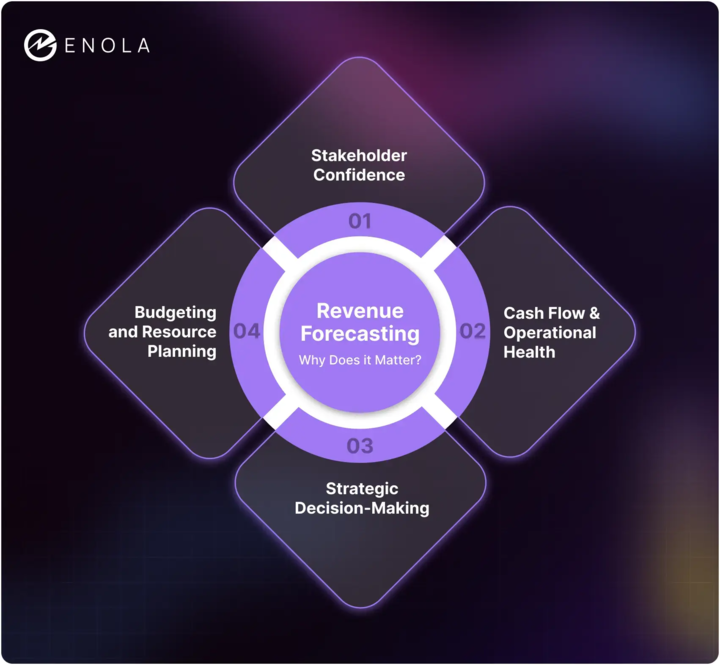
A solid revenue forecast directly shapes business decisions. A reliable forecast helps companies set realistic budgets and allocate resources effectively. It’s also critical for cash flow management – anticipating when revenue will arrive ensures you have funds to cover expenses and invest in growth.
In short, revenue forecasting provides a data-driven glimpse into the future of your business, helping you prepare for both opportunities and risks ahead.
Companies that forecast well can proactively address shortfalls or scale up for surges in demand. This is why revenue forecasting is considered an essential component of financial planning and business strategy, underpinning confident decision-making across the organization.
The Challenges of Forecasting Without a Data Team
Despite its importance, producing a reliable forecast can be difficult without a data team or analysts to crunch the numbers. Smaller businesses and teams without dedicated data experts often face several hurdles:
Data Quality and Silos:
Accurate forecasts demand clean, comprehensive data, but many businesses suffer from fragmented or poor-quality information. Sales figures might live in a CRM, subscription revenue in another database, and marketing spend in a spreadsheet, and they may not reconcile.
Without a single source of truth (SSOT) to unify these datasets, every department ends up using different numbers, which leads to confusion and erodes trust in the forecast. Without a data team to integrate and clean these sources, leaders often face “garbage in, garbage out,” resulting in flawed projections and decision paralysis.
Manual Effort and Errors:
Lacking analytical support, many teams resort to forecasting in Excel or by gut feel. Manually gathering data from various reports, updating formulas, and creating scenarios can take weeks.
Busy leaders wearing multiple hats simply don’t have hours to fuss over pivot tables every week. As a result, forecasts might not get updated frequently, which hurts accuracy in fast-changing conditions. All that manual work also introduces chances for errors in formulas or data entry.
Lack of Advanced Modeling:
Professional analysts often use sophisticated models (regressions, time-series, driver-based models) to improve forecast accuracy. Without that expertise on hand, business leaders may stick to rudimentary methods, such as taking last year’s revenue and adding a flat growth rate.
This simplistic approach ignores nuances such as seasonality, conversion rates, demand fluctuations, churn, or market shifts. The result can be consistently off-target projections, either overly optimistic or overly pessimistic, because the forecasting method isn’t robust.
These challenges explain why many leaders struggle to forecast effectively on their own. It’s not that forecasting is impossible without data scientists (in fact, most analytics problems can be solved with simple methods rather than advanced algorithms); it’s that the process is time-consuming and prone to issues if you don’t have the right tools and approach.
Enola: Your AI Super-Analyst for Revenue Forecasting (No Data Team Required)
So how can you forecast revenue accurately without a data team? The key is to leverage the right process and tools to eliminate manual effort. Even if you lack in-house data experts, you can achieve reliable forecasts by combining your business knowledge with automated analytics.
Here’s a step-by-step approach:
1. Focus on Drivers and Assumptions:
Many forecasting mistakes happen when companies plug in numbers without understanding what drives those numbers. The first step is to identify the key factors that drive your revenue, such as sales volume, average deal size, customer acquisition rate, churn rate, and seasonal demand. By grounding your forecast in these drivers and making clear assumptions, you create a more realistic and actionable projection.
How Enola helps:
You can incorporate driver assumptions by asking Enola targeted questions about each factor.
For instance, ask “If our conversion rate improves by 5%, how will that impact quarterly revenue?” Enola will instantly analyze your historical data and show you how changes in a driver (like conversion rate) would affect your forecast. This ensures your revenue forecast logic stays tied to real business inputs.
Curious how this works in practice? Try our Sandbox and see Enola in action.
2. Use Simple Forecasting Techniques:
Stick to basic but effective forecasting methods, and consider forecasting different segments separately, such as new sales versus renewal revenue in a subscription business, to add more nuance. Remember, a “directionally accurate” forecast is better than one that’s overly complex and precisely wrong.
How Enola helps:
Enola can quickly do these baseline calculations for you. By querying your data in plain English, you can have Enola compute trends or averages in seconds.
For example, ask “What was our quarter-over-quarter revenue growth for the past 2 years?” and then “Based on that trend, forecast next quarter’s revenue.” This lets you generate a fast, reasonable forecast and adjust it as needed, without fiddling with Excel formulas
Check the product page to see how Enola’s forecasting fits alongside other features like automated insights and anomaly detection.
3. Leverage No-Code Analytics Tools:
One of the biggest game-changers for teams without analysts is the rise of no-code, AI-powered analytics platforms. Instead of manually collating data from multiple sources and building models from scratch, you can let an AI tool handle the heavy lifting.
How Enola helps:
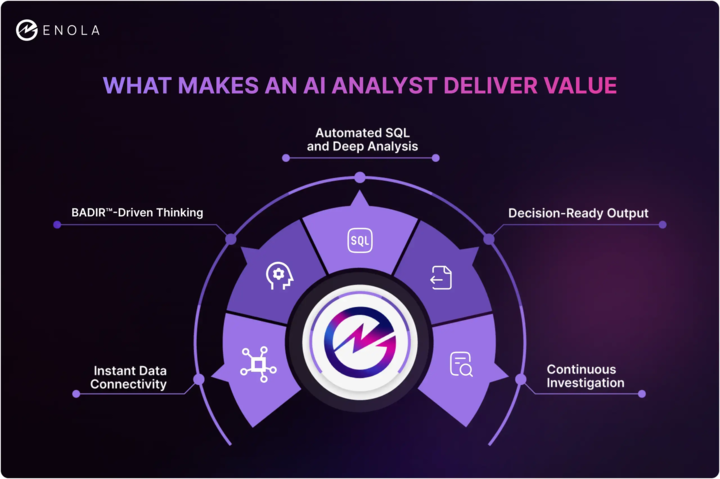
Enola is an AI super-analyst designed to be your on-demand data expert. It connects to your data sources (Snowflake, BigQuery, Redshift, etc.) and performs the automated data analysis for you.
This means you can skip the tedious steps of gathering data and coding formulas, as Enola crunches the numbers in minutes, allowing you to focus on interpreting results and making decisions.
In short, you get advanced analytics without needing a data team or coding skills, making it a self-service, no-code analytical solution for forecasting
4. Get Analysis and Insights in Plain English:
Another challenge of not having analysts is the difficulty of interpreting the data and understanding the “why” behind the numbers. It’s not enough to get a revenue figure; you also need to know the drivers and context.
How Enola helps:
Enola follows a structured methodology (the BADIR™ framework) to break down your question into analysis steps and then gives you a clear narrative.
For example, if you ask Enola to forecast next quarter’s revenue, it could return a predicted revenue figure, a chart showing the trend line, and a written explanation of the factors influencing that forecast.
In other words, Enola delivers an answer and the insight behind the answer, everything in minutes. This kind of narrative insight empowers you to confidently explain the forecast to your team or investors, because you understand the drivers behind the numbers.
5. Eliminate Bottlenecks and Iterate Quickly:
Traditional forecasting is often a slow, periodic exercise. You might build a forecast annually or quarterly and feel stuck with it as conditions change, simply because updating it takes too much effort. Without a data team, this becomes a major bottleneck.
How Enola helps:
There’s no need to wait days or weeks for someone to gather data and build a new report; Enola can analyze live data on the fly and update the forecast whenever you ask. Your revenue forecast remains dynamic and up to date, allowing you to refine assumptions or explore new scenarios as your business evolves.
The impact on decision speed is tremendous. Teams leveraging Enola make decisions nearly 10× faster, eliminating the delays that come with analyst-dependent processes. When you can get an answer in minutes, you’re able to respond to opportunities or risks in real time.
From Guesswork to Confidence: The Future of Revenue Forecasting
By following these steps and leveraging the right tools, any team can produce effective revenue forecasts without hiring a full data department. Advanced data modeling and real-time updates keep the forecast sharp, allowing the team to focus on applying insights where they matter most.
For example, companies that switch to AI-driven forecasting report getting insights 10x and cutting analysis costs by up to 90% compared to manual workflows. And the benefits extend beyond revenue projections. The same AI-driven approach can accelerate other forecasts too, including sales, demand, cash flow, and inventory forecasting, leading to more agile financial planning and more confident profit forecasting for your business.
In a world where agility and insight are competitive advantages, leveraging an AI super-analyst for planning can be the decisive step to stay ahead of the curve. With Enola by your side, you can turn what used to be a painful, guesswork-laden chore into a streamlined, data-driven conversation – and make informed decisions to drive your business forward.
FAQs:
What is revenue forecasting, and why is it important for businesses?
Revenue forecasting is the process of estimating how much revenue your business will generate in a future period. It’s important because it guides critical decisions like budgeting, staffing, and strategic planning.
In short, revenue forecasting provides a data-driven roadmap of your business’s future, ensuring leaders can move forward with confidence
Modern tools like Enola can automatically crunch your historical data and build a reliable forecast for you. You can even try Enola for free to see your own revenue outlook in minutes, no heavy number-crunching required.
Why is accurate revenue forecasting challenging without a data team?
Without a dedicated data team, businesses often struggle with fragmented data and manual processes. Important numbers might be spread across a CRM, a billing database, and spreadsheets, making it hard to get a single source of truth.
Lacking data experts, many leaders end up guessing or using overly simple methods, which can lead to off-target predictions. This is where Enola steps in.
No analysts required. Enola acts like your on-demand data expert. Give it a try, and you can focus on decisions while Enola handles the data wrangling.
How can an AI tool like Enola improve revenue forecasting accuracy and efficiency?
An AI Super-Analyst tool like Enola can make your forecasting both more accurate and a lot faster. First off, it takes the manual work (and human error) out of the process by automatically analyzing your historical data for patterns.
Second, it’s lightning-fast. Instead of spending days tinkering with Excel, Enola can deliver a forecast in minutes.
Just ask in plain English, and you’ll get an answer on the spot, without all the spreadsheet hassle.
Want to see what instant insights look like? Get started for free with Enola today – it’s already helping teams make faster, smarter forecasts.
How does Enola work without requiring data analysts or coding skills?
Enola is built so that you don’t need any technical skills to get answers. It follows a structured method (BADIR™ framework) to make sure the results are sound, but you won’t see any of that heavy lifting.
Within minutes, you’ll just get an easy-to-understand answer or chart explaining the “why” behind the numbers. Give it a try – ask Enola something in the sandbox and see how it handles the analysis.
Can Enola integrate data from multiple sources to create a unified revenue forecast?
Absolutely.
It connects directly to your different systems such as your CRM, billing platform, marketing tools, or even cloud data warehouses like Snowflake and BigQuery.
Enola pulls all that information together behind the scenes into a single source of truth. So when you ask for a revenue forecast, it’s drawing on all the relevant data (new sales, renewals, upsells, etc.) across those sources at once. Enola essentially breaks down data silos for you. It only takes a few minutes to connect your sources.
Try it out and see how easily Enola brings all your data together for a unified forecast.
Who can benefit from using Enola for forecasting, and what is the ROI for business teams?
Enola is useful for just about anyone who makes business decisions. It helps decision-makers across the company, from CEOs and General Managers to heads of Sales, Operations, Finance, or Product. It’s especially valuable in fast-moving industries like SaaS, fintech, or logistics, where waiting weeks for data just isn’t an option.
The ROI has been remarkable: teams using Enola have gotten insights up to 10× faster at around 90% lower cost than the old analyst-driven approach.
Bottom line: Enola helps you make better decisions faster and cheaper. You can start a free trial to see this payoff for yourself.
Related Blog: