
Data is no longer a secondary resource for today’s organizations. It is the key driver of competitive advantage. However, most organizations find it challenging to make data-driven decisions that are timely and accurate. This is where AI analytics for business makes a difference.
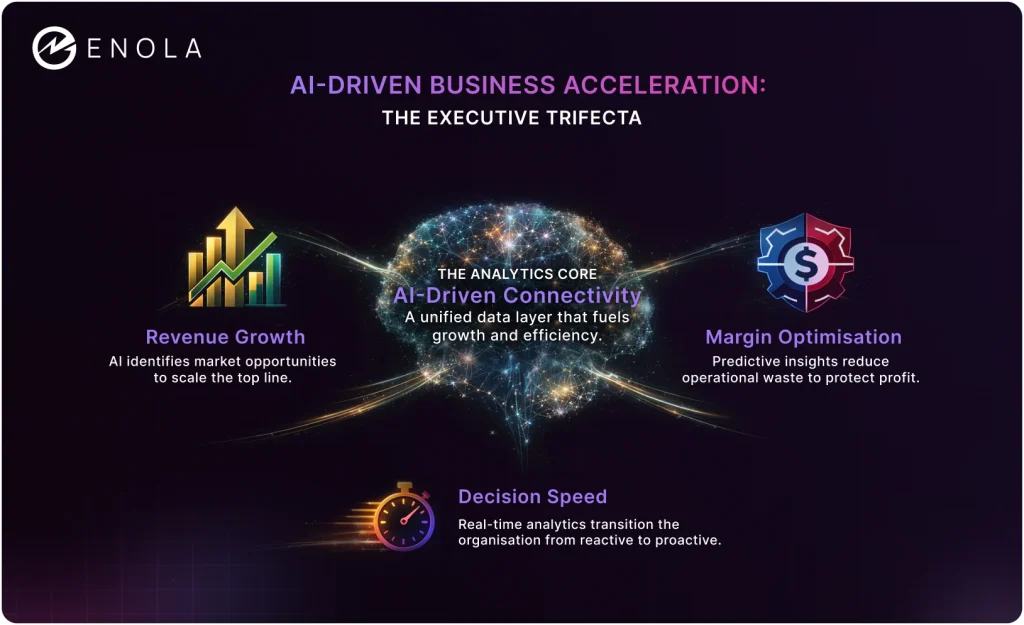
By leveraging artificial intelligence and being built specifically for decision-makers, business analytics AI impacts the speed of growth, efficiency of operations and profitability of a business.
Revenue Growth with More Informed Opportunity Identification
Revenue growth is a function of identifying informed opportunities. Most reporting is backwards-looking, making it impossible to act before the opportunity fades. Business analytics with AI changes this paradigm by constantly analyzing customer behavior, pipeline activity, pricing performance as well as market trends.
With AI analytics, revenue teams can spot which segments are converting faster, which products deliver the highest lifetime value and where deals are getting stuck. Instead of making decisions based on gut or lagging dashboards, today’s leaders can now ask direct questions such as which customer groups are most likely to upsell this quarter or which growth drivers are delivering profitable growth.
This allows for quicker targeting, better prioritization and more accurate forecasting. This means that sales and marketing expenditures are optimized based on actual revenue potential, rather than estimates.
Enhancing Margins with Cost and Efficiency Intelligence
Margin expansion can be more difficult than revenue growth because inefficiencies are masked throughout the business. AI-driven analytics uncovers these inefficiencies by integrating financial, operational and product data into a single analytical framework.
Real time business analytics enables finance and operations professionals to track unit economics as they evolve. This includes monitoring increasing costs of acquisition, margin leakage within customer segments and cost overruns within process-level activities. Rather than learning about margin leakage at the end of the month, executives can address it while there is still time for corrective measures.
By facilitating AI-informed decision-making, companies can better optimize pricing approaches, renegotiate contracts with suppliers and make better use of resources. Over time, these cumulative effects translate to better gross margins and improved cash flow.
Faster Decisions, Bigger Impact
Speed is driving business performance discreetly. Stretching out decisions diminishes the effectiveness of any, no matter how good, as time passes. Decisions that can be made in “minutes” instead of “weeks” improve ROIs powered by AI-driven analytics.
Leaders today require answers that must be provided within planning rooms, price talks and board briefings. AI analytics allows leaders to ask questions using simple language and receive instant answers. This reduces dependence on analysts and allows decisions to be made without any delays.
Faster decisions also fuel faster experimentation. New pricing changes, campaign concepts, features and their results can be tested and evaluated in real time with live analytics.
Growth at Scale, Without More Complexity
As organizations grow, the complexity of the data will likewise increase. There will be more tools, sources and metrics to contend with. AI analytics for business offers a solution to scale an organization while avoiding analytical overhead.
Automation of data interpretation and semantics will ensure that teams are always aware of the context as data volumes increase. Applying artificial intelligence technology in decision-making keeps leaders focused on desired outcomes rather than on technologically driven analysis.
That scalability will allow companies that are growing quickly and cannot afford to wait to keep that growth purposeful, profitable, and well-aligned.
Turning Data Into Action
One of the biggest failures of traditional analytics is insight without action. We have dashboards as well as charts that show us what happened; but they rarely explain what to do next. AI-driven analytics helps solve the problem by structuring analysis around business questions and outcomes.
Smart business analytics links information to KPIs, financials and actions to be taken. Rather than analyzing individual details, business owners are able to see how improvements in conversion rates, customer loss or costs affect revenue and margin targets.
This focus helps analytics serve decision-making, rather than merely reporting. Ultimately, this model promotes trust in data and expands its use throughout the leadership.
Measuring AI Return on Investment
It is not uncommon for artificial intelligence projects to stall due to a lack of clear ROI potential. The reality is that artificial intelligence return on investment is measurable when analytics directly impacts revenue, margin as well as growth decisions.
Key signals include faster time to insight, accurate predictions, improved conversion rates along with stable margins. Where real-time business analytics drives everyday decisions, ROI manifests beyond mere cost savings in the effectiveness of business strategies.
Leaders who track these statistics can convince themselves of their AI investments and even refine the methodology of analysis with time.
How AskEnola Enables Revenue-Driven AI Analytics
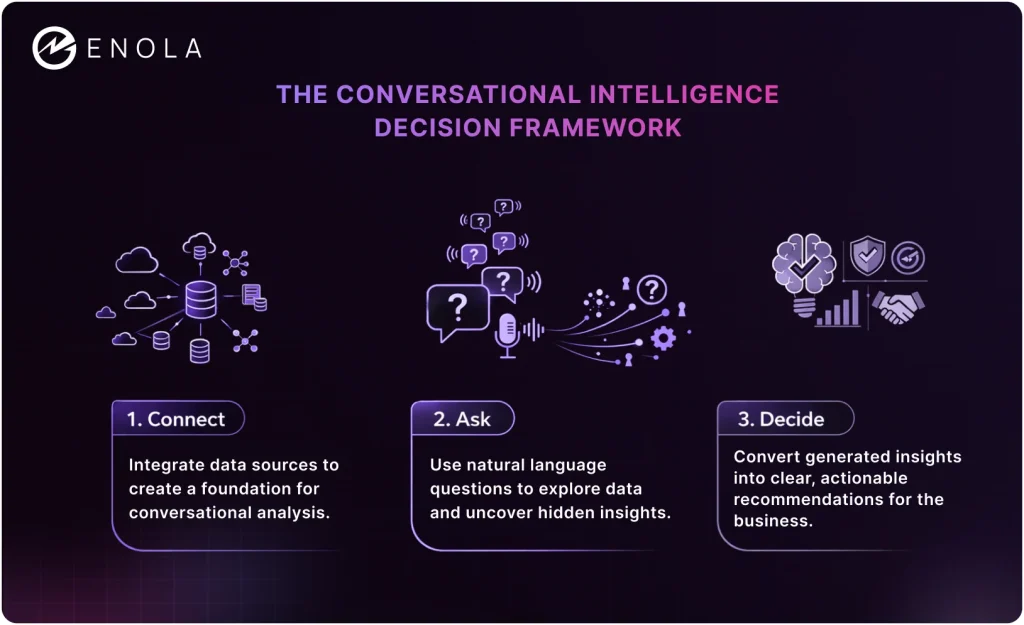
AskEnola is purpose-built for organisations that need fast, reliable answers from complex data environments. Acting as an AI Super-Analyst, it enables AI driven analytics by allowing leaders to ask business questions in plain English and receive contextual, decision-ready insights in seconds.
Powered by the BADIR™ framework, AskEnola ensures every insight is tied to a business goal, supported by accurate data and delivered with clear recommendations. This makes business analytics AI practical, explainable and immediately actionable for revenue, finance and growth teams.
The Strategic Edge of Decision-First Analytics
Sustainable growth actually comes from better decisions, not more data. Having said that, the impact of AI-driven business analytics hinges on speed, trust as well as clarity, as opposed to the traditional focus on sophistication.
Thus, by enabling AI driven decision making, organizations are able to excel on the top line, protect margins and grow with confidence.
So, for leaders who care about results more than dashboards, decision-first analytics isn’t merely just na option anymore; it is a necessity. Without a doubt, it is the fundamental underpinning of winning in the data economy.
Related Blog: