If your customer acquisition costs are climbing faster than your revenue, you’re not alone. Across SaaS, Fintech, and E-commerce, rising ad costs, privacy restrictions, and budget freezes are making it harder than ever to bring CAC down. The good news? AI is no longer a buzzword—it’s a proven lever for reducing CAC at scale.
In this playbook, you’ll see exactly how marketing leaders are using AI to cut acquisition costs through smart analytics, real-time optimization, and hyper-personalization. Whether you’re managing lean budgets or scaling aggressively, these are the same strategies that turn AI into a CAC-reducing machine.
Step 1: Audit Your Current CAC Reality (And Face the Music)
Marketing teams are not typically famous for being the data-driven. In fact, according to Gartner, marketing analytics are responsible for influencing just over half of marketing decisions.
Before diving into solutions, let’s establish your baseline with the right analytics foundation. Most marketing teams calculate CAC incorrectly, leading to false optimism about their performance.
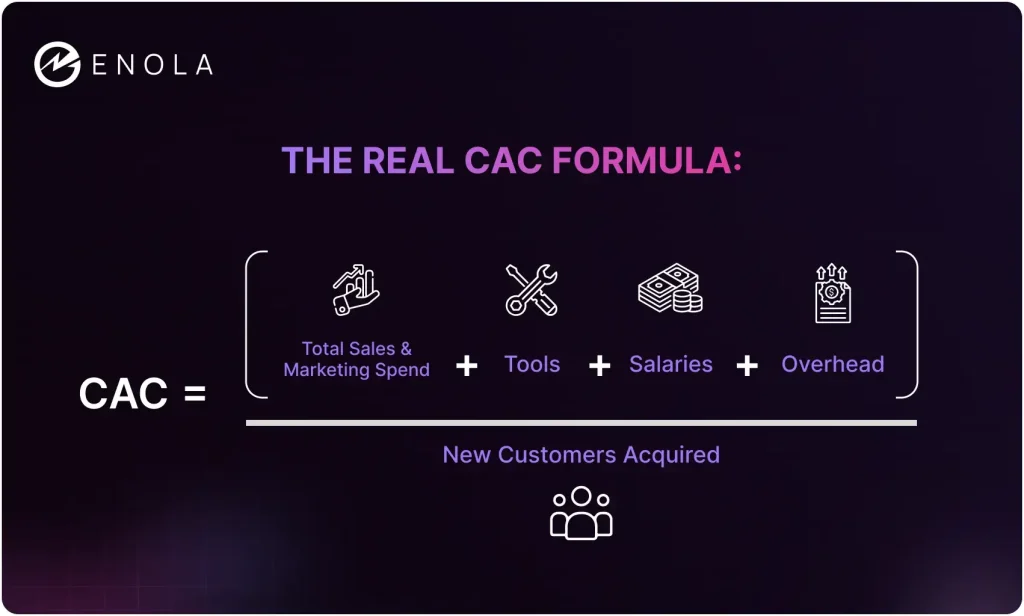
The Real CAC Formula: CAC = (Total Sales & Marketing Spend + Tools + Salaries + Overhead) ÷ New Customers Acquired
The key is to include all sales and marketing expenses in CAC so the number is fully loaded rather than understated. Many teams undercount by excluding tools and people costs, but best practice is to segment CAC by channel and calculate both “basic” and “fully loaded” CAC to guide decisions more accurately.
→ Pro Tip: Break down CAC by channel, not just overall averages. Your LinkedIn ads might have a $200 CAC while your organic content delivers $50 CAC. This granular view reveals where to double down and where to cut loose.
The fastest way to get this baseline is through no-code analytics platforms like Enola. With just 15 minutes of onboarding, even for enterprise-level data setups, you can connect all your marketing data sources and get immediate CAC visibility across channels. This saves businesses massive amounts of time compared to traditional analytics implementations that can take weeks or months to set up properly.
Step 2: Implement Predictive Analytics for Lead Scoring
Reducing CAC with AI often starts with better targeting, and predictive lead scoring is a high-impact entry point. Traditional lead scoring relies on basic demographic data and simple behavioral triggers. AI-powered predictive analytics, on the other hand, can examine hundreds of data points to identify which prospects are most likely to convert—before they even know they want to buy.
The Implementation Process:
- Aggregate Historical Data: Collect 12-24 months of customer journey data, including touchpoints, engagement patterns, and conversion outcomes.
- Deploy Machine Learning Models: Use predictive analytics to score leads based on likelihood to convert and potential lifetime value.
- Create Dynamic Segments: Automatically route high-scoring leads to your sales team while nurturing lower-scoring prospects through automated sequences.
For marketing leaders looking to understand the nuances between different AI approaches, check out this comprehensive guide on AI Analyst vs AI Assistant: What’s Right for Your Business? It breaks down exactly why context-aware AI analysis delivers better results than generic chatbot responses.
Step 3: Deploy AI-Powered Personalization at Scale
Generic marketing messages are where budgets go to die. Fortunately, we are at a point in time where we never have to settle for generic messaging.
AI personalization doesn’t just mean inserting someone’s first name into emails. Rather, it’s about creating individualized experiences across every touchpoint. Advanced personalization tactics include:
- Dynamic Website Content: Show different value propositions based on visitor behavior, industry, and company size
- Contextual Email Sequences: Trigger specific nurture paths based on engagement patterns and pain points
- Personalized Ad Creative: Generate custom ad copy and visuals for different audience segments automatically
Teams reducing CAC with AI in this way see higher conversions without increasing spend, driving down cost per acquisition naturally.
Step 4: Optimize Marketing Automation Workflows
Set-it-and-forget-it automation causes performance decay. AI-enhanced workflows adapt in real time, sending the right message at the right moment. By optimizing triggers, send times, and content with AI, marketing teams have consistently reported reducing CAC while improving lead quality.
Here’s a great example of smart workflow optimization:
- Behavioral Trigger Analysis: Identity which actions predict conversion and build workflows around these moments
- Send Time Optimization: Use AI to determine the best time to reach each individual prospect
- Content Performance Learning: Automatically A/B test different messages and promote winners
AI‑assisted marketing automation improves efficiency by optimizing triggers, send times, and content variants; case libraries show reductions in acquisition costs and time-to-sale when workflows adapt to user behavior and surface sales‑ready signals (e.g., pricing page visits) for immediate outreach. A pragmatic approach is to map key buying signals, auto-create tasks when they occur, and A/B test sequences with machine‑selected subject lines and content to measure lift in qualified pipeline and cost per opportunity
Step 5: Master Real-Time Campaign Optimization
This is where reducing CAC with AI shines. Continuous adjustments to bidding, targeting, and creative ensure your budget is always going to the highest-ROI segments. Instead of wasteful static campaigns, AI reallocates resources dynamically to reduce acquisition costs over time.
Real-Time Optimization Framework:
- Dynamic Bid Adjustment: Automatically increase bids for high-converting keywords and audiences
- Creative Rotation: Test and promote winning ad variations without manual intervention
- Audience Refinement: Continuously expand or narrow targeting based on conversion data
Step 6: Implement Cross-Channel Attribution
An estimated 75 percent of customers use multiple channels in their ongoing experience, according to McKinsey, and if you can’t see which touchpoints actually drive conversions, reducing CAC becomes impossible. AI-powered multi-touch attribution connects the dots across channels and devices, letting you cut spend on underperforming channels and double down where it counts.
Here are some attrition best practices that can contribute towards optimizing CAC.
- Multi-Touch Attribution: Track every touchpoint in the customer journey, not just first or last click
- Weighted Attribution Models: Assign different values to various touchpoints based on their influence on conversion
- Cross-Device Tracking: Connect customer interactions across mobile, desktop, and offline channels
A lot of times, when teams move from last‑click to multi‑touch attribution, they often find under‑credited channels (like content and email) contribute more to conversion than previously recognized, leading to smarter budget allocation and lower blended CAC. Best practice is to implement a multi‑touch model, validate it against historical cohorts, and then reallocate a test budget tranche toward the incrementally proven channels while monitoring CAC and ROAS weekly
For marketing teams struggling with trustworthy AI implementation, this framework guide on choosing Trustworthy AI provides essential criteria for evaluating AI tools that won’t lead you astray with unreliable insights.
Step 7: Optimize Customer Lifetime Value Through AI
The smartest approach to reducing CAC isn’t just acquiring customers cheaper—it’s acquiring customers who are worth more. AI helps identify and target prospects with higher lifetime value potential.
LTV Optimization Strategies:
- Predictive LTV Modeling: Identify characteristics of high-value customers and target similar prospects
- Upsell Opportunity Identification: Predict which customers are ready for expansion revenue
- Churn Risk Scoring: Proactively engage at-risk customers to preserve lifetime value
Targeting marketing efforts by predicted lifetime value (LTV) helps teams spend acquisition dollars on customers who will generate more revenue over time, improving the LTV:CAC ratio. Operationally, you can consider building a simple LTV model from historical cohorts, seed paid audiences with high‑LTV lookalikes, and measure cohort LTV and payback versus business‑as‑usual over successive 30/60/90‑day windows.
Your 90-Day Implementation Roadmap
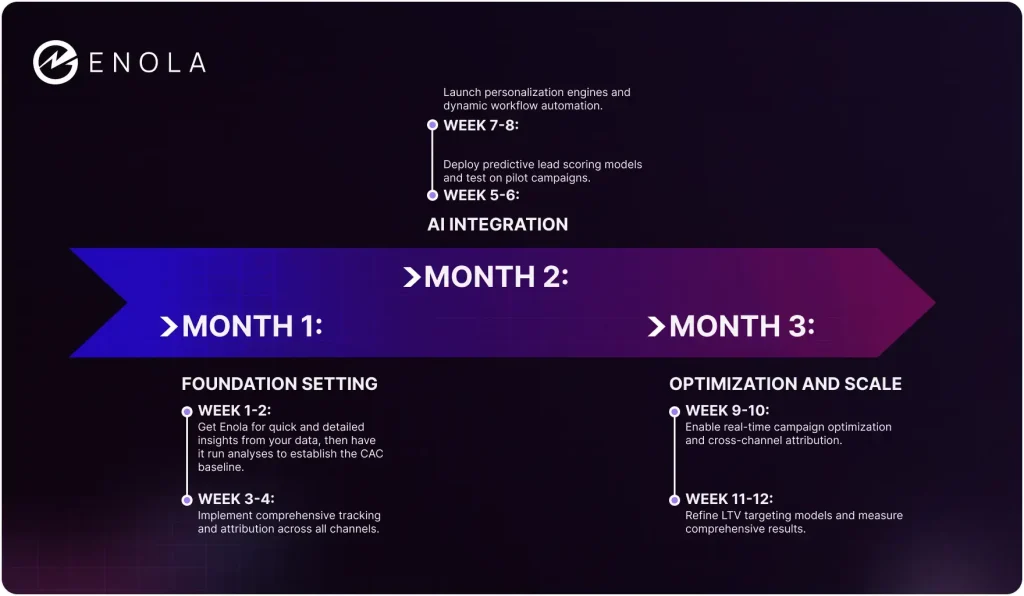
Month 1: Foundation Setting
- Week 1-2: Get Enola for quick and detailed insights from your data, then have it run analyses to establish the CAC baseline
- Week 3-4: Implement comprehensive tracking and attribution across all channels
Month 2: AI Integration
- Week 5-6: Deploy predictive lead scoring models and test on pilot campaigns
- Week 7-8: Launch personalization engines and dynamic workflow automation
Month 3: Optimization and Scale
- Week 9-10: Enable real-time campaign optimization and cross-channel attribution
- Week 11-12: Refine LTV targeting models and measure comprehensive results
The Bottom Line: AI Isn’t Optional Anymore
While competitors struggle with rising acquisition costs using outdated methods, AI-powered marketing leaders are gaining unfair advantages. The tools exist, the results are proven, and the competitive gap is widening daily.
The question isn’t whether AI will transform customer acquisition—it already has. The question is whether you’ll be leading the charge or watching from the sidelines.
Ready to turn your CAC challenges into competitive advantages? The future of efficient customer acquisition is here, and it’s powered by intelligent automation, predictive insights, and data-driven decision making.
Want to see how AI can specifically reduce your CAC? Platforms like Enola make it possible to deploy these advanced strategies without the typical technical barriers, giving marketing leaders the tools they need to win in the AI-driven era.
Related Blog: