For years, analytics platforms have been treated as passive reporting systems. They described what happened, but rarely influenced or informed what should happen next.
That is not the case today, though, as organisations today compete not just on data access but on the speed of business decisions and the quality of insights they provide for future decision making. That is what AI-powered business intelligence does for businesses.
Instead of static dashboards, companies now deploy intelligence systems that surface opportunities, predict outcomes, and recommend actions tied directly to revenue, cost, and risk.
From Reports to Revenue Engines
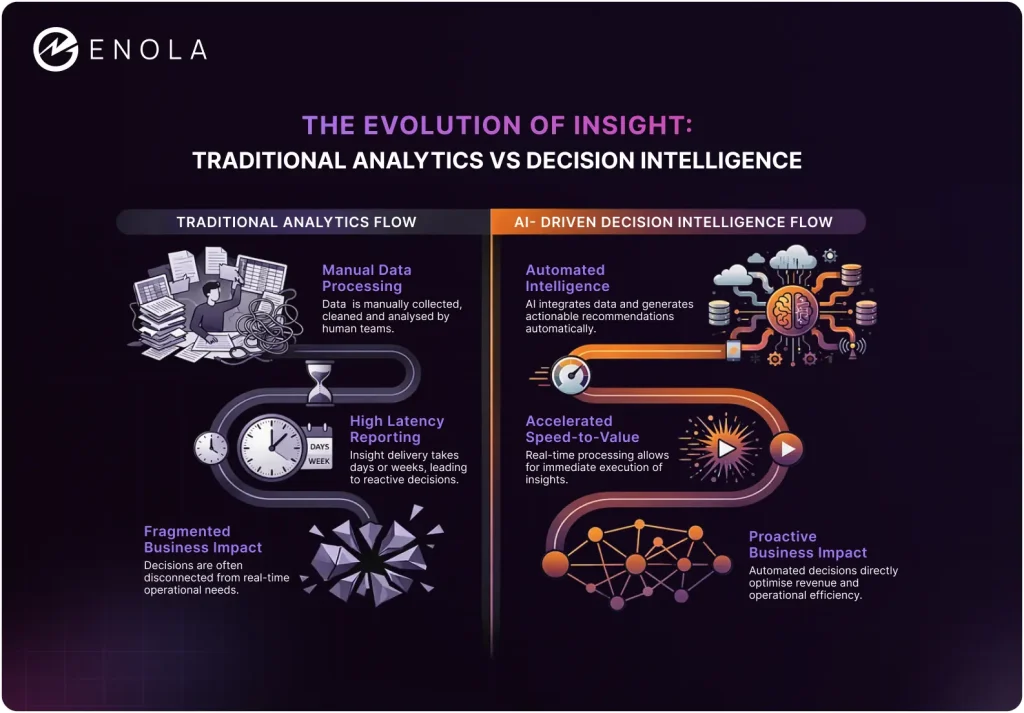
Traditional reporting answers historical questions. Profit growth is the result of decisions taken well beforehand. Business intelligence through AI is where data analytics becomes truly predictive and prescriptive. It analyses patterns across datasets, identifies anomalies, forecasts scenarios, and highlights the highest impact actions. The shift is structural. Analytics evolves from being merely a support function.
This explains why many executives don’t question the need of AI analytics; they inquire about the benefits that can be derived from AI integration in the revenue workflows instead. Now, what are the benefits of using AI in business? They are simple:
- Faster decisions
- Less digging
- Better forecasts
- Reduced costs
Why Traditional BI Falls Short
Legacy BI tools rely heavily on analysts, dashboards and the interpretation of results. It requires the user to know how to ask a question and how to frame the query. In environments with high change rates, this introduces decision friction.
However, AI based business intelligence overcomes this barrier. In today’s business environment, a leader can use natural language to query data. AI technology in BI tools also helps eliminate the “interpretation gap.”
Instead of leaving you to look at the charts and figure out what they mean, why they’re changing and what to do about it, these tools provide that middle layer that helps answer these questions readily.
The logic is simple: data that doesn’t make sense often leads to no action. Data that makes sense often leads to action.
AI Analytics That Power Real-Time Choices
Speed is a big competitive advantage. Markets are shifting hour by hour and customer behavior is changing daily. The rigidity of traditional ways of reporting just can’t kep up. AI analytics uses real-time data, making recommendations while decisions are still relevant.
For revenue teams, that means iterating on campaigns in progress. For finance, it means catching outliers before financial issues become entrenched. For operations, it means always optimizing, rather than waiting for the next cycle.
Measuring Profit Impact, Not Just Activity
Too many organizations measure analytics based on additional usage, which includes data views, downloads, etc. But, those indicators do not reflect business value. The correct evaluation framework asks about the benefits of using AI in business when tied to profit drivers. Metrics should include revenue uplift, conversion improvements, cost reduction, risk avoidance as well as decision cycle time.
Whenever success is measured by financial metrics, the focus naturally shifts. More investments are made in systems where decisions are being created, not just where data is being made visible.
Generative AI for business intelligence plays a major role here. It produces narrative explanations, scenario simulations and recommended actions that teams can execute immediately. That reduces analysis time and increases execution time, which is where profit is created.
Benefits for Executives of AI-Driven Insight
The situation that leaders face is one of uncertainty and one where timing is crucial. They don’t require another source of information; they require accuracy. However, through AI technology business intelligence, accuracy is provided by analyzing intent and delivering relevant pieces of information instantaneously. Leaders won’t require days to wait for analyst research; they are capable of testing hypotheses within mere seconds.
Business intelligence using AI is taken to the next level by using generative technology, which converts complex data into easily digestible strategies that fit ideally into business situations. It also aids management in making timely decisions by avoiding endless debate cycles, helping them act with confidence. In competitive markets, decision latency is often the hidden cost that erodes margins. AI removes that latency.
How AskEnola Translates Analytics into Actionable Profit Intelligence
AskEnola operates as an AI Super Analyst built for organizations that need reliable answers instantly. Using its BADIR framework, it structures every query around business goals, analysis logic and validated data to deliver accurate insights with recommendations. Moreover, it connects directly to enterprise warehouses, runs queries in place and produces decision-ready outputs without analyst dependency or delays.
From Insight to Competitive Advantage
The strategic takeaway is straightforward. Analytics solutions that merely report on business performance are cost centres. Systems that guide decisions are profit engines. Business intelligence powered by AI allows businesses to respond to insights at the precise moment when they have the greatest impact. This matters in pricing, marketing, business as well as financial decisions.
Leaders assessing analytics investment should prioritize capability maturity over feature lists. The key competitive advantage is the ability to understand questions, derive insights independently and provide recommendations based on KPIs. This is why generative AI for business intelligence is rapidly becoming a boardroom priority. It fills the gap between raw data and strategic implementation.
Companies that lead the way with AI-powered analytics gain a structural advantage. They learn, adapt as well as act faster. In the long run, this enables them to build better margins, better experiences and more robust operations. For teams ready to move from reporting to results, the next step is simple.
Request a free trial with AskEnola to see how decision speed changes when analytics becomes an active business partner.
Related Blog: