
Revenue models are no longer static frameworks based merely on historical performance and periodic reporting cycles, but dynamic systems based on live data, predictive intelligence as well as decision-making loops. An AI driven business can fundamentally change revenue creation, protection, and growth.
Today, AI is no longer just an efficiency layer but also the operating system of modern growth strategies. The impact of AI on business growth, ranging from pricing and sales acceleration to margin optimization as well as customer retention, is changing the economics of scale.
The Shift from Reactive Reporting to Revenue Intelligence
The usual way to perform revenue management used to be all about using dashboards, reviewing quarters, and analysis. This generally led to poor decision-making and a feeling that opportunities were being missed.
The new model is based on continuous intelligence. There is growing interest among business leaders in AI’s role in redefining business intelligence into an anticipatory system that delivers answers to strategic questions instantly. Rather than waiting for answers from business analysts, business leaders can ask questions, verify assumptions as well as react within minutes.
Using AI to Increase Sales Through Precision Targeting
One of the most immediate effects of AI on revenue strategies with regard to revenue models is its effect on sales acceleration. With respect to using AI to boost sales, this practice can be done beyond lead scoring. Advanced AI systems analyse behavioural signals, engagement data, and purchase history to identify high-intent prospects with greater accuracy.
AI can:
- Predict conversion probability at the account level
- Recommend next-best actions for sales teams
- Identify cross-sell and upsell opportunities
- Flag churn risk before revenue leakage occurs
This thus has a direct impact on pipeline velocity and win rates. Within an AI powered business model, the sales team will be enabled to make decisions based on contextual clarity versus intuition. Marketing and revenue operations operate based on shared, real-time metrics.
Dynamic Pricing and Margin Optimization
AI is also changing the manner in which organizations approach their processes of pricing as well as profitability and returns. Static pricing models cannot respond effectively to demand fluctuations, competitor movements or even customer behaviour shifts. However, with AI in their growth strategies, businesses use predictive algorithms for dynamic pricing depending on:
- Customer lifetime value
- Demand elasticity
- Inventory levels
- Competitive positioning
The major advantage of this approach lies in revenue maximization without compromising margins. While deployed within a wider platform of decision intelligence, pricing strategy is linked explicitly to goals such as revenue growth, margin expansion or increased market share.
Understanding how AI affects business intelligence would be important at this point, as pricing is no longer just a financial calculation; it is now a strategic decision supported by data and aligned with other key performance indicators of the company.
Operational Efficiency as a Revenue Multiplier
Revenue growth is not only about growing top-line sales. It is just as important to sustain margins and enhance leverage. It automates repetitive tasks, reduces report delays while also minimizing human error. In an AI-driven business, finance and revenue teams can:
- Automate performance variance analysis
- Identify anomalies in revenue reporting
- Model scenario-based forecasts instantly
- Identify cost leakages in real time
This results in a compounding effect. Faster analysis means faster decision-making. Faster decision-making means optimised results. Over time, this loop fundamentally changes the entire revenue model. It transforms it from reactive to predictive.
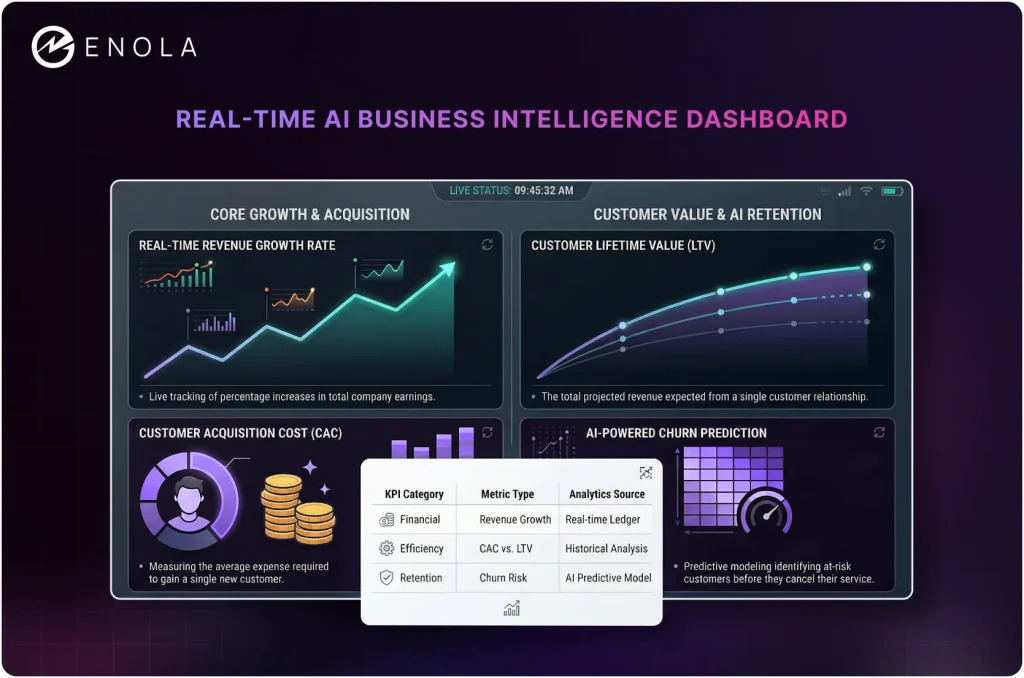
Revenue Models Driven by Speed, Clarity and Trust
Delays are expensive in high-growth environments. Bottlenecks by analysts, fragmented dashboards and inconsistent reporting hold strategy execution back. AI-powered businesses remove these friction points.
With AI platforms, the connection is directly to the modern data warehouses such as Snowflake, BigQuery and Redshift, Azure and Databricks. Queries run in-warehouse; this ensures security and better performance. With automatic semantic layer creation and structured reasoning, leaders receive explainable insights rather than opaque outputs.
When organizations adopt AI as a structured enterprise-grade system, rather than a standalone tool, AI in business growth does become well-measurable and quite sustainable.
From Business Intelligence to Decision Intelligence
Previously, business intelligence was centered around visualization. Decision intelligence extends this further. It integrates actions with decisions.
A modern decision intelligence platform does not simply present charts, it also arranges analysis according to business questions, uses hypothesis-driven reasoning while also offering recommendations based on business objectives.
This is the crux of how AI is transforming business intelligence. The focus is no longer on data access and dashboards, but on impact to decisions. They ask direct business questions such as:
- Why did revenue dip in a specific region last week?
- Which customer segments are driving margin expansion?
- What levers will increase conversion by 5 percent this quarter?
AskEnola: Powering AI-Driven Revenue Decisions
AskEnola functions as an enterprise-grade decision intelligence platform that enables founders, CXOs and revenue leaders to ask complex business questions in plain English and receive decision-ready insights in seconds. Built on its proprietary BADIR™ framework, it ensures every insight is tied to KPIs, structured analysis and actionable recommendations while maintaining enterprise-grade security and zero data movement.
The Future of AI-Driven Revenue Architecture
Revenue models are evolving towards continuous optimisation loops. Data feeds insights. Insights drive actions. Actions generate new data. AI closes the loop at speed.
Using AI to increase sales, optimize pricing, reduce churn and streamline operations becomes part of a unified strategy rather than isolated initiatives. For organisations ready to operate as a truly AI driven business, the competitive advantage lies not just in data access, but in structured, reliable intelligence that translates directly into revenue impact.
Book a demo with AskEnola to see how AskEnola enables 10X faster, decision-ready insights that reshape how revenue is built and scaled.
Related Blog: