
Imagine a VP of Sales staring at a sudden 15% drop in conversion rates but still waiting days for an explanation. She’s made dozens of calls and fired off emails, but business insights finally arrive three weeks later, long after the quarter’s budget planning has passed. By then, competitors have seized ground that a timely price adjustment might have kept, and the team is scrambling to explain lost deals.
This is not hypothetical: it happens in boardrooms and CXO cabins every week.
When decision-makers act on stale analysis, the cost is real in terms of missed opportunities and frustrated teams who feel like they’ve lost the data race.
But why does this happen despite enough data and dedicated analysts?
In my experience, the issue in such situations isn’t a lack of data, talent, or technology. It’s just that most analytics processes are built for reporting, not for rapid decision-making (unlike the BADIR™ framework *wink* *wink*).
Companies often boast of big data lakes and sophisticated ML models, yet still find that as many as 85% of data leaders say flawed data management leads to poor decision-making and lost revenue¹. In practice, analytics teams spend most of their time on plumbing: the report cited above also found that 72% of data leaders admit their team’s time is wasted on manual pipeline oversight, with 69% noting their outcomes would improve if analysts focused on business decisions rather than data wrangling.
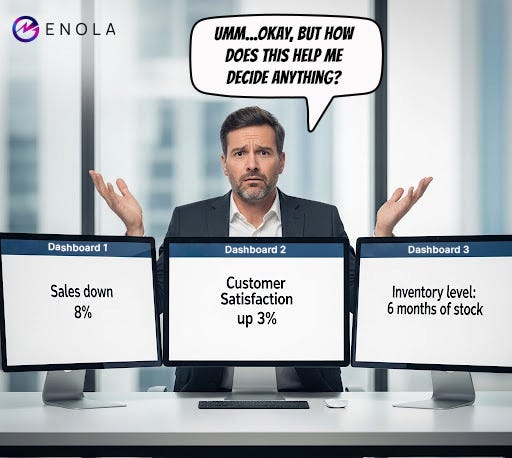
In other words, most analytics teams are bogged down in process and are completely divorced from delivering business answers. Meanwhile, front-line managers keep prodding for clarity. This is exactly why tools like Enola, which enable conversational analytics, are gaining traction, empowering managers to get fast, clear narratives from their data without waiting on lengthy reports.
At this point, someone might think that they should just hire better analysts, but the real issue is not a lack of data science skills.
Many organizations have world-class PhDs and cutting-edge tools, yet executives still end up guessing when it comes to business decisions. The International Data Corporation (IDC) finds that more than a third of executives often don’t get around to using the data they receive because it arrives too late, wasting all the resources spent on data capture, analysis, cleansing, and presentation2.
Put bluntly, piling on more data and dashboards won’t fix this. As an IDC analyst notes, there’s more data than ever before, and yet the only way to thrive is to improve decision velocity.
So, you can have terabytes of business insights ready for next month’s report, but if your team can’t act on them in time, they’re practically useless. The status quo of BI and reporting leaves many leaders waiting—and losing—at crucial moments when speed and clarity are what really matter.
Diagnosing the Root Causes
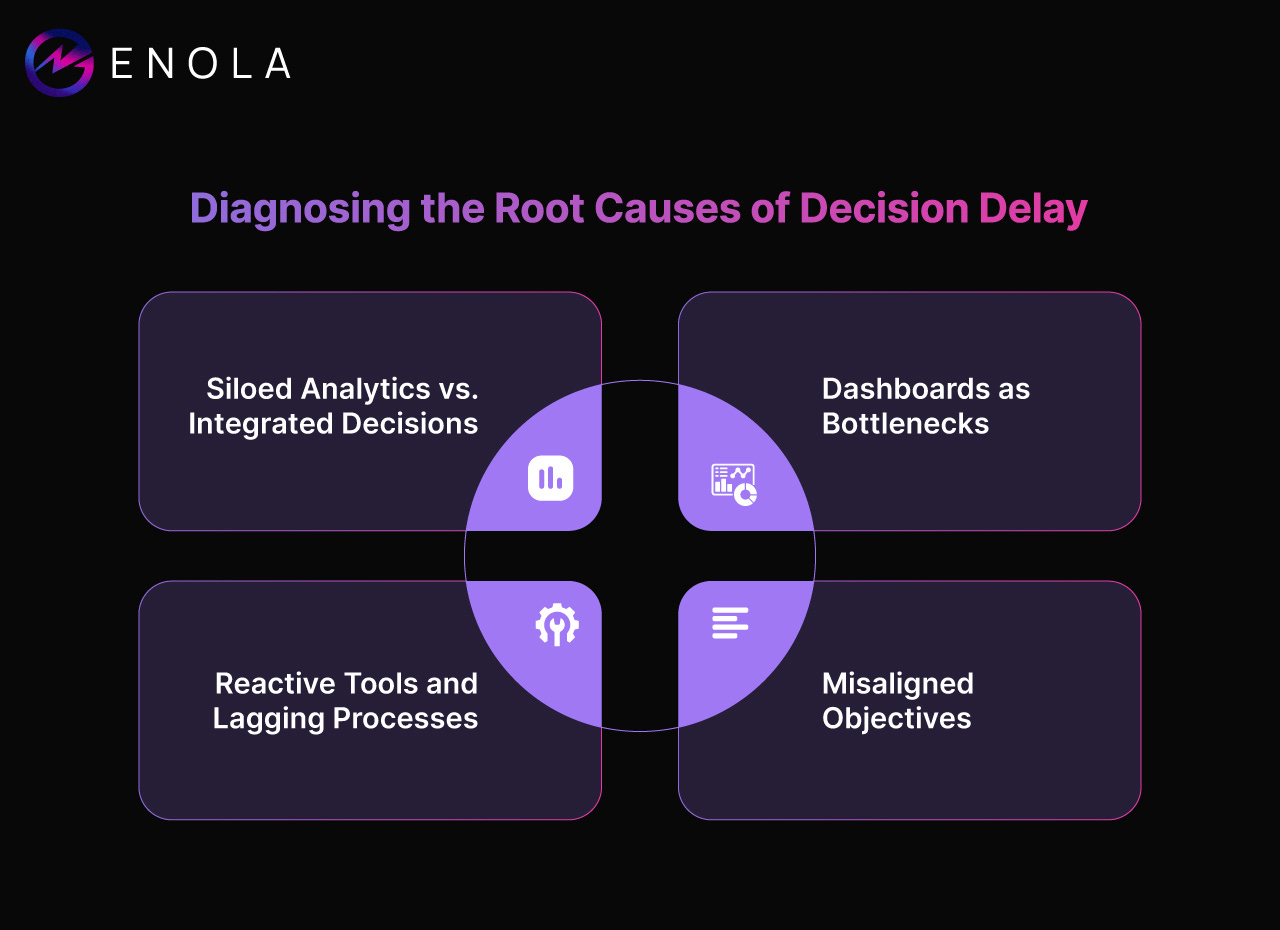
1. Siloed Analytics vs. Integrated Decisions
Too often, analytics talent sits apart from the business questions. In such setups, every request queues up for a handful of analysts, slowing everything to a crawl.
So is decentralization the answer, then?
Turns out, in decentralized chaos, each team builds its own data model that doesn’t talk to the others. Either way, the result is classic waste on both sides because a driven analyst could also complain that their work has little or no business impact because by the time insights arrive, the business keeps doing what it’s always done.
To break this logjam, some companies try hiring “analytics translators” – hybrids with business and data skills – but these experts are rare and easily overloaded. More effective is coaching the business to ask better questions in the first place. As INSEAD experts note, it’s often more effective to coach leaders in the art of asking great questions than to rely on “translators”3. A good business question is strategic, bounded, and actionable, not a vague request for “more insights.”
When analysts instead have to chase down half-baked questions, it turns engineers into report-providers rather than strategic partners.
2. Dashboards as Bottlenecks
Paradoxically, the very tools meant to accelerate answers can slow things down.
Off-the-shelf dashboards often freeze into static status boards, updated on schedules, and rarely translate into decisions and action. Business users like yourself find themselves digging through rows to infer trends instead of getting direct guidance.
Since dashboards fail to drive decisions, business users default back to manual methods. Often enough, employees either resort to gut-feeling or default to brainstorming with an incomplete view of the big picture. That means extra handoffs and error-prone manual analysis, which is precisely the opposite of an efficient workflow.Message Piyanka Jain
3. Reactive Tools and Lagging Processes
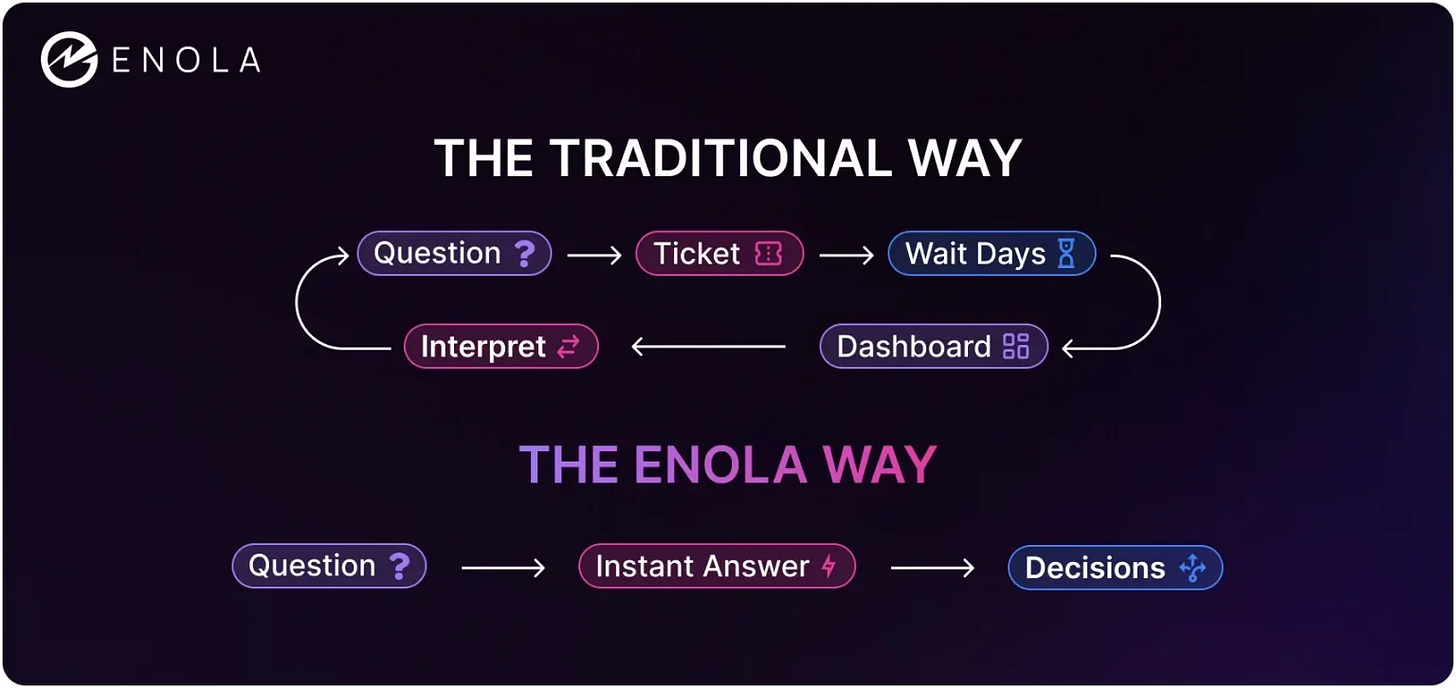
Many companies still operate in a “pull” model: someone identifies a problem, requests a report, and waits. By contrast, high-velocity environments use automated, push-style alerts and streaming analytics.
Yet only a small percentage of data is analyzed in real time before reaching the data lake. In practice, only 13% of firms even see new data-driven business insights within hours; for 76%, it takes days or weeks just to prep the data for decision-impacting answers¹.
These delays turn every analytics cycle into a sprint with a long pause. By the race’s end, the opportunity’s gone.
4. Misaligned Objectives
Finally, business teams themselves often struggle to frame the right question, while data teams aren’t structured to coach them. Without a shared process, data efforts become shotgun blasts. One proven remedy is to follow a disciplined analytics framework that starts and ends with the business decision.
For example, the BADIR™ framework explicitly begins with the Business question and culminates in an actionable Recommendation.
By enforcing a hypothesis-driven plan and a focus on KPIs, BADIR aligns analytics with what leadership actually needs. In practice, this means analytics teams ask “Which decision are we trying to inform?” up front, and wrap up by saying “Here’s the recommendation to move our KPI,” rather than just, “Here’s the model output.”
Framing every project end-to-end in this way helps avoid the classic “analysis for its own sake” problem.
Solutions and Strategic Shifts
Leading companies have started shifting from perfection to speed and from data delivery to decision support. Instead of obsessing over fully exhaustive reports, they measure the success of analytics by how quickly and effectively decisions are made. In general, these companies adopt shorter cycles and incremental answers: for example, shipping a quick preliminary insight in a day and refining it as more data comes in, rather than waiting weeks for a “complete” analysis.
High-performing business leaders also embed analytics in the business workflow. They form small, cross-functional squads – think one product manager, one data engineer, one analyst (or even better, a Super-Analyst), and a domain expert – dedicated to key decision areas (sales, ops, marketing, etc.).
This contrasts with a central “report factory.” Embedding teams ensures analysts deeply understand context and can refine questions on the fly. It also builds data literacy: when the marketing team leader is sitting alongside the analyst, the team learns to frame questions and evaluate answers together.
Organizations are also automating reactive tasks so that human experts can focus on strategic insights. Naturally, if analysts aren’t building pipelines or fixing broken data feeds, they can spend more time on interpretation and collaboration. For instance, many firms are moving from hand-crafted ETL to managed data platforms or ELT automation. This relieves analysts from manual toil, which nearly three-quarters of teams identified as wasted work in VentureBeat’s survey, so they can quickly model scenarios instead of rebuilding the data foundation.
Of course, generative and agentic AI tools are emerging as accelerators, too.
Instead of waiting for an engineer, a manager can ask a business-goal-driven AI analyst such as Enola for an instant summary of why revenue dipped, and get a narrative answer in seconds. Indeed, users believe this approach pays off: 58% said they’d pay more for analytics that explicitly support decisions, and 75% feel that AI-powered analytics could uncover value buried in their data4.
This is quite similar to how financial services firms are piloting AI agents that automatically surface anomalies in sales forecasts or next-best actions for customer churn. Or how e-commerce teams use AI to continuously monitor campaign performance and instantly alert them to underperforming channels.
Finally, many companies are formalizing decision-support frameworks like BADIR as part of their culture. They train both analysts and executives to start every new analysis by pinpointing the KPI or decision the insight should move. When teams follow such a framework, they produce recommendations by default – even if it’s just “pause this product launch until more data arrives” – instead of just handing over data. This focus on business questions and “hypothesis-driven planning” dramatically cuts wasted work.
Outdated (or rather, non-existent) analytics processes are more than a nuisance—they’re a competitive liability. Facing today’s volatile markets means improving your decision velocity: the ability to cycle from data to action faster than the competition. Every day you’re waiting on stale reports is a day your rivals can adapt and win. The answer is not simply “more dashboards” or “faster databases,” but a fundamental shift in approach.
Data is only valuable when it informs the decision at the right moment. Align your analytics engine end-to-end with how your business actually makes decisions, from the KPI you care about all the way through to a clear recommendation. Once you do that, you’ll find that the answers were inside your data all along; you just needed to ask the right questions sooner.
Looking ahead, challenge your teams this week: What pressing decision are you stalled on? How would your insight process change if that question were front-and-center? The winners will be those who get answers not days late, but days early, or even real-time, and act on them decisively.
Sources
2. VentureBeat Report: Flawed data management leads to lost revenue for most companies
4. INSEAD, Are You Asking the Right Questions of Your Data Team?
This post was originally published on Piyanka Jain’s Substack.
Related Blog: