
Today’s data teams face an increasingly dynamic environment. Traditional dashboards are evolving from instant, contextual, and decision-ready insights. Power BI focuses on the traditional approach to business intelligence. Dashboards, layering, and analyst-driven workflows. On the other hand, AI analytics focus on interpreting business intent and generating insights instantly and automatically.
In this comparison, we break down how AI-driven analytics differs from Power BI, where each fits, and what modern enterprises should prioritize when evaluating business intelligence vs artificial intelligence tools.
How Power BI Works
Power BI is a popular choice for visualizing data and creating reports. Data sources are connected, datasets are molded, and dashboards are built that refresh at regular intervals. This is usually the function of analysts, who set up measures, create DAX formulas, and build reports that are relevant to different groups of people.
This model is effective if:
- Metrics are well-defined
- Reporting requirements are static
- Teams have dedicated analysts
However, business intelligence and artificial intelligence have different approaches to ambiguity. If a CXO asks an unexpected question that was not predefined in a dashboard, it often requires a new report or analyst intervention. This can cause decision delays.
How AI Analytics Platforms Operate
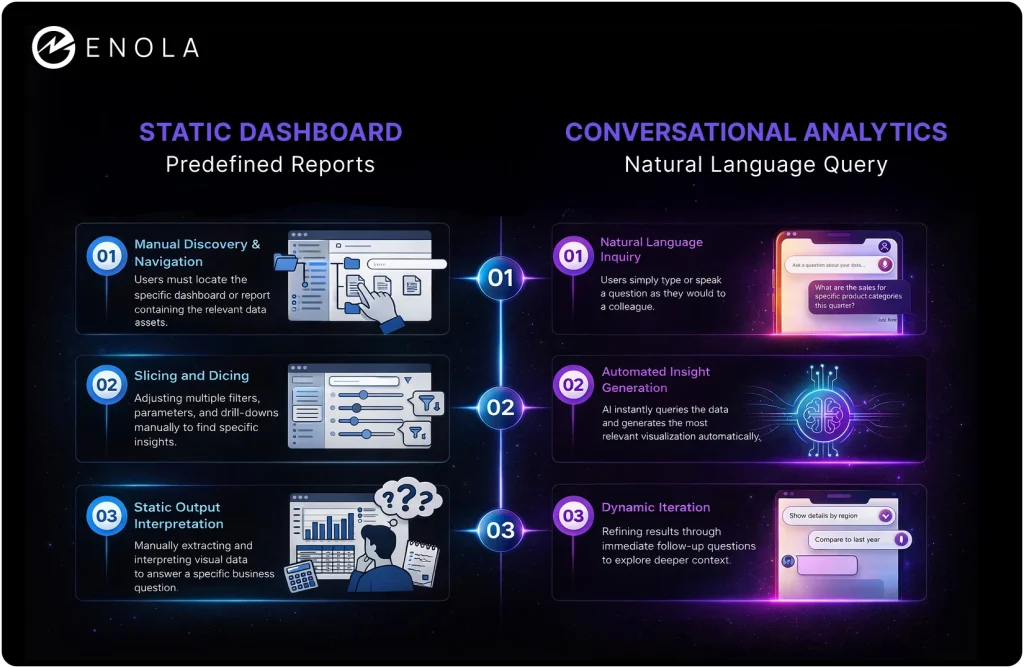
AI analytics platforms are designed to be fast and simple to use. Instead of navigating through dashboards, a query is asked in natural language. The system interprets intent and provides relevant information and context, including recommendations.
Thus, Power BI is about navigating through a dashboard, while AI relies on intent recognition and automated reasoning. Instead of relying on analysts, they can use AI-based platforms to derive insights and answers to complex questions in a matter of seconds.
AI vs BI in Real-World Scenarios
Let’s consider an example of how this translates into real-world situations:
1. Decision-Making for Executives
In traditional BI, executives depend on pre-built dashboards. However, if they want deeper insights, they have to request a special report, which might take some time. AI analytics, on the other hand, ask follow-up questions instantly and refine their query to gain better insights.
2. Analysis of Marketing Team Performances
BI helps marketing teams make better decisions using dashboards to track their performance. However, if they want to find out the underlying reasons for a decline in performance, it becomes difficult using traditional BI tools. AI platforms can analyze trends, segment anomalies, and suggest corrective actions automatically.
3. Revenue Forecasting
BI tools help in forecasting revenues based on past data, while AI analytics helps in evaluating the underlying factors that contribute to it and provides recommendations. This is where business intelligence and AI begin to intersect, but AI adds reasoning and context.
4. Planning Finances and Controlling Costs
Finance teams normally use BI tools to monitor product costs. However, if there is an unusual spike in costs, understanding what may have caused this spike may require pulling multiple reports.
AI analytics can help detect unusual changes, identify the cause of the costs, and provide explanations in context, helping finance leaders to proactively manage costs.
Speed, Scale, and Analyst Dependency
The key difference between AI and BI lies in their ability to increase workflow efficiency. Traditional BI tools require:
– Data modeling
– Dashboard creation
– Continuous maintenance
– Analyst assistance for complex queries
AI analytics reduces these dependencies by automating interpretation and analysis. Instead of navigating multiple dashboards, leaders interact directly with data conversationally.
Many organizations also use both systems in place. When considering business intelligence and artificial intelligence, the organizations must ask: Are we focused on steady reporting or swift decisive action?
Governance, Security, and Data Integrity
The concern with AI analytics is the integrity of the data and the possibility of hallucinations. However, enterprise-grade AI platforms address performing queries in secure data warehouses, ensuring data integrity and governance.
Various modern AI analytics tools can connect to data warehouses such as Snowflake, Google BigQuery, and Amazon Redshift without moving or duplicating any data. These queries are performed in the warehouse. No data is moved or copied.
How AskEnola Bridges This Gap
AskEnola is an AI-based analytics platform that is built for growing, data-driven organizations. Unlike traditional dashboard-based Business Intelligence products, AskEnola is an “AI Super Analyst” that allows users to ask complex business questions using natural language, and receive highly structured insights to support business decisions in a matter of seconds.
At the core of the platform is the BADIR™ framework (Business Question, Analysis Plan, Data, Insights, Recommendations), which structures every response. Instead of providing answers in the form of charts and numbers, AskEnola provides a clear definition of the business question, a description of the analysis, identification of the relevant data, key insights at the KPI level, and recommendations.
AskEnola directly queries the cloud-based data warehouse, which ensures that all security and governance requirements are met. This helps to automate the analytical processes and reduce the need for traditional reporting, allowing for faster business decisions.
The Future of Data-Driven Decision Making
Both AI analytics platforms and Microsoft Power BI serve important roles in modern data teams. However, the right choice depends on your goals. Power BI is best for creating dashboards, tracking KPIs, and creating structured reports. On the other hand, AI analytics tools are best for quickly answering business questions and converting the answers into understandable, actionable insights.
As business complexity increases, the need for faster, more flexible analysis increases. AI-driven analysis helps to create business value by reducing the time consumed and providing direct access to insights. The best approach is the one that increases accuracy, speeds up decision-making, and provides the confidence to make informed decisions.
Related Blog: