
Organisations today collect vast amounts of information from sales platforms, marketing tools, product usage data, and operational systems. Data has become the backbone of modern business decisions, but extracting meaningful insights from it often requires time, technical expertise, and multiple tools. This is where augmented analytics plays a major role.
Augmented analytics is Augmented analytics uses AI and machine learning to automate data preparation, insight discovery, and insight sharing — augmenting the capabilities of both analysts and business users by surfacing relevant patterns without manual query writing.
Augmented analytics refers to the use of artificial intelligence and machine learning to assist in data preparation, analysis, and insight generation. Rather than relying on manual processes, augmented analytics tools help automate large parts of the analytical workflow.
The approach combines AI, natural language processing, and machine learning to make analytics faster, more accessible, and more useful for decision-makers.
Process of Augmented Analytics
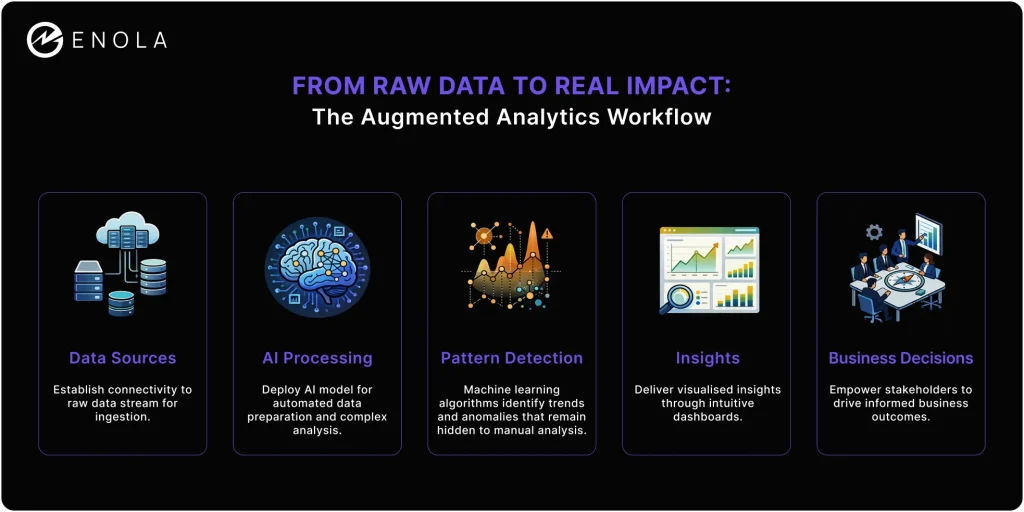
Traditional analytics usually involves several manual steps, which can slow down decision-making. The typical ways to do this will require cleaning the data, constructing the queries, creating the dashboards, and interpreting the results. Those tasks can be accomplished in a very efficient manner with augmented analytics in minutes compared to hours or days.
Augmented analytics simplifies this process by embedding intelligence directly into the analytics workflow process from start to finish without the need for manual input.
Here is how the process typically works:
Scanning and Preparing the Data
This process involves the automatic scanning of the datasets available for analytics and preparing them for analysis, thereby reducing the amount of time on manual data cleansing.
Detecting Data Patterns
AI is able to scan the datasets with different models to identify patterns, correlations, or discontinuities in the data that can otherwise go unnoticed.
Using Natural Language Queries
Users can ask questions in simple conversational English instead of writing technical queries. The system interprets the intent and runs the analysis.
Insight generation
The results are provided as clear insights generated through automated data analysis, often with visuals or summaries along with appropriate contextual explanations.
This significantly reduces dependency on technical teams, as marketing heads, finance heads, and product managers can explore data without any technical knowledge about query language or data engineering processes.
Benefits of Augmented Analytics
There are several reasons modern businesses have adopted augmented analytics:
- Faster decision-making: Insights that previously took days can now be produced within minutes or even seconds.
- Access to data for non-technical users: Provides non-technical users the ability to explore and understand data on their own, without relying heavily on analysts.
- Reduction of analytical bottlenecks: Automated processes support the efficient movement of data, removing delays.
- Better insight generation: AI systems can detect patterns and correlations that may be overlooked during manual analysis.
Fast-growing companies are placing an increased emphasis on these benefits, particularly to respond rapidly to changing market conditions, changing customer behaviours or operational performance.
How Augmented Analytics Automates Workflows
Because of the rapid increase in the amount of data available today, many businesses are turning to augmented analytics in their modern analytic strategies, as traditional processes for creating analysis do not support the increasing growth of data.
Augmented analytics addresses this challenge by enabling data analytics automation across several stages of the analytics workflow. AI automates various tasks associated with the analytics process, such as locating relevant datasets, suggesting visualisation methods for presenting data, and identifying trends within the data.
The Growing Role of Data Analytics Automation
Sales platforms, customer engagement tools, financial systems, and product analytics platforms all produce valuable information in modern organizations. Manually collecting insight from this data is often inefficient and very time-consuming.
Therefore, data analytics automation is critical to modern augmented analytics. using AI-based pattern recognition and smart data processing to allow organisations to structure insights from large datasets.
The augmented analytics definition goes much further than just adding AI capabilities to dashboards by enabling organisations to change from reactive reporting to proactive decision-making and constantly discover insights that support business outcomes.
Challenges and Limitations of Augmented Analytics
Though augmented analytics makes it faster and easier to access insights, it also comes with some challenges and limitations. One of the biggest challenges that come up is that AI can only work with the data it is given. Therefore, incomplete, inconsistent, or outdated information can result in false conclusions.
In some situations, business questions can be difficult to fully understand and require human judgment to understand the context clearly. It can also take some time to learn how to ask questions in a way that will provide the best results. In some situations, gaining insights from diverse sources can also be difficult, especially in large businesses.
How AskEnola Supports An Augmented Analytics Solution
AskEnola, a modern augmented analytics software solution, has been designed specifically for business decision makers, providing teams with the ability to generate structured, contextual and actionable insights in simple formats instantly.
By using its BADIRTM framework and in-warehouse analysis, AskEnola enables companies to find reliable insight based on current business goals while having less dependency on analysts. The result is a much simpler flow for teams: ask a question, understand what is happening, and decide the next step with clarity.
The Real Impact of Augmented Analytics
One significant impact of augmented analytics is that the speed at which businesses can turn questions into decisions has increased dramatically. Thus, the objective isn’t just faster reporting; it is about providing business users with immediate access to reliable sources of business-relevant data so they can make informed decisions.
Modern augmented analytics platforms eliminate the greatest bottleneck in modern businesses, which is waiting too long between questions and clear answers.
With AskEnola, the process becomes even more efficient. Every query is tied to a business objective, analysed with structured logic and business leaders are able to gain immediate insights from these queries.
As a result, the business is able to make decisions more quickly with fewer delays and with less reliance on analysts and with decision-support systems backed by real data.
What is an example of augmented analytics?
For example, when a sales manager team asks “Why did revenue increase in a certain region?” and gets an instant explanation, such as higher demand or a recent campaign. This helps teams to quickly understand changes and act on insights without manual data analysis.
Where is AR mostly used?
Augmented reality (AR) is widely used in industries such as retail, healthcare, education, and gaming. It supports enhancing real-world experiences by adding digital elements to your real-world surroundings.
What is AR vs AI?
AR enhances real-world experiences by overlaying digital content, while AI focuses on processing, analyzing data, making predictions and supporting better decision-making.
What are the key benefits of augmented analytics?
Augmented analytics simplifies data analysis by using automation and built-in insights. It also helps users save time, reduce manual effort, and make data accessible across teams.
Related Blog:
Frequently Asked Questions
What is augmented analytics?
Augmented analytics is the use of artificial intelligence and machine learning to automate data preparation, insight discovery, and sharing — reducing the manual effort required by both data analysts and business users. Rather than requiring users to know which questions to ask or which metrics to examine, augmented analytics tools proactively surface relevant patterns, anomalies, and recommendations from your data. It augments human analytical capability rather than replacing it.
How does augmented analytics improve decision-making?
Augmented analytics improves decision-making by reducing the time and expertise required to go from raw data to actionable insight. Traditional analytics requires analysts to manually clean data, build queries, and generate reports — a process that can take days. Augmented analytics automates these steps, allowing business users to receive insights in near-real-time. This speed, combined with AI-driven pattern recognition that humans might miss, results in faster and often more accurate decisions.
What is an example of augmented analytics?
A practical example of augmented analytics: a retail company asks its AI analytics platform ‘Why did our conversion rate drop last week?’ An augmented analytics tool automatically queries sales, traffic, product, and promotional data, identifies that the drop was concentrated in mobile users on iOS, correlates it with a recent app update, and delivers that finding as a narrative recommendation — without the analyst having to manually investigate each data source. This is augmented analytics in action.
How is augmented analytics different from traditional BI?
Traditional BI is reactive — it shows you historical data in dashboards that you must interpret yourself. Augmented analytics is proactive — it uses AI to surface insights, flag anomalies, and suggest next steps without requiring users to know which metrics to examine. Traditional BI answers the question ‘What happened?’ Augmented analytics answers ‘What happened, why did it happen, and what should I do about it?’ — making the analytical process far more efficient for non-technical decision-makers.