Many companies regularly review dashboards, reports, and other periodic performance to continuously improve how they run their day-to-day operations. While these tools provide visibility, they don’t always clearly articulate why a specific metric has changed. By the time insights reach decision makers, the opportunity to act may already have shifted.
Here, the combination of big data analytics and artificial intelligence plays an important role. In order for an organization to use large datasets as source signals to better understand the factors that may be impacting their metrics, organizations require an intelligent approach to analyzing the patterns that exist in large amounts of data.
To understand how they work together in modern analytics, let’s dive into the use of big data and AI and why it has become central to how organisations analyze big data.
What Is Big Data Analytics and its Importance
Before discussing the synergy between big data analytics and modern businesses, it is essential to understand what big data analytics is and why it matters for modern businesses.
Big data analytics refers to the process of analyzing large and complex sets of data to find patterns or relationships, as well as to gain actionable insights from that data that can be used for decision-making in businesses. Typically, big data sets comprise data from multiple sources, including:
– Transaction systems
– Digital platforms & applications
– IoT devices
– Operational tools
Traditional analytics tools do not provide the capability to analyze these big datasets. Compared to more traditional analytics tools, advanced analytics platforms provide organizations with an improved ability to analyze large amounts of both structured and unstructured data in real time.
Through this faster and improved ability to effectively analyze large datasets, companies improve their ability to anticipate future business trends, understand consumer perceptions, and improve operational efficiency.
Big data analytics essentially converts scattered data into structured knowledge that allows decision makers to have greater confidence in their decisions.
Big Data vs AI: Understanding the Difference
Big data focuses on the storage, processing, and analysis of large datasets. It deals with collecting and managing information from various sources at scale.
On the other hand, Artificial Intelligence focuses on the development of systems that can learn patterns, predict future outcomes, and automate the decision-making process.
As large datasets provide raw material for AI models to work with, AI provides the intelligence to interpret the information contained in these datasets. Without this input, AI models will not have meaningful input, and, conversely, without intelligent models, large datasets will not be effectively utilised.
This complementary relationship is why analytics strategies are continuing to evolve towards involving the use of both technologies in combination.
How Big Data and AI Work Together in Analytics
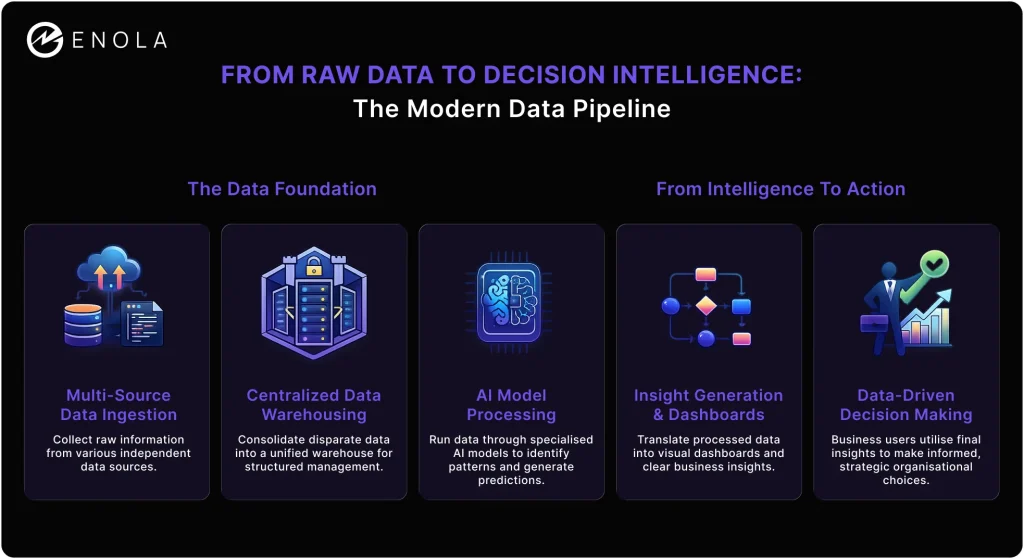
The real transformation takes place when AI and big data analytics work together. Big data platforms store and organise massive datasets, and AI algorithms can be used to analyse this information to determine patterns and how events will unfold.
For example, machine learning models can analyse historical sales data to forecast demand. Furthermore, NLPs can be used to provide actionable insights into the customer experience. This includes being able to assess customer feedback from thousands of different support instances through natural language processing as well as recommendations based on user behaviour.
Key Business Applications of Combined Analytics
Within the past few years, the integration of big data and big data analytics with intelligent systems has enabled organisations to analyse large volumes of information more effectively. Businesses across various sectors are leveraging these technologies to solve complex issues and make better decisions.
Customer Intelligence
Retailers and digital platforms gather patterns in consumer behavior, helping them personalize their experiences and increase customer engagement.
Fraud Detection
Machine learning models are used by financial institutions to identify unusual transaction patterns (i.e., fraud) and detect them in real time.
Operational Efficiency
Manufacturers utilize equipment data to predict maintenance needs and when there might be prolonged periods of equipment failure.
Optimizing Marketing
Marketing teams leverage predictive analytics to find out what channels, campaigns, etc., provide the best return on investment for their marketing budget.
In many sectors, processing massive quantities of data and performing intelligent analysis has resulted in more accurate insights or faster decision-making.
How AskEnola Enables Faster AI Driven Insights
Most organisations today have massive amounts of data across product, marketing, finance, and operations. The real challenge is getting a clear answer from that data when a business question arises.
A simple question about revenue, product usage, or campaign performance can quickly become a series of checks on the dashboard, requests to analysts, and reports. AskEnola eliminates this experience by allowing business teams to ask clear conversational questions about their data and receive clear answers in seconds.
Business questions remain the focal point rather than the data analysis mechanics. Teams in product, marketing, finance and revenue operations can easily determine what’s driving a metric, identify where a change occurred and assess what should be addressed next. Eliminating the wait associated with data requests allows leaders to move from question to decision more quickly.
The Future of AI Powered Analytics
As the amount of data continues to increase across business lines such as sales, marketing, product, and finance, the greatest challenge today is gaining actionable insights from massive datasets. The delay in response time due to waiting on reports or searching through various dashboards only complicates this further.
Data analytics is evolving toward a more streamlined approach. Rather than having to search through various report formats such as graphs, charts, tables, etc., teams will be able to pose simple, direct questions concerning their data and receive detailed responses immediately. This access to timely and contextualized information allows leaders to spend more time making decisions rather than looking for data to support their decisions. This shift is what will define the future of data-driven companies.
FAQs –
What is big data analysis and artificial intelligence?
Big data analysis involves examining large sets of data to find patterns and insights. On the other hand, AI uses that data to automate tasks and make contextual predictions.
What is Big Data?
Big data refers to large and complex data sets that are difficult to manage with traditional tools. It is used to uncover patterns, trends, and insights that can support better decision-making.
What are the three types of big data?
The 3 main types are structured, unstructured, and semi-structured data. They differ based on how the data is organized and stored.
What are the big data platforms?
Big data platforms include tools and systems used to store, process, and analyze big data sets. They help businesses manage data efficiently and provide actionable insights.
Related Blog: